%2010.svg)


Table Of Contents

For RIAs and broker-dealers, compliance has become a daily operating challenge. Best-interest expectations under Reg BI, suitability alignment, share-class oversight, concentration monitoring, and reverse-churn risk all create real exposure when firms rely on fragmented tools and manual reviews.
More on this: AI for regulatory compliance.
StratiFi calls out these exact pain points like monitoring accounts for share-class violations, concentration and suitability issues, and flagging reverse-churn patterns, inside a unified compliance workflow.
That’s why AI-powered compliance solutions for finance advisors are gaining attention. These solutions promise continuous monitoring, faster evidence retrieval, and defensible documentation without adding operational drag.
Related capability: how AI-powered data extraction works for advisors.
This listicle shares -
- What RegBI compliance monitoring with AI means for compliance professionals
- What capabilities matter most for RIAs and broker-dealers
- The top options (organized by category) to help Ops and CCOs evaluate the best fit without getting lost in the buzzwords
What Do AI-Powered Compliance Solutions for RIAs & BDs 7Mean?
RIAs and broker-dealers experience “AI compliance solutions” as tools that reduce compliance risk by monitoring activity, detecting exceptions, and producing audit-ready evidence with less manual work.
Simply put, AI-enabled compliance solutions combine -
- Automation: turning repeatable compliance tasks into workflows (reviews, approvals, logging, record capture).
- Continuous monitoring: moving from periodic sampling to ongoing oversight across accounts, client communications, or interactions.
- Pattern detection: using analytics (and sometimes machine learning) to flag issues and prioritize what needs human review, rather than flooding compliance teams with noise.
This matters because modern standards like Reg BI require broker-dealers to meet multiple obligations (Disclosure, Care, Conflict of Interest, Compliance) and to evidence in practice that those obligations are being met. Thus, staying “compliant” isn’t enough; firms must be able to show how recommendations were made, supervised, and documented.
If you're shortlisting tools, see the best AI document data extraction tools for advisors.
What Sets AI-Driven Compliance Apart from Traditional Tools?
Traditional regulatory compliance software tends to be rules-first and retrospective: they help track tasks, store documents, and support periodic reviews. They can be useful, but often leave firms doing the toughest tasks manually.
For instance, pulling evidence together, reconciling systems, and deciding what matters.
AI-enabled compliance tools shift the model in three practical ways:
- Instead of only tracking whether a task was completed, AI-enabled monitoring can surface behavioral or risk patterns that suggest emerging issues.
For example, communications surveillance tools that use behavioral analytics/classifiers to detect potential misconduct patterns.
- The best AI compliance solutions for financial firms create audit trails and defensible documentation as part of the workflow, reducing the scramble to reconstruct evidence after the fact.
- These tools integrate monitoring, documentation, and supervision, allowing the CCO to quickly answer: What happened? Why did it happen? What was done about it?
Thus, AI-powered compliance solutions for finance advisors are most valuable when they help advisory firms operate with continuous oversight and exam-ready documentation, without increasing operational complexity or headcount.
Why RIAs Need RegBI Compliance Monitoring with AI?
For RIAs and broker-dealers, compliance has shifted from a periodic obligation to a continuous operating risk. The challenge is maintaining defensibility as firms scale, products become more complex, and regulatory scrutiny intensifies.
Here are the top forces driving this shift -
-
Rising Enforcement, Changing Rules, and Regulatory Ambiguity
Reg BI enforcement, suitability reviews, share-class conflicts, and reverse churning are no longer edge cases; the bigger challenge for RIAs is keeping up with a regulatory landscape that is constantly evolving and often open to interpretation.
Rules change, guidance shifts, and enforcement priorities evolve, leaving firms to interpret expectations that are rarely black and white.
Regulators expect firms to demonstrate how best-interest decisions were made, based on the information available at the time, not just that policies exist. This requires continuous supervision, consistent rationale, and documentation across accounts, not sampled snapshots.
AI-driven Reg BI monitoring helps firms keep pace with change by embedding oversight into everyday workflows and creating defensible records as decisions happen, not after the fact.
-
Audit Preparation Is Still Manual and Disruptive
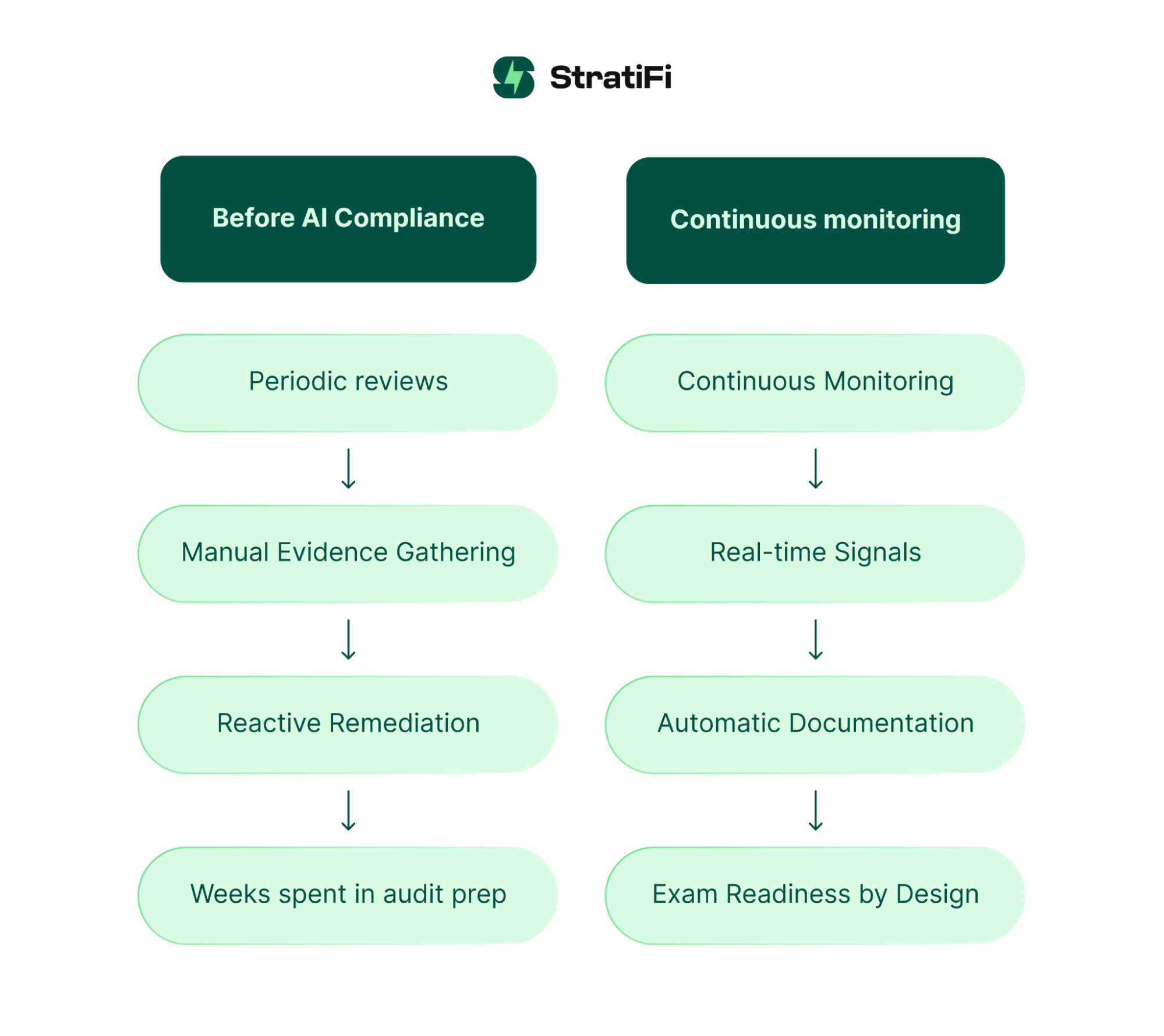
In many firms, preparing for an SEC or FINRA exam can take weeks. Compliance teams hunt for records across CRMs, portfolio systems, email archives, and shared drives, often reconstructing decisions long after they were made.
This reactive model increases cost, stress, and risk.
-
Personal Liability for Compliance Leaders Is Real
Chief Compliance Officers (CCOs) are personally accountable for gaps they cannot always see in fragmented systems. Manual reviews and periodic reports do not scale with account volume, advisor activity, or market volatility.
-
Fragmented Tech Stacks Create Blind Spots
Most RIAs operate with multiple disconnected tools, one for communications review, another for trade monitoring, and another for documentation. When systems don’t talk to each other, risk signals remain isolated, and defensible narratives are hard to assemble.
-
Defensible Documentation Has Become a Business Requirement
Modern compliance is about proving intent, suitability, and best-interest alignment. AI-powered compliance solutions help capture this context as decisions occur, reducing reliance on memory, spreadsheets, and after-the-fact justification.
To sum up, RegBI compliance monitoring with AI is about operational defensibility, not just automation. It offers firms the ability to monitor continuously, surface issues early, and produce audit-ready evidence without slowing advisors down.
How We Picked These Solutions
Not every tool that mentions “AI” reduces compliance risk for RIAs or broker-dealers. Hence, when creating this list, we focused on practical compliance outcomes, not marketing claims.
Each solution was evaluated against criteria that reflect how compliance actually works in advisory firms, especially under Reg BI and ongoing SEC/FINRA scrutiny.
Here’s what mattered most to us.
-
Continuous Surveillance versus Periodic Checks
Modern compliance risk doesn’t appear on a quarterly schedule. We prioritized tools that support ongoing monitoring, across accounts, activity, or communications, over those limited to periodic reviews. Continuous oversight reduces blind spots during market volatility and high advisor activity.
-
Explainable AI versus Black-Box Alerts
Alerts only help if compliance teams can explain why something was flagged. Solutions that provide clear, reviewable rationale ranked higher, especially for firms that must defend decisions to regulators.
-
Embedded Workflows versus Standalone Tools
Tools were favored if they fit into advisor and compliance workflows organically, capturing evidence, reviews, and actions as part of day-to-day operations without adding more workload. Standalone monitoring tools that require manual follow-up or external documentation scored lower.
-
Automated Documentation versus Manual Capture
Regulators don’t just ask what happened; they want to know how it was supervised and documented. We prioritized solutions that automatically generate audit-ready records rather than relying on compliance teams to assemble evidence after the fact.
-
Scalability versus Integration
While integrations matter, they’re not the same as scale. The strongest tools help firms handle more accounts, advisors, and complexity without proportional increases in compliance headcount.
-
RIA and Broker-Dealer Relevance
Finally, each solution had to be meaningfully applicable to RIAs and/or broker-dealers. Hence, we have avoided generic financial crime platforms or enterprise-only regulatory tools.
We used these criteria to group the tools by capability tier, helping you to identify what best fits your current maturity level and where you need to evolve next.
6 Top AI Compliance Solutions for Finance Advisors, RIAs, and BDs
Category A - Full AI-Powered Compliance Platforms
Mid-to-large RIAs and broker-dealers are managing advisor growth, product complexity, and increasing regulatory scrutiny.
Platforms in this category go beyond task tracking or single-surface monitoring. They function as part of the firm’s core operating infrastructure, supporting compliance, oversight, and exam readiness at scale.
What defines this category?
- Centralized compliance operations across multiple surfaces
- Embedded workflows for supervision, review, and documentation
- Automation is designed to reduce manual effort and operational risk
- Always-on exam readiness through structured records and audit trails
Top Pick: StratiFi (ComplianceIQ)
Why it’s #1: StratiFi is built around continuous, account-level oversight through a unified dashboard that allows compliance teams to monitor every account for common advisory risks, without relying on sampling or manual reconciliation.
Unlike most “AI-enabled compliance” tools that focus on a single surface, such as communications, tasks, or approvals, StratiFi integrates compliance directly into advisor workflows, enabling automated, continuous monitoring without adding to advisor workload.
From class violations and concentration breaches to suitability issues and beyond, compliance teams can consistently see, flag, and document what matters across portfolios and advisors, all in one place.
What it does:
- Always on account-level oversight + unified compliance dashboard
StratiFi “monitors every account across every compliance requirement” in one dashboard, including share class violations and concentration breaches. Set it once for 24/7 monitoring.
- AI-driven exception detection (so the CCO reviews what actually matters)
StratiFi describes AI flags for patterns like reverse churn, trading activity, and cash concentration, with the goal that compliance reviews focus on genuine exceptions requiring judgment.
- Multi-factor portfolio risk intelligence (PRISM)
PRISM (StratiFi’s risk scoring model) for “institutional multi-factor risk analysis,” including deeper breakdowns such as factor exposures, correlation patterns during stress, and portfolio risk spectrum analysis.
- Behavioral risk alignment signals
Conduct behavioral check-ins and alerts when clients feel anxious, supporting ongoing suitability alignment and relationship management workflows.
- Automated document extraction
The platform is positioned as an AI-powered document extraction trained on thousands of statement formats to recognize and extract data from documents with immediate portfolio analytics, thus reducing manual entry and speeding analysis.
- Threshold-based alerts (risk/suitability/concentration)
StratiFi also highlights alerts when risk, suitability, and position concentration breach thresholds.
Best for:
- Mid-sized to large RIAs and broker-dealers that want proactive, ongoing oversight across (~5000+) accounts
- Teams that need audit readiness by design, with centralized visibility rather than evidence hunts across tools
Pros
- Continuous, exception-driven monitoring across accounts (share class, concentration, suitability, drift, reverse churn patterns)
- Strong “defensibility” posture via centralized oversight + alerts + documentation workflows
- Reduces manual effort through document extraction + immediate analytics
Considerations
- Works best if paired with other StratiFi products for advisors
Want to experience what proactive RegBI compliance monitoring with AI looks like in practice? Book a demo and ask to see how compliance actually works with StratiFi.
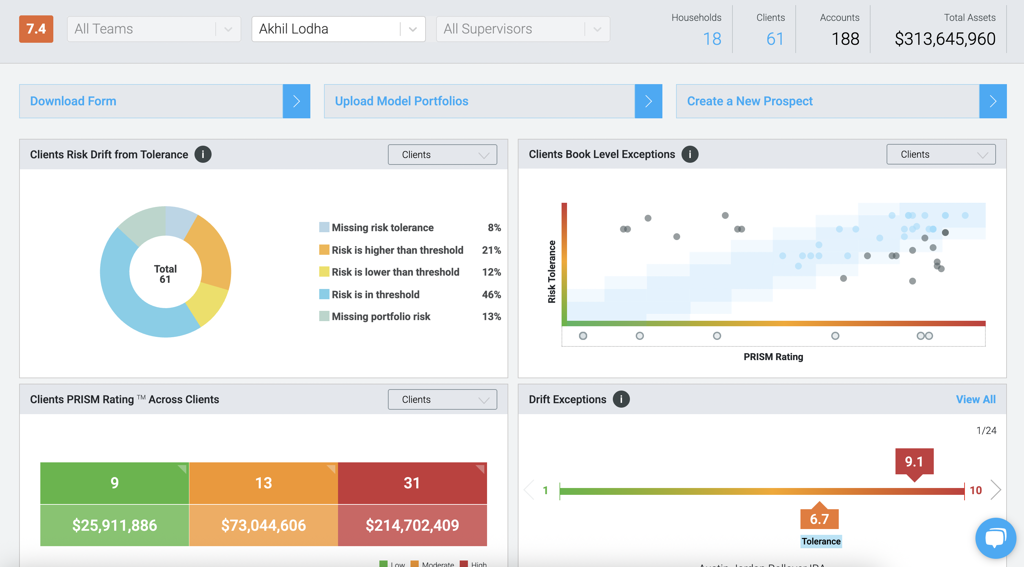
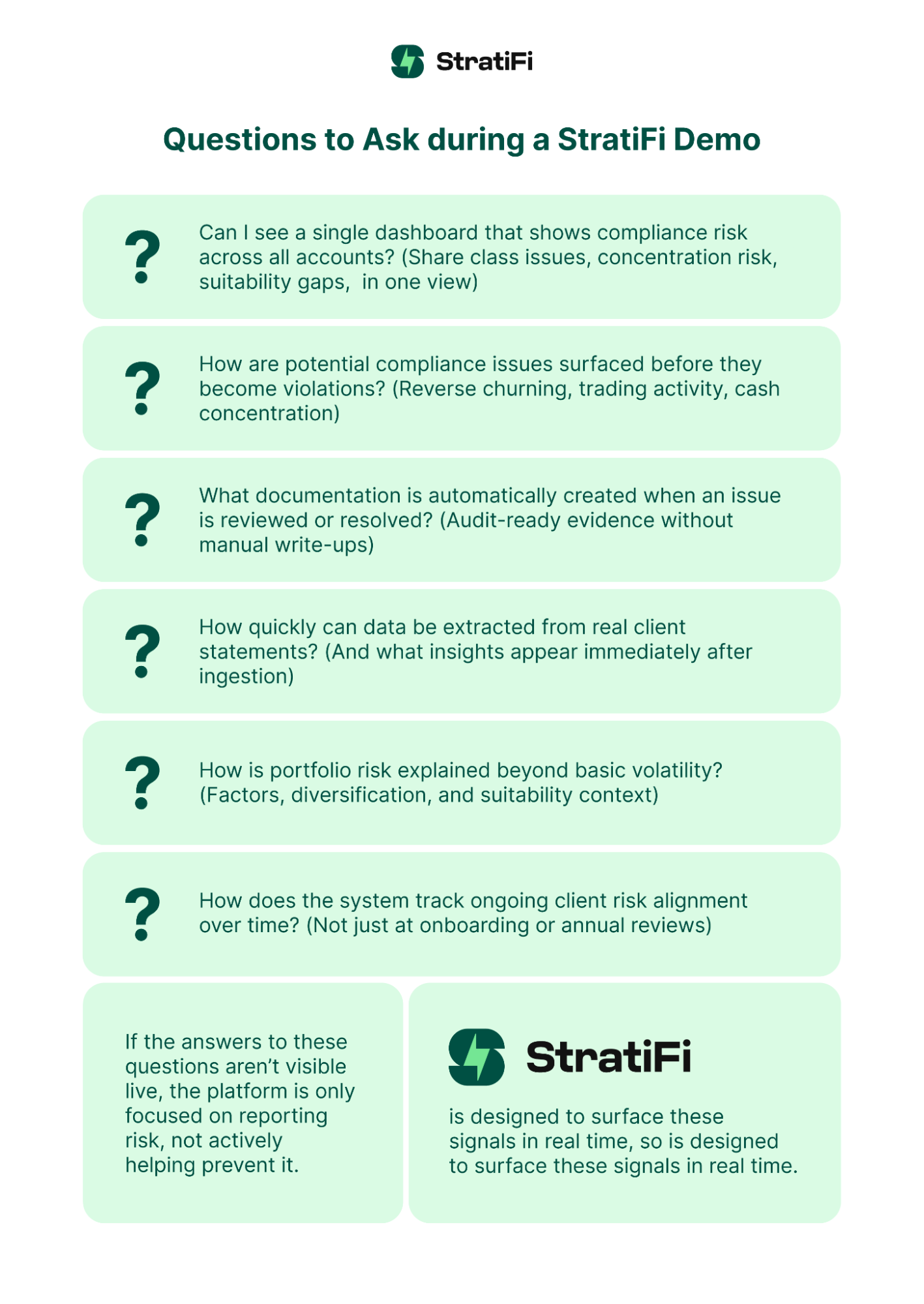
Category A platforms enable continuous, AI-driven compliance across all accounts with built-in audit readiness. StratiFi’s dashboard shows what proactive Reg BI monitoring looks like in practice, beyond checklists and point solutions.
2. Hadrius

What it does
Hadrius is a comprehensive compliance automation and surveillance platform designed to centralize regulatory oversight across advisory firms. It brings together trade surveillance, marketing and communications review, attestations, regulatory workflows, and audit preparation into a single compliance operating environment.
The platform uses AI-assisted analysis and rules-based automation to streamline reviews, surface potential issues, and maintain audit-ready records across multiple compliance surfaces
Best for
- RIAs and broker-dealers seeking a full compliance operations platform
- Firms looking to replace spreadsheets, email-driven reviews, and fragmented compliance processes
- Compliance teams that want centralized control over marketing review, surveillance, attestations, and audits
Pros
- Broad, multi-surface compliance coverage (trades, marketing, communications, attestations, audits)
- Centralized dashboards and workflows that improve visibility and coordination for compliance teams
- Strong automation for compliance operations and exam readiness
- Uses AI to assist review processes and reduce manual effort
Cons
- Compliance workflows are often human-initiated or review-driven, rather than continuously running once configured
- Limited focus on portfolio-level risk analytics or client-facing risk intelligence
- Less emphasis on embedding compliance signals directly into advisor investment workflows
Category A Tools: How Hadrius Compares with StratiFi
|
StratiFi |
Hadrius |
|
|
Emphasis |
Portfolio risk, compliance insights, and client engagement |
Compliance automation and surveillance |
|
Where it excels |
PRISM Ratings quantify volatility, correlation, and concentration risk for every client and portfolio. Custom, branded fact sheets and risk reports for client communication. Automates statement ingestion, classification, and portfolio evaluation for faster reviews. Flags share class violations, concentration risk, and suitability alerts. Uses AI to automate investment risk scoring and document processing. |
Not focused on portfolio-level risk analytics. Internal compliance dashboards; not client-facing. Automates compliance workflows, not investment processes. Full compliance OS: trade surveillance, communication review, attestations, audit trails. Uses AI for compliance review and zero-data retention surveillance. |
|
When to choose |
You want to improve client transparency, scale risk management, and automate investment workflows while gaining compliance insights directly from portfolio data. StratiFi helps advisors quantify and communicate risk, build trust, and differentiate their services. StratiFi focuses on what drives growth: clear risk communication, efficient portfolio workflows, and stronger client engagement. |
You need a comprehensive compliance infrastructure to automate marketing review, trade surveillance, attestations, and regulatory oversight across the firm. |
Category B - AI-Enhanced Monitoring Tools
Best for firms that need detection and supervision for specific use cases, but not a full AI operating system. These tools are effective at finding and managing issues, but do not unify portfolios, suitability, documentation, and advisor workflows the way a full OS does.
The tools in this category are effective when the goal is to detect, review, and manage specific compliance risks, especially in communications and marketing. However, because they operate in narrow domains, firms often still rely on separate systems for portfolios, suitability, documentation, and advisor workflows.
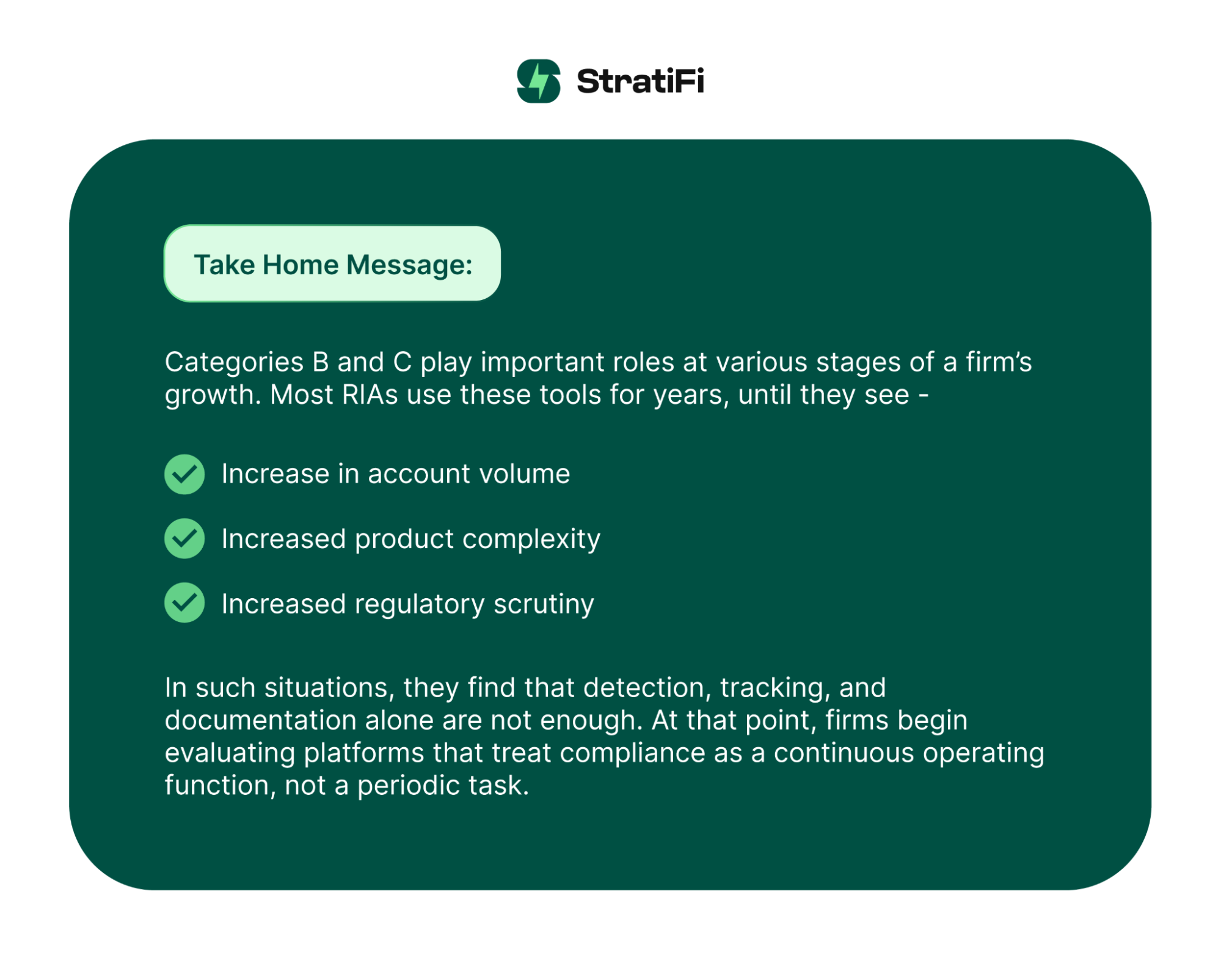
This is why many growing RIAs eventually outgrow Category B tools and look toward unified platforms that connect detection with decision-making and documentation.
3. Smarsh
What it does
Smarsh is a long-established financial services compliance platform that offers AI-native, unified solutions for capturing, archiving, and supervising communication data. It focuses on communications governance, data archiving, supervision, and retention across email, text, social media, and collaboration tools. It applies policy rules and machine-learning techniques to identify potential compliance risks.
Beyond communications, Smarsh also records retention, supervision workflows, and data governance, allowing firms to meet regulatory requirements around recordkeeping, supervision, and cyber/data compliance.
Best for
- RIAs and broker-dealers with heavy communications and recordkeeping obligations
- Firms under strict supervision and retention requirements
- Compliance teams looking for regulator-recognized archiving and review infrastructure
Pros
- Strong coverage across communication channels (email, text, chat, social, voice)
- Mature archiving and retention capabilities that are well understood by regulators and examiners
- Scales effectively for large firms with high communication volumes
- Established platform with deep experience in financial service compliance
Cons
- Primarily focused on communications and data governance, but not portfolio-level or suitability risk
- Does not connect communications signals to investment decisions, IPS alignment, and account-level compliance
- Firms need additional tools to handle Reg BI defensibility, suitability monitoring, and portfolio insights
4. Saifr

What it does
Saifr focuses on AI-assisted pre-review of marketing and communications content for financial services firms. It uses natural language processing (NLP) to analyze written content, such as advertisements, websites, emails, and social posts, and flag language that may pose regulatory risk before content is published.
Rather than replacing compliance judgment, Saifr acts as a first-pass review layer, helping compliance teams identify potentially problematic phrases, disclosures, or claims earlier in the workflow.
Best for
- RIAs and wealth management firms producing high volumes of marketing or client-facing content
- Compliance teams looking to reduce manual effort in pre-approval reviews
- Firms that want consistency in marketing language checks aligned with regulatory expectations
Pros
- Speeds up marketing and advertising review cycles
- Helps standardize content reviews across teams and advisors
- Useful as an early warning system before human compliance approval
- Reduces back-and-forth between marketing and compliance teams
Cons
- Limited to content and communications review
- Does not provide account-level monitoring, suitability oversight, or portfolio surveillance
- No continuous compliance monitoring across accounts or advisors
- Must be paired with other tools for full Reg BI and supervisory coverage
Category C - Rules-Plus-AI Add-Ons
Best for firms that want structure and consistency in compliance workflows, but are not ready for a full AI operating system.
Rules-plus-AI add-ons are often the first step firms take away from manual compliance. They help standardize processes, reduce missed tasks, and improve audit readiness compared to spreadsheets alone.
However, because they focus on process enforcement rather than real-time insight, firms using Category C tools still rely heavily on human review and multiple systems to identify emerging risk.
As firms grow, increase account complexity, or face more frequent exams, these tools often become necessary but insufficient, prompting the move toward AI-driven, unified compliance platforms.
5. Smartria
What it does
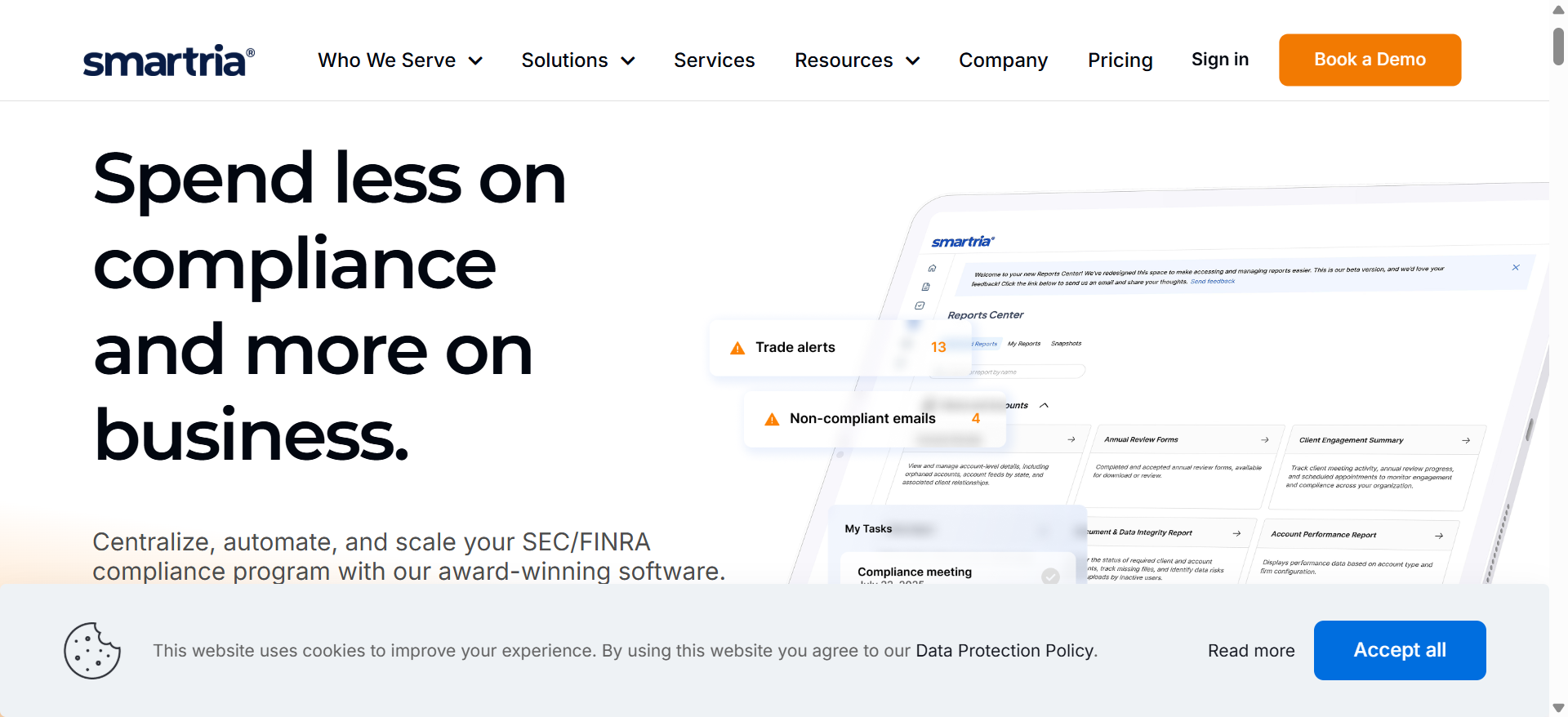
Smartria is a compliance program management platform designed to help RIAs organize, track, and execute core compliance obligations. It centralizes workflows such as compliance calendars, attestations, personal trading reviews, code-of-ethics tracking, marketing reviews, and certain trade monitoring activities.
The platform replaces spreadsheets, shared drives, and email-based tracking with a structured system of record, helping compliance teams maintain consistency and accountability across recurring regulatory tasks.
Best for
- Small to mid-sized RIAs formalizing or scaling their compliance programs
- Firms transitioning away from manual checklists and spreadsheet-driven compliance
- Compliance teams that need visibility into task completion, attestations, and reviews
Pros
- Strong structure for recurring compliance tasks and workflows
- Centralized tracking for attestations, personal trading, and reviews
- Improves accountability and reduces missed deadlines
- Easier to implement and operate than enterprise-grade platforms
Cons
- Primarily rules- and checklist-driven, not intelligence-driven
- Limited continuous or real-time monitoring across client accounts
- Does not natively connect portfolios, suitability logic, and documentation
- Relies on human review rather than automated exception detection
6. Comply
What it does
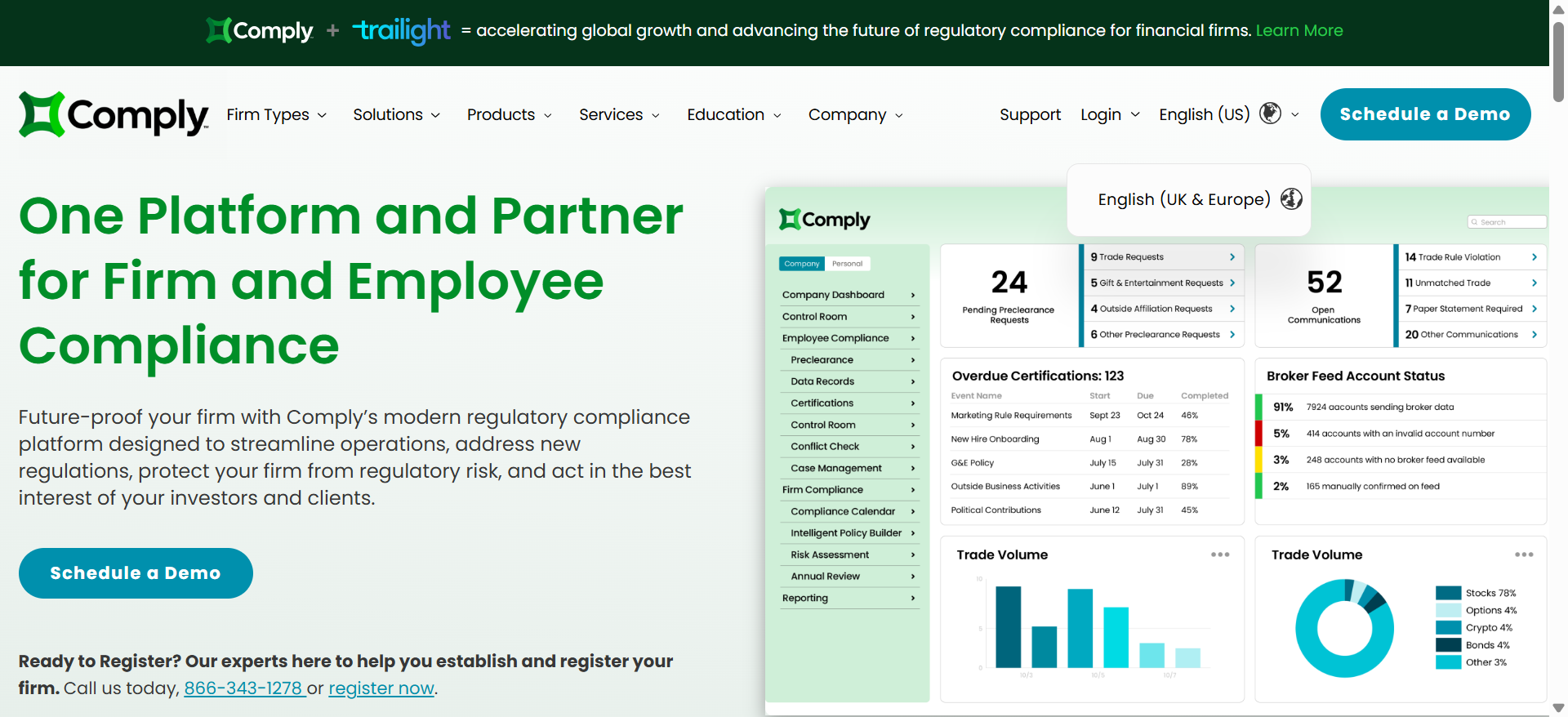
Comply is a compliance management platform focused on helping RIAs and broker-dealers structure and standardize regulatory workflows, with particular strength in Reg BI and best-interest documentation.
It supports activities such as exam management, registrations, filings, compliance calendars, and structured documentation around investment recommendations. Through its modules (including RIA in a Box and CompliSci), Comply helps firms organize regulatory obligations and maintain consistency across advisor documentation.
Rather than monitoring portfolios or advisors in real time, Comply emphasizes process discipline and documentation consistency.
Best for
- RIAs and broker-dealers with registration-heavy or exam-intensive compliance needs
- Firms looking to standardize Reg BI and best-interest analysis across advisors
- Compliance teams seeking structure around filings, exams, and regulatory timelines
Pros
- Strong framework for Reg BI and best-interest documentation
- Centralized tracking for exams, filings, and regulatory deadlines
- Improves consistency and audit preparedness versus manual processes
- Widely adopted and familiar within the RIA compliance ecosystem
Cons
- Largely documentation-centric, not intelligence-driven
- Relies heavily on manual data input and advisor participation
- No continuous account-level monitoring or automated exception detection
- Requires additional tools to cover communications surveillance, portfolio risk, or suitability monitoring
How These Tools Compare
Here’s a clear comparison table that can help you decide which tool best fits your business needs.
|
Solution |
Continuous Monitoring |
Explainable Signals |
Documentation Automation |
Workflow Integration |
Best For |
|
StratiFi |
Yes (account-level, continuous) |
Yes (risk, suitability, exception rationale tied to portfolios) |
Yes (embedded into advisory & compliance workflows) |
Deep (advisors, compliance, investment, ops) |
RIAs & BDs seeking always-on oversight, proactive Reg BI monitoring, and audit readiness by design |
|
Hadrius |
Partial (trigger- and workflow-driven) |
Partial (rules + AI-assisted review) |
Yes (compliance records, audit trails) |
High (compliance ops, surveillance, attestations) |
Firms needing a comprehensive compliance operations platform across marketing, trades, and supervision |
|
Smarsh |
Partial (communications-focused) |
Limited (policy & ML-based alerts) |
Yes (archiving, retention, retrieval) |
Moderate (communications & data governance) |
Firms prioritizing communications supervision, data retention, and cyber compliance |
|
Saifr |
No (pre-review focused) |
Limited (language & content flags) |
No |
Narrow (marketing workflows only) |
RIAs streamlining marketing and advertising compliance reviews |
|
Smartria |
No (checklist-based) |
No |
Limited (task & attestation records) |
Moderate (compliance program management) |
Small–mid RIAs formalizing compliance programs and task tracking |
|
Comply |
No (event-based) |
No |
Partial (Reg BI & best-interest rationale) |
Narrow (recommendation analysis & exams) |
Firms standardizing Reg BI documentation and exam workflows |
Use Cases: Matching Tools to Real Firm Painpoints
Use Case 1: Managing communications & marketing supervision at scale
The challenge: Firms must review advisor emails, texts, social posts, and marketing materials to meet regulatory standards, without slowing down advisor activity or overwhelming compliance teams.
Which category works best:
- Category C (Rules-Plus-AI Add-Ons)
Works well for structured marketing reviews and approvals when volume is manageable and content types are predictable.
- Category B (AI-Enhanced Monitoring Tools)
Strong fit for communications-heavy environments. AI flags risky language, accelerates reviews, and improves consistency across digital channels.
- Category A (Full AI Compliance Platforms)
Useful when communications oversight must be connected to client outcomes, suitability context, and advisor behavior patterns, not just reviewed in isolation.
Important: If communications supervision is the primary pain point, Category B tools often deliver the fastest value..
Use Case 2: Organizing compliance programs & exam preparation
The challenge: Compliance teams need to manage calendars, attestations, filings, policies, and exam responses without relying on spreadsheets or email chains.
Which category works best:
- Category C (Rules-Plus-AI Add-Ons)
Ideal for exam tracking, task management, and ensuring nothing falls through the cracks. Many firms start here.
- Category B (AI-Enhanced Monitoring Tools)
Helpful when exam preparation requires pulling in communications records or review history.
- Category A (Full AI Compliance Platforms)
Becomes valuable when firms want exam readiness to be continuous, with documentation and supervision evidence generated automatically over time.
Take-home message: For firms seeking structure and predictability, Category C tools are often sufficient until scale or exam frequency increases.
Use Case 3: Maintaining suitability & best-interest alignment over time
The challenge: Market volatility, portfolio changes, and evolving client behavior make it difficult to ensure ongoing suitability — not just at onboarding or annual reviews.
Which category works best:
- Category C (Rules-Plus-AI Add-Ons)
Can support periodic updates and structured documentation, but relies on manual inputs.
- Category B (AI-Enhanced Monitoring Tools)
Limited impact here, as most tools monitor communications rather than portfolios or suitability logic.
- Category A (Full AI Compliance Platforms)
Designed for ongoing suitability monitoring, linking portfolios, risk context, and documentation as conditions change.
Important: When suitability must be maintained continuously, firms begin to outgrow Categories B and C.
Use Case 4: Scaling without increasing compliance headcount
The challenge: As advisors, accounts, and product complexity grow, manual reviews and checklist-based supervision don’t scale linearly.
Which category works best:
- Category C (Rules-Plus-AI Add-Ons)
Improves organization but still grows linearly with firm size.
- Category B (AI-Enhanced Monitoring Tools)
Reduces workload in specific domains (e.g., communications), but leaves firm-wide prioritization to humans.
- Category A (Full AI Compliance Platforms)
Uses exception-driven workflows so compliance teams focus only on what requires judgment.
Important: When growth creates prioritization problems, not just workload problems, firms move toward Category A platforms.
Buyer Checklist: What to Ask Vendors
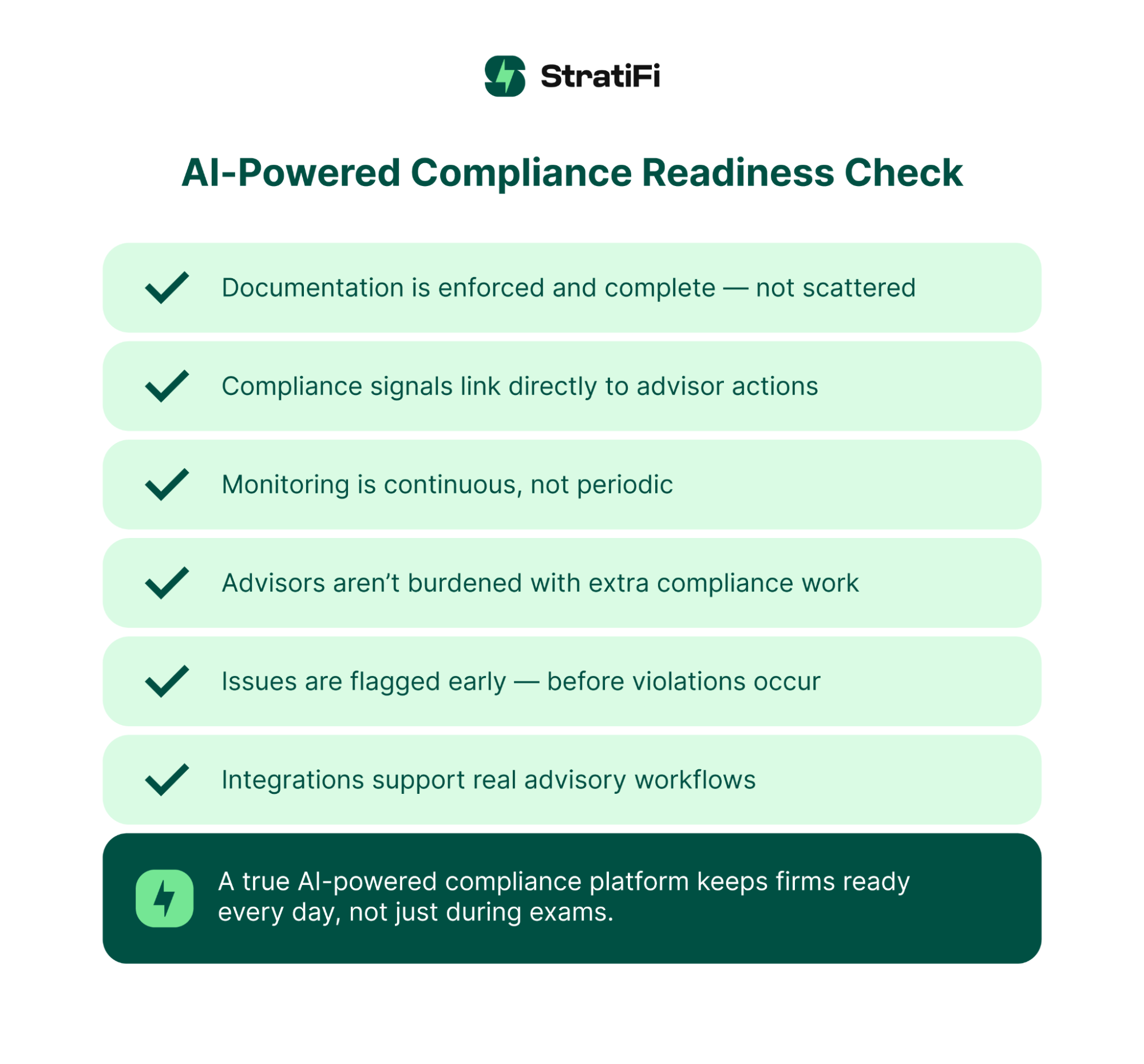
When evaluating RegBI compliance monitoring with AI solutions for finance advisors, the primary goals are its completeness, continuity, and defensibility.
The right questions help distinguish tools that merely track tasks from platforms that embed compliance into daily operations.
If a vendor can confidently demonstrate these capabilities using real workflows and real data, it’s a sign the platform is designed for proactive compliance.
On the other hand, if answers rely on “exports,” “manual reviews,” or “custom reporting later,” compliance is still reactive.
AI-Powered Compliance Buyer Checklist
|
Evaluation Question |
Why It Matters for RIAs and BDs |
|
Can the system produce comprehensive, exam-ready documentation on demand? |
During exams, regulators expect complete, consistent records. not scattered files assembled under pressure. Systems should enforce documentation as part of normal workflows so evidence already exists when needed. |
|
Does the platform connect compliance signals directly to advisor actions? |
Compliance evidence is strongest when alerts, reviews, and resolutions are tied to the actual decisions advisors make, rather than logged separately in spreadsheets or after-the-fact notes. |
|
Does it automate continuous data collection and monitoring, not just periodic reviews? |
Manual reviews increase the risk of gaps. Continuous monitoring helps firms stay exam-ready at all times and reduces the chance of violations occurring unnoticed. |
|
Does it reduce work for advisors instead of adding to it? |
Advisors already carry heavy workloads. The best compliance platforms automatically capture records, flag issues, and guide next steps, without requiring extra manual data entry. Advisors can focus on serving their clients. |
|
Does the system help prevent violations, not just document them? |
Compliance tools should surface emerging issues early so firms can take corrective action before problems escalate into regulatory findings. |
|
What systems does it integrate with, and how deeply? |
Integrations should support real workflows (custodians, portfolio systems, CRMs), not just data imports. Weak integrations recreate silos and manual reconciliation. |
Turn Compliance into a Competitive Advantage, Now!
RegBI compliance monitoring with AI is about operating with confidence, knowing that documentation, suitability, and oversight are continuously enforced as part of everyday advisory work.
For RIAs, broker-dealers, and financial advisors facing rising regulatory scrutiny, advisor burnout, and fragmented systems, the difference is clear:
Reactive compliance documents risk after the fact; proactive compliance prevents it.
The next step is experiencing how a unified, AI-powered compliance approach actually works across real advisory workflows.
Request a demo with StratiFi now to see how AI-driven compliance intelligence can reduce risk, simplify oversight, and scale with your firm, without adding work for advisors.
FAQs
What are AI-powered compliance solutions for financial advisors?
AI-enabled compliance solutions use intelligent automation, continuous monitoring, and pattern detection to manage regulatory obligations such as Reg BI, suitability, and recordkeeping.
Unlike traditional tools, they embed compliance into daily workflows rather than relying on periodic reviews.
How is RegBI compliance monitoring with AI different from traditional compliance software?
Traditional compliance software focuses on checklists, attestations, and after-the-fact reporting. AI compliance platforms continuously capture data, link advisor actions to documentation, and surface risks early, thus reducing manual effort and regulatory exposure.
Can AI-powered compliance tools or regulatory compliance software help with SEC exams?
Yes. The strongest RegBI compliance monitoring with AI solutions ensures documentation is enforced and maintained continuously, so firms can produce comprehensive, exam-ready records on demand instead of assembling them manually under time pressure.
Does RegBI compliance monitoring with AI add more work for advisors?
Well-designed platforms reduce advisor workload. They automate documentation, flag issues early, and guide corrective actions, thereby allowing advisors to focus on client relationships rather than compliance administration.
How should RIAs evaluate AI-powered compliance vendors?
Firms should look for platforms that offer continuous monitoring, defensible documentation, workflow integration, and proactive risk prevention, not just alerts or reporting.
The goal is operational defensibility, not just visibility.