%2010.svg)


Table Of Contents
.png)
Compliance expectations for RIAs and broker-dealers continue to rise. These expectations are driven by Reg BI enforcement, evolving suitability standards, increased exam frequency, and growing documentation expectations.
Besides, advisory firms are scaling: more advisors, more products, more complex households, and higher regulatory scrutiny. Legacy compliance systems are built around periodic reviews, spreadsheets, and manual workflows; they were not designed for this complex reality.
Hence, choosing the wrong compliance software will slow teams down and create advisor friction, operational drag, inconsistent oversight, and hidden regulatory exposure that surfaces only during exams.
This buyer’s guide for RIAs and broker-dealers breaks down the best finance compliance management software in 2026. It shares how these regulatory compliance software differ, and how to choose the right one based on your firm’s size, complexity, and growth goals.
What Does Finance Compliance Software Mean for RIAs and Broker-Dealers?
Finance compliance software or RIA compliance software is a system that governs how regulatory obligations are executed day to day, not just how they are reported during an exam.
At its core, it helps firms manage regulatory obligations across supervision, documentation, monitoring, and exam readiness in a consistent and defensible way.
Modern RIA compliance software go beyond task tracking:
- They centralize compliance workflows across advisors, operations, and compliance teams
- They standardize how documentation is created, updated, and stored
- They monitor advisor activity and surface potential suitability or best-interest issues
- Support Reg BI, suitability, and supervisory requirements in ongoing workflows
- Reduce manual effort during audits and regulatory exams
For growing firms, compliance management software is more than just a back-office utility or a periodic reporting tool; it’s a part of the firm’s operating infrastructure.
Thus, it shapes how advice is delivered, how risk is managed, and how confidently the firm can scale under regulatory scrutiny.
When chosen properly, an RIA compliance software enables growth without increasing exposure.
How We Evaluated These Platforms
This list focuses specifically on regulatory compliance software, not AML, fraud detection, or generic GRC platforms (Governance, Risk and Compliance) built for large enterprises or banks.
Our goal was to identify tools that support how RIAs and broker-dealers operate daily.
We evaluated the regulatory compliance software based on the following criteria:
-
Compliance Coverage
Support for Reg BI, suitability, supervision, documentation, and exam readiness, across accounts and advisors, not just policy tracking. Offers a unified compliance monitoring dashboard to help compliance officers catch every violation before regulators do.
-
Automation Depth
Whether compliance is handled through periodic, manual processes or continuous, embedded monitoring that operates as work happens.
-
Workflow Integration
How well the platform connects advisor activity with operations and compliance teams, reducing handoffs, rework, and manual follow-ups.
-
Scalability
Ability to support multi-advisor, multi-strategy firms without increasing headcount or operational complexity as the firm grows.
-
Audit Readiness
Whether comprehensive, defensible documentation can be surfaced on demand, without weeks of reconciliation or manual assembly.
-
RIA and Broker-Dealer Relevance
Purpose-built for advisory firms, rather than repurposed enterprise, banking, or financial crime platforms.
These criteria reflect what determines whether the RIA compliance software enables firms to scale or quietly becomes a block.
Best Finance Compliance Software for RIAs & Broker-Dealers (2026)
1. StratiFi
What it does
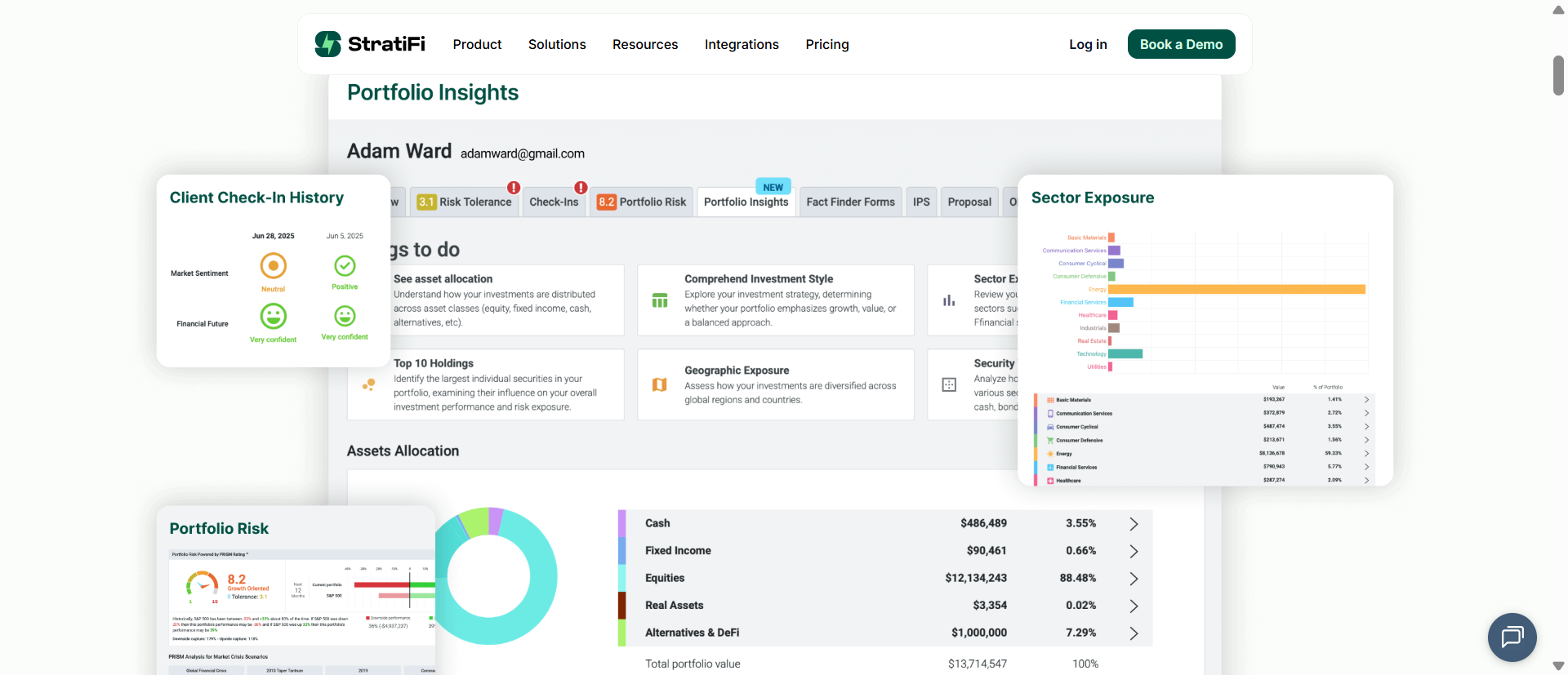
StratiFi functions as a unified compliance operating layer for RIAs and broker-dealers. It brings together continuous monitoring, automated documentation, and integrated workflows across advisors, compliance, investment, and operations.
Rather than managing compliance as a downstream task, StratiFi embeds regulatory oversight directly into how advice is delivered and supervised.
Why it stands out
Most compliance software focuses on tracking or reviewing activity after the fact. StratiFi is built around preventive compliance, capturing decision rationale, suitability alignment, and supervisory evidence as actions occur.
This reduces reliance on manual reconciliation, spreadsheets, and last-minute exam preparation, while giving leadership real-time visibility into firm-wide risk.
StratiFi is designed to scale compliance with the business, rather than becoming another system firms outgrow as complexity increases.
Best for
- RIAs and broker-dealers managing advisor growth and portfolio complexity
- Firms managing multiple advisors, strategies, and complex portfolios
- Firms preparing for frequent SEC exams or heightened regulatory scrutiny and seeking continuous exam readiness (not periodic preparation)
- Organizations looking to move beyond fragmented compliance tools toward a scalable operating model
Pros
- Automated compliance monitoring for share class violations, concentration risk, and suitability issues.
- Continuous, account-level oversight rather than periodic reviews
- Embedded documentation that supports defensibility by design
- Unified visibility across multiple advisors, portfolios, and compliance teams
- Single source of truth across compliance, investment, and operations
Cons
- Requires alignment with existing advisory workflows
- Not designed as a lightweight or standalone add-on, but as an operating platform
2. Hadrius: Ideal for AI-Assisted Marketing & Content Review

What it does
Hadrius is a compliance operations platform designed to centralize supervisory workflows across marketing review, communications oversight, trade surveillance, attestations, and audit preparation.
It uses AI-assisted review and workflow automation to help compliance teams manage day-to-day regulatory activities in one system.
Who it’s best for
- Mid-sized RIAs and broker-dealers
- Firms looking to consolidate compliance operations into fewer tools
- Compliance teams seeking better coordination across marketing, communications, and audits without adopting a full operating system
Hadrius is well-suited for firms seeking a comprehensive compliance operations platform that standardizes supervision and audit workflows, especially where compliance processes are centrally managed.
Pros
- Broad, multi-surface compliance coverage (marketing, comms, trade review, attestations)
- Centralized dashboards for compliance teams
- Reduces reliance on spreadsheets and email-based reviews
- Supports audit readiness through structured workflows and reporting
Cons
- Primarily operational and supervisory in nature, not an intelligence layer
- Limited AI-driven predictive analysis compared to OS-level platforms
- Compliance insights still depend heavily on predefined rules and manual review processes
- Less embedded into advisor decision-making workflows than end-to-end platforms
3. Smarsh

What it does
Smarsh is a widely adopted compliance platform that captures, archives, and supervises electronic communications across channels such as email, messaging apps, and collaboration tools. It applies policy rules and AI-assisted review to help firms meet supervision and recordkeeping requirements.
Who it’s best for
- RIAs and broker-dealers with heavy digital communications oversight
- Firms under strict supervision and recordkeeping requirements
- Organizations prioritizing regulator-recognized archiving solutions
An industry-standard solution for communications supervision, typically used alongside other compliance or portfolio oversight tools rather than as a standalone regulatory compliance software.
Pros
- Extensive coverage across modern communication channels
- Mature archiving, retention, and supervision capabilities
- Well understood by regulators and examiners
- Scales effectively for large advisor populations
Cons
- Focused primarily on communications and data governance, not end-to-end compliance workflows
- Limited linkage between communications monitoring and broader suitability or documentation processes
- Does not address portfolio-level suitability or investment rationale
- Requires other systems to manage Reg BI defensibility end-to-end
4. Compliance Alpha (ACA Group)
.png?width=1920&height=878&name=Compliance%20Alpha%20(ACA%20Group).png)
What it does
Compliance Alpha is part of ACA Group’s technology offering and focuses on regulatory compliance monitoring, testing, surveillance, and reporting for financial services firms. It is supported by ACA’s broader regulatory advisory and consulting expertise.
Who it’s best for
- RIAs and broker-dealers with complex regulatory exposure
- Firms seeking institutional-grade compliance frameworks
- Organizations that value advisory-led compliance oversight
Best suited for firms prioritizing regulatory rigor and structured compliance governance, particularly where advisory support and formal compliance programs are central.
Pros
- Backed by deep regulatory expertise from ACA Group
- Strong compliance testing, monitoring, and reporting capabilities
- Suitable for firms under heightened regulatory scrutiny
- Integrates technology with compliance advisory services
Cons
- Less embedded into everyday advisory workflows
- Compliance processes often remain review-driven
- Heavier implementation and operational overhead
5. Comply (including RIA in a Box and CompliSci modules)
What it does
Comply is a compliance management platform that helps RIAs and broker-dealers organize regulatory workflows across registrations, filings, exams, and ongoing compliance tasks.
Through its RIA in a Box and CompliSci modules, Comply supports compliance program management, exam preparation, task tracking, and trade surveillance within a structured, rules-driven framework.
Rather than providing continuous, AI-led oversight, the financial compliance software focuses on helping firms stay organized, meet deadlines, and assemble required documentation during regulatory reviews.
Who it’s best for
- Registration-heavy RIAs and broker-dealers
- Firms with established compliance teams seeking structure around exams and filings
- Organizations that need centralized tracking of regulatory obligations and supervisory tasks
Pros
- Strong tool set for exam preparation and regulatory workflow management
- Clear visibility into filings, deadlines, attestations, and compliance calendars
- Helps reduce missed tasks and administrative compliance gaps
- Familiar and widely adopted in the RIA compliance ecosystem
Cons
- Relies heavily on manual documentation and user-driven data entry
- Compliance evidence is often assembled after the fact rather than captured continuously
- Limited automation and minimal AI-driven risk prediction
- Less embedded into advisor workflows compared to OS-level platforms
6. Smartria
What it does
Smartria provides compliance program management software for RIAs and broker-dealers, focusing on workflow automation, task management, and compliance record-keeping. The platform supports activities such as marketing review, employee attestations, trade monitoring workflows, and supervisory task tracking through structured, rules-based processes.
It is designed to help compliance teams standardize recurring compliance activities and maintain organized records across the firm.
Who it’s best for
- Small to mid-sized RIAs
- Firms looking to structure/standardize/automate compliance workflows
- Firms transitioning away from spreadsheets and email-based tracking
A solid compliance management foundation for firms early in their growth, before complexity demands continuous monitoring or deeper intelligence.
Pros
- Broad operational coverage across compliance tasks
- Supports marketing review, attestations, and trade monitoring
- Improves organization and visibility for compliance teams
Cons
- Limited AI-driven analysis or predictive risk detection
- Heavily dependent on predefined rules and manual inputs
- Does not provide continuous, account-level monitoring
- Less integrated into advisor decision-making workflows
7. Greenboard

What it does
Greenboard is a compliance management platform designed to help RIAs organize regulatory obligations, supervisory tasks, and exam preparation. It focuses on task tracking, compliance calendars, documentation management, and audit support within a centralized interface.
The financial compliance software aims to give teams visibility into what needs to be done, by whom, and by when, thus helping firms stay organized and exam-ready.
Who it’s best for
- RIAs seeking structured compliance task management
- Firms preparing for regulatory exams and ongoing reviews
- Compliance teams looking for centralized tracking and accountability
Pros
- Clear visibility into compliance tasks, deadlines, and responsibilities
- Supports exam preparation and documentation organization
- Helps reduce missed deadlines and overlooked obligations
Cons
- Relies on manual updates and user-driven inputs
- Limited automation and no continuous monitoring
- Does not embed compliance into advisor workflows
- Primarily reactive rather than proactive in risk detection
8. Orion Compliance
What it does
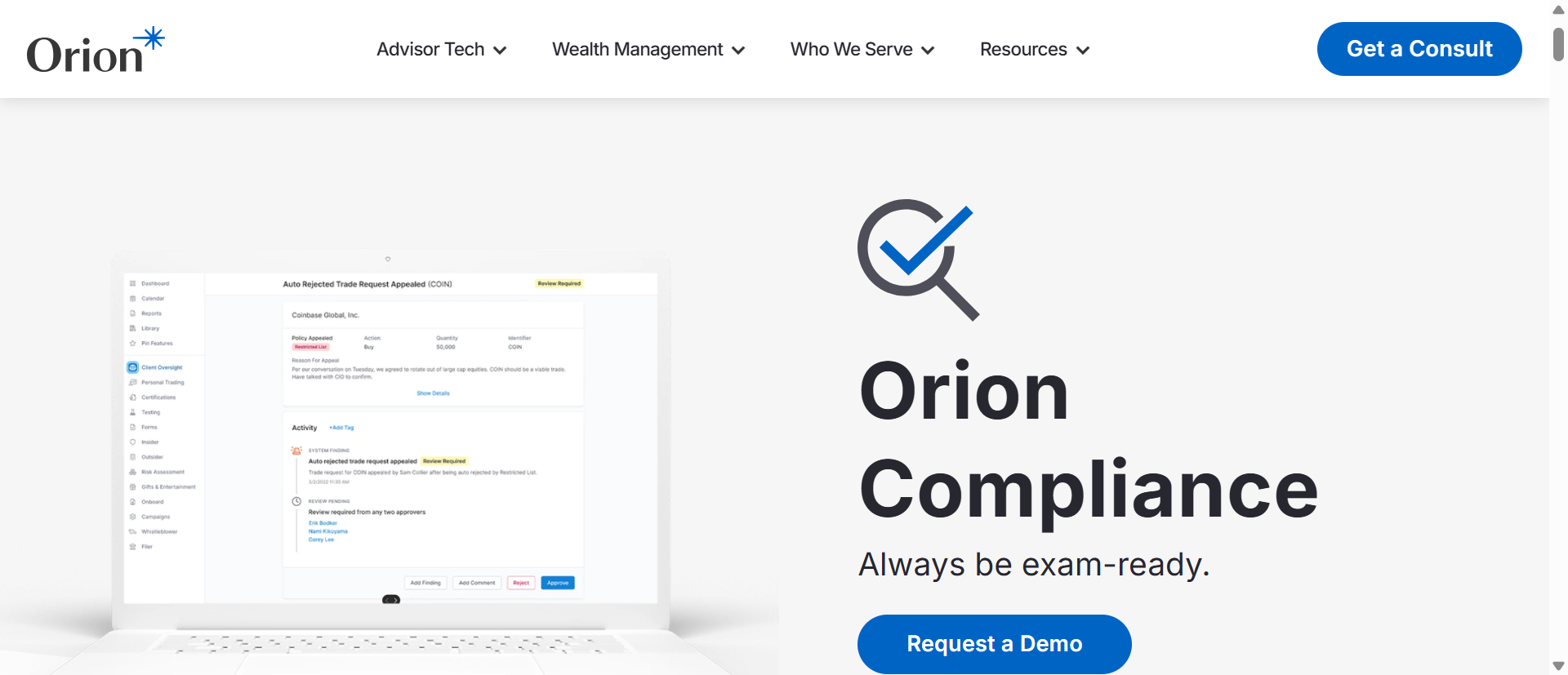
Orion Compliance is part of the broader Orion Advisor Tech ecosystem and provides compliance tools integrated with portfolio accounting, reporting, and advisor technology. It supports supervisory review, documentation, and compliance workflows within firms already using Orion’s platform.
Rather than operating as a standalone compliance management software, Orion Compliance functions as an embedded layer within the Orion environment, benefiting from proximity to portfolio and reporting data.
Who it’s best for
- RIAs already operating on the Orion platform
- Firms seeking tighter integration between portfolio data and compliance workflows
- Organizations preferring a single-vendor ecosystem
The platform is well-suited for Orion-centric firms that want compliance capabilities embedded within their existing advisor technology stack.
Pros
- Native integration with Orion’s portfolio accounting and reporting tools
- Familiar environment for firms already using Orion
- Centralized compliance workflows tied to portfolio data
- Reduces the need for external integrations within the Orion stack
Cons
- Limited flexibility outside the Orion ecosystem
- Less focused on AI-driven compliance intelligence
- Compliance capabilities depend on Orion’s broader platform roadmap
- Not designed as a standalone compliance operating system
Every tool discussed above solves a different compliance problem. The differences in their scope, automation, and scalability become clear when viewed side by side.
Here is a table that summarizes their capabilities.
How These Tools Compare
|
Platform |
Monitoring Model |
Workflow Integration |
Documentation Handling |
Scalability Profile |
Best for |
|
StratiFi |
Continuous, account-level monitoring across portfolios |
Deep: embedded across advisor, compliance & Ops workflows |
Automated, captured as work happens |
High: scales with advisors, accounts & product complexity |
RIAs & broker-dealers needing proactive, exam-ready compliance embedded into daily advisory operations |
|
Hadrius |
Ongoing, multi-surface monitoring (rules + AI-assisted, often review-triggered) |
Moderate: centralized compliance workflows |
Workflow-based records and audit trails |
Moderate: scales compliance operations |
Firms are centralizing compliance across marketing, communications, attestations & audits |
|
Smarsh |
Continuous communications monitoring |
Low: communications-centric |
Archiving, retention & supervision of records |
Moderate: strong at comms scale |
Firms prioritizing communications supervision, retention & cyber/comms compliance |
|
Compliance Alpha (ACA Group) |
Periodic & risk-based reviews supported by analytics |
Moderate: compliance & risk workflows |
Structured regulatory documentation and reports |
High: enterprise & multi-entity scale |
Large RIAs, BDs & asset managers seeking institutional-grade compliance programs & regulatory advisory support |
|
Comply (RIA in a Box + CompliSci) |
Periodic, checklist- & review-driven |
Moderate: compliance team workflows |
Manual documentation assembled for reviews and exams |
Limited: manual effort grows with scale |
Registration-heavy RIAs managing exams, filings, and regulatory calendars |
|
Smartria |
Task- & rules-driven |
Moderate: compliance program workflows |
Manual task-based documentation |
Limited: operational scale only |
Small–mid RIAs formalizing compliance programs |
|
Greenboard |
Manual, task-driven |
Moderate: task & calendar management |
Manual uploads and tracking |
Limited: organizational focus |
Firms needing structured compliance tasks & exam tracking |
|
Orion Compliance |
Event- and review-driven, portfolio-adjacent |
Moderate: within the Orion ecosystem |
Workflow-based documentation tied to Orion data |
Moderate: dependent on Orion stack |
RIAs already on Orion, seeking integrated compliance workflows |
Mistakes to Avoid When Choosing the Best RIA Compliance Software for Your Firm
- Buying tools that solve only one surface
Communications-only or task-only tools improve visibility but leave firms stitching together risk, documentation, and oversight elsewhere.
- Over-indexing on checklists instead of workflows
Checklists help track obligations. They don’t ensure compliance happens as advice is delivered.
- Confusing “AI-powered” with “operationally embedded.”
AI alerts are useful only if they connect directly to advisor actions, documentation, and supervision, not if they live in isolation.
When Should You Move beyond Basic Tools: Watch Out for These Signs
Most firms don’t outgrow their compliance tools overnight. They experience friction first.
Here are a few red flags that you should watch out for. When these signs appear, you know you have a serious infrastructure problem.
- Exams feel disruptive every year, regardless of preparation
- Advisors worry more about documentation than markets
- Compliance relies on spreadsheets or manual reconciliation
- Leadership lacks real-time visibility into firm-wide risk
Modern RIA compliance software operationalizes trust. It embeds oversight into everyday decisions, captures documentation as work happens, and reduces friction for advisors instead of creating it.
Leadership gains confidence that growth won’t introduce hidden exposure, and compliance shifts from a cost center to an operating advantage.
That’s the difference between managing compliance and building a firm that scales with it.
Not sure if your compliance stack will scale with your firm?
A quick StratiFi walkthrough can quickly reveal where risk, documentation, and workflows break under growth. Schedule a demo now to learn more about our unified compliance operating layer built to scale.
FAQs
What is Finance Compliance Software for RIAs?
Financial compliance software helps RIAs and broker-dealers manage supervision, documentation, monitoring, and exam readiness across Reg BI and suitability requirements.
How is Modern Compliance Software Different from Legacy Tools?
Modern regulatory compliance software embeds compliance into daily workflows and automates documentation, rather than relying on periodic reviews, spreadsheets, or after-the-fact reporting.
Do RIAs Need AI-powered Compliance Software?
As regulatory expectations and firm complexity grow, AI-powered compliance helps firms monitor risk continuously, reduce manual effort, and maintain defensible records at scale.
Can Compliance Software Reduce Advisor Workload?
Yes. When compliance is embedded into workflows, advisors spend less time on documentation and more time serving clients, without increasing regulatory risk.
How Do RIAs Know When It’s Time to Upgrade Their Regulatory Compliance Software?
If exams feel disruptive, documentation is manual, or leadership lacks real-time visibility, it’s a sign that basic tools no longer support the firm’s growth or risk profile.