%2010.svg)


Table Of Contents
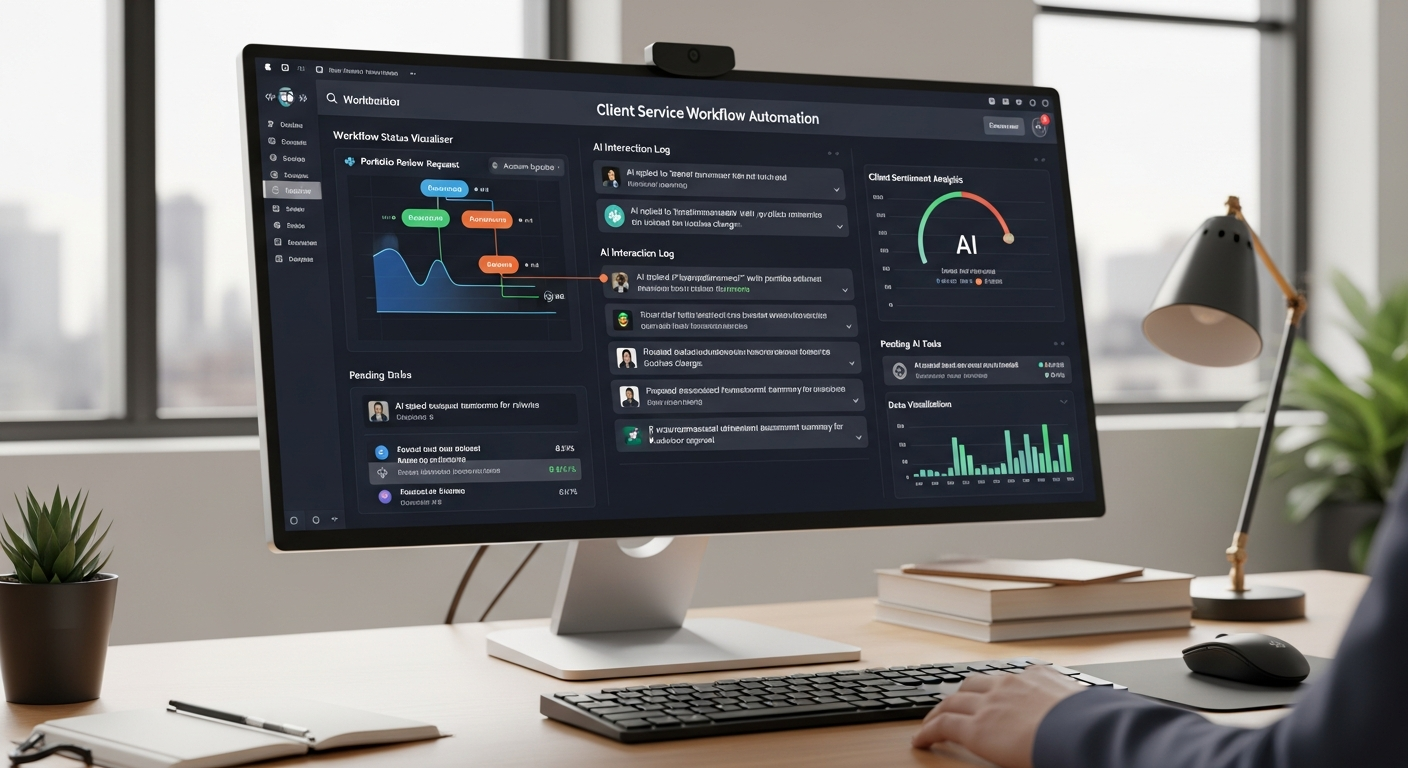
AI is not eliminating the client service associate role at RIAs — it's inverting it. Document extraction now handles the transcription work that used to consume a CSA's day (reading statements, keying holdings, re-entering the same data into three systems), and the role is shifting to what humans are actually good at: judging exceptions, catching anomalies, and talking to clients. Firms that redesign the role around that shift are pulling ahead; firms that just "add AI" to the old workflow are automating a bad process.
Your best CSA was never a typist. Your workflow just treated them like one.
Here's the reframe: the client service associate role was never supposed to be a data-entry job. It became one by accident. Every new account arrives as a stack of PDFs — custodial statements, 401(k) summaries, held-away account printouts — and someone has to turn that paper into structured data before anything else can happen. That someone became the CSA, and the transcription work quietly ate the job. Onboarding a single household can mean manually keying hundreds of positions across multiple statements, then re-entering subsets of that data into the CRM, the portfolio tool, and the proposal system — because none of them talk to each other.
The cost isn't only the hours. It's what the hours displace. Every afternoon spent retyping a statement is an afternoon not spent following up with a client, preparing a review, or catching the transfer that stalled at the custodian. And manual keying at volume produces errors — transposed digits, missed positions, stale values — that surface weeks later as suitability questions and rework.
AI-powered statement processing changes the economics of that entire workflow. Document extraction technology reads uploaded account statements — PDFs, scans, custodial downloads — identifies the holdings, quantities, and values, and converts them into structured data automatically. What used to be hours of keying becomes minutes of review.
What does "exception handling" actually mean for a CSA?
Exception handling means the human reviews what the machine flags, instead of producing what the machine now produces. In a statement-scanning workflow, the AI extracts every position it can read with confidence and flags what it can't: an ambiguous ticker, a handwritten note, an unusual security type, a value that doesn't reconcile. The CSA's job becomes working that exception queue — resolving the flags, validating the edge cases, and approving the output.
That's a genuinely different job description, and a better one:
| Old CSA workflow | New CSA workflow |
|---|---|
| Key every position from every statement | Review flagged exceptions only |
| Re-enter data into 3+ disconnected systems | Validate once; data flows downstream |
| Find errors weeks later, during reviews | Catch anomalies at intake, same day |
| Measured on throughput (accounts keyed) | Measured on judgment (exceptions resolved, clients served) |
| First week of onboarding: transcription | First week of onboarding: client contact |
Two things make this shift real rather than cosmetic. First, extraction accuracy has to be high enough that exceptions are the minority — if the CSA re-checks everything, you've added a step, not removed one. Second, the extracted data has to flow somewhere. Extraction that ends in another spreadsheet just relocates the retyping.
Why does the downstream data flow matter more than the extraction itself?
Because transcription was never the whole problem — fragmentation was. The reason a CSA keys the same household's data multiple times is that the risk tool, the ops system, and the compliance platform each need their own copy. Automate the first entry and you've solved a third of the problem.
This is where architecture decides whether AI actually changes the role. In StratiFi, AdvisorIQ · Statement Scanning reads the uploaded statements and extracts holdings into structured data — and because it sits inside one platform, that data flows directly onward: AdvisorIQ → OperationsIQ for suitability and operational review, then into ComplianceIQ for supervision, with an audit trail generated automatically along the way. One intake, one validation, and the entire downstream stack is working from the same numbers. No re-keying, no version drift between systems, and no "which spreadsheet is current?" conversation.
That connectedness also changes what the CSA's exception work is worth. An anomaly caught at intake — a concentration that looks off, an account type that doesn't match the profile — surfaces in the same system where ops and compliance will act on it. The CSA stops being the person who types the data and becomes the first line of quality control for the firm's entire data pipeline. For the broader picture of what document extraction can automate across an RIA's workflows, our 2026 guide to financial document automation goes deep on the intake-to-supervision pipeline.
What should firms do with the recovered capacity?
Deliberately reinvest it — because capacity that isn't redirected gets absorbed invisibly. Firms running statement scanning report advisors and support staff recovering a large share of their administrative time; StratiFi's own benchmark is advisors getting back 40%+ of admin time. The firms that benefit most decide in advance where those hours go:
- Client contact. Proactive check-ins, faster response times, review prep. This is the work clients actually feel, and it's the strongest retention lever a service team has.
- Onboarding speed. When intake takes minutes instead of days, the time-to-first-value for a new client collapses — and so does the window where transfers stall and second thoughts creep in.
- Data quality ownership. Give the CSA formal responsibility for the exception queue and intake data quality. It upgrades the role, creates a career path, and gives compliance a named first reviewer.
- Capacity without headcount. For growing firms, the same service team absorbs more households. That's the operating-leverage story founders care about — growth that doesn't require a proportional hire.
One caution: don't market the change internally as "AI is taking over data entry." Frame it as what it is — the firm finally removing the part of the job everyone hated. Adoption follows quickly when the people affected experience the change as a promotion rather than a threat.
Frequently Asked Questions
Will AI replace client service associates at RIAs?
No — but it is replacing the transcription portion of the role. Document extraction handles reading and keying statements; the CSA role shifts toward exception review, data quality, and client-facing work. Firms still need the judgment; they no longer need the typing.
What is statement scanning for financial advisors?
Statement scanning is AI-powered document extraction that reads account statements — custodial PDFs, 401(k) summaries, held-away account documents — and converts holdings, quantities, and values into structured data automatically. In StratiFi, this is AdvisorIQ · Statement Scanning, and the extracted data flows onward through OperationsIQ and ComplianceIQ.
How accurate is AI statement extraction?
Accurate enough that human review focuses on flagged exceptions rather than re-checking every line — ambiguous entries are surfaced for a person to resolve, which keeps a human in the loop on exactly the items that need judgment.
How does automated statement processing help with compliance?
Because extraction happens inside a supervised workflow, intake data lands in the same system that runs suitability and supervision, and every step generates an audit trail automatically. Manual keying into disconnected spreadsheets leaves no comparable record.
If your service team is still keying statements by hand, the fastest way to see the difference is to watch a real statement go through: visit the AdvisorIQ · Statement Scanning feature page and see what your CSAs could be doing with their afternoons instead.