%2010.svg)


Table Of Contents

Advisory firms generate enormous amounts of information, but much of it stays trapped inside PDFs, statements, onboarding forms, and review documents. Humans can read that information. Systems usually cannot.
The result is a familiar operational bottleneck: manual data entry, repeated document review, slower compliance workflows, and delayed visibility across accounts.
AI-powered data extraction changes that by converting unstructured documents into structured, usable data that can feed operational systems and analytics. In financial services, intelligent document processing is increasingly used to classify documents, extract key fields, and support compliance and reporting workflows.
For RIAs, that makes AI-powered data extraction more than an efficiency tool. It becomes a way to turn document-heavy processes into usable advisory intelligence at scale.
The Hidden Operational Challenge in Wealth Management
Most advisory firms are short on usable data. Critical information exists across:
- custodial statements
- client onboarding forms
- investment policy statements (IPS)
- account review documents
- third-party reports and PDFs
But this data is unstructured, which means it cannot flow easily across systems.
This issue shows up in the following ways:
Manual data entry across systems
Advisors and operations teams repeatedly input the same data into CRMs, portfolio systems, and compliance tools.
Document reviews consume operational time
Teams spend hours extracting key details from PDFs instead of acting on insights.
Inconsistent and fragile records
Data entered manually introduces errors and gaps, especially across large client books.
Delayed insights across portfolios and accounts
By the time information is processed, the opportunity to act on it may already be lost.
The result?
Firms face an operational visibility problem. Data remains locked in documents:
- Portfolios are harder to monitor consistently
- Compliance documentation becomes reactive
- Advisory workflows slow down as firms scale
Thus, firms lack systems that understand and act on information in real-time.
What Is AI-Powered Data Extraction?
AI-powered data extraction refers to the use of artificial intelligence and machine learning to identify, interpret, and convert information from unstructured documents into structured, usable data.
Unlike traditional data extraction software, which relies on fixed templates or manual mapping, modern AI document extraction systems can:
- Recognize different document formats (PDFs, statements, forms)
- Identify relevant fields (holdings, account details, transactions, client data)
- Adapt to variations in layout and structure
- Output clean, structured data that can integrate into operational systems
How Does It Work?
At a high level, intelligent data extraction combines:
- Document classification (what type of document is this?)
- Field identification (what information matters?)
- Data extraction and normalization (convert into a structured format)
- System integration (feed into downstream workflows)
RIA-Relevant Examples
For advisory firms, AI-powered data extraction from documents applies directly to everyday workflows:
- Extracting portfolio holdings and transactions from custodial statements
- Capturing client details and financial data from onboarding forms
- Parsing investment policy statements (IPS) for compliance alignment
- Pulling review notes and documentation into compliance systems
Thus, instead of manually reading and re-entering information, firms can automate data extraction and make it immediately usable across systems.
AI-powered data extraction turns documents from static records into active inputs for advisory, compliance, and operational workflows.
The Role of Data Extraction in Advisory Intelligence
AI-powered data extraction changes how advisory firms operate, monitor, and make decisions. When data flows directly from documents into systems, it becomes part of a broader advisory intelligence layer.
Better Portfolio Oversight
Extracted data like holdings, transactions, and allocations can feed directly into portfolio systems. This enables continuous visibility across accounts, rather than relying on periodic updates or manual reconciliation.
Faster Compliance and Documentation
When data from documents is captured automatically, compliance records are updated in real time. This reduces reliance on manual documentation and ensures that records reflect actual advisory activity.
Scalable Operations
As firms grow, manual document processing becomes a bottleneck. Automated data extraction software removes repetitive work, allowing teams to scale without proportionally increasing operational headcount.
Firm-Wide Visibility
With structured data flowing into the system, leadership and compliance teams gain consistent visibility across advisors, portfolios, and client segments, making it easier to identify gaps, patterns, or emerging risks.
Thus, data extraction moves firms from document-driven workflows → intelligence-driven operations. Instead of reacting to information after it’s processed, firms can act on it as it becomes available.
The Way Forward: AI-Driven Operations in Wealth Management
Forward-looking advisory firms are moving toward operating models where data flows continuously into systems that support decision-making, compliance, and client service. In this model:
Documents feed directly into advisory systems
Custodial statements, onboarding forms, and review documents are automatically processed and converted into structured data.
Compliance records update as work happens
Documentation is no longer created after the fact. It is generated as a byproduct of real advisory activity.
Operational processes run continuously
Portfolio updates, client changes, and document inputs trigger workflows without manual intervention.
Insights become immediate and actionable
Advisors and compliance teams can act on information as it becomes available, not after it is reviewed manually.
This is where AI-powered data extraction evolves from a back-office tool into a foundational layer for advisory operations.
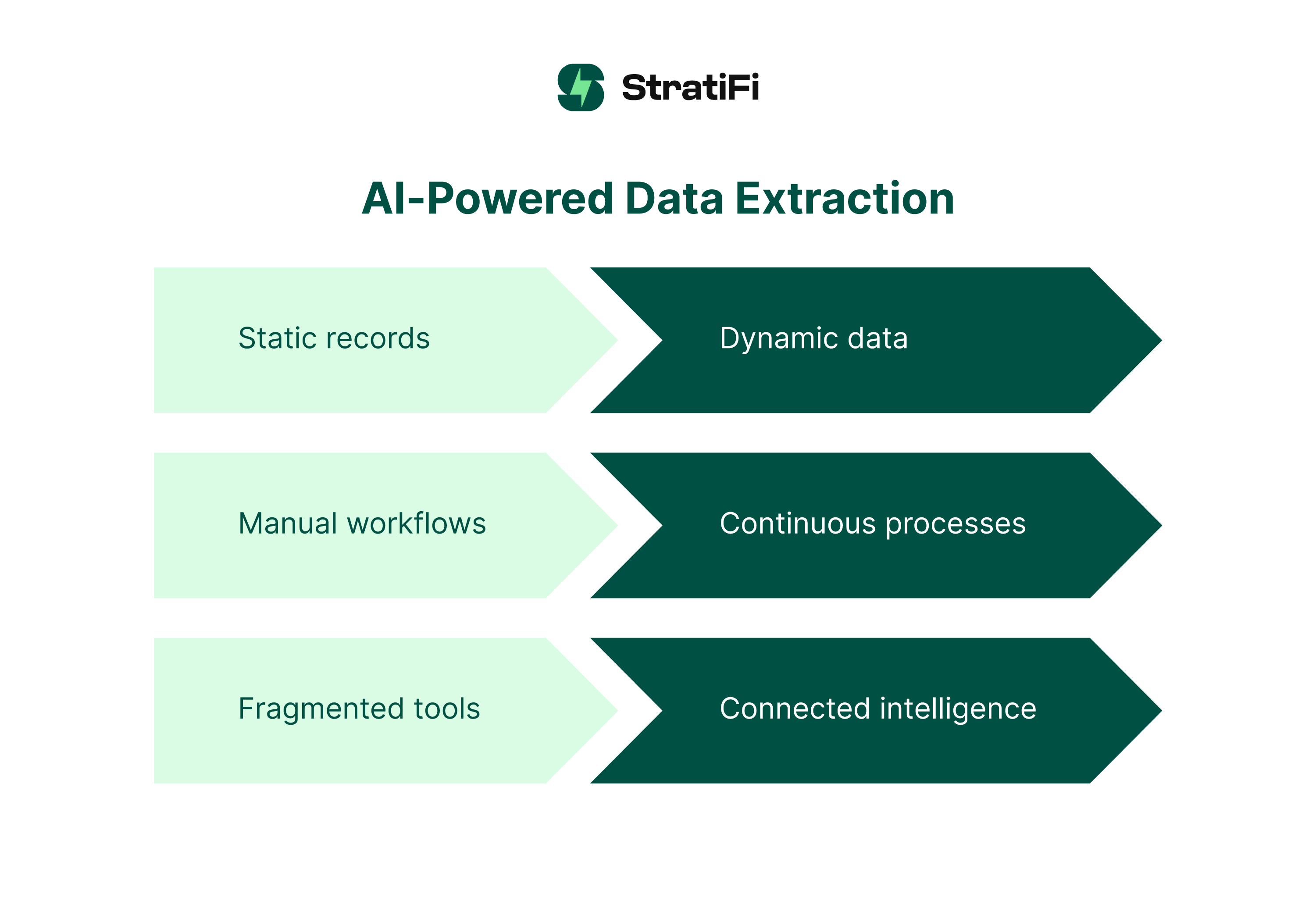
Firms adopting this model are more consistent, scalable, and defensible.
If you want to be among these firms, you must turn document-heavy workflows into structured, actionable intelligence. Book a demo to see how StratiFi uses AI-powered data extraction to power portfolio insights, compliance workflows, and advisory decisions.