%2010.svg)


Table Of Contents
The April 2026 release in six bullets.
- Trading Activity Exceptions. Surveillance for both under-trading and over-trading patterns.
- Salesforce integration. StratiFi workflows now connect to your CRM of record.
- Proposal Defaults. Firm-level setup so advisors stop rebuilding the same configuration.
- RTQ documentation notes. Context flows into Risk Tolerance, Fact Finder, and compliance notes.
- Client Reviews CSV. Export and import for portable review data.
- OperationsIQ Beta. AI-assisted suitability review workflows in limited beta.
Modern wealth firms are being asked to monitor more activity, document more decisions, and move faster across teams without adding more manual work. The April 2026 StratiFi release is built around exactly that pressure. It pairs stronger surveillance and more connected workflows with the first AI-assisted suitability workflows now in limited beta. Below is what shipped, what is on the horizon, and what each change means for the compliance and operations leaders who run the day-to-day at RIAs and broker-dealers.
See How StratiFi WorksTrading Activity Exceptions
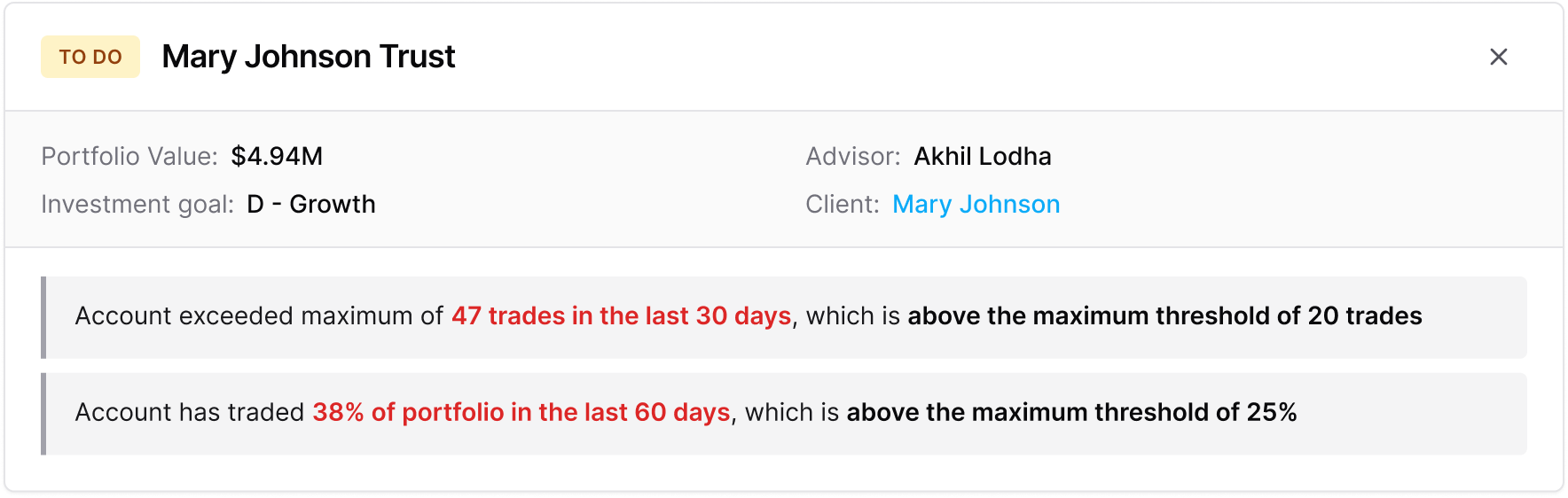
NewStratiFi now flags trading patterns at both ends of the spectrum, excessive activity and inactivity, over a configurable time window.
The problem
Trading activity creates risk in two directions. Too much activity can raise excessive-trading concerns. Too little activity can signal portfolios that are not actually being reviewed or managed as expected. Most surveillance frameworks watch one tail. Both deserve attention.
What is new
Trading Activity Exceptions give compliance teams a dedicated way to monitor trading behavior across portfolios over a configurable time period. When activity falls outside the defined rules, the system raises an exception for review.
Why it matters
Under-trading is hard to spot manually because there is no event to flag. A configurable lower-bound exception turns it into a continuous, documentable signal. Firms can identify trading patterns in advance, instead of reconstructing them during an examination.
Salesforce integration
NewStratiFi now connects directly with Salesforce, so client data, advisor workflows, and compliance documentation can sit on a single client identity.
The problem
Advisor and operations teams often work across disconnected systems. Data lives in two places, the same client gets updated twice, and workflows fragment along tool lines instead of along the actual work.
What is new
The Salesforce integration connects StratiFi workflows with the CRM many wealth firms already use as their system of record for clients and households.
Why it matters
Three things change when CRM and supervisory stack are connected:
- Advisors stop re-keying client data into two systems.
- Operations sees one source of truth for who the client is and where their review stands.
- Compliance documentation is anchored to the same client identity the rest of the firm uses, which is what examiners expect.
Proposal Defaults
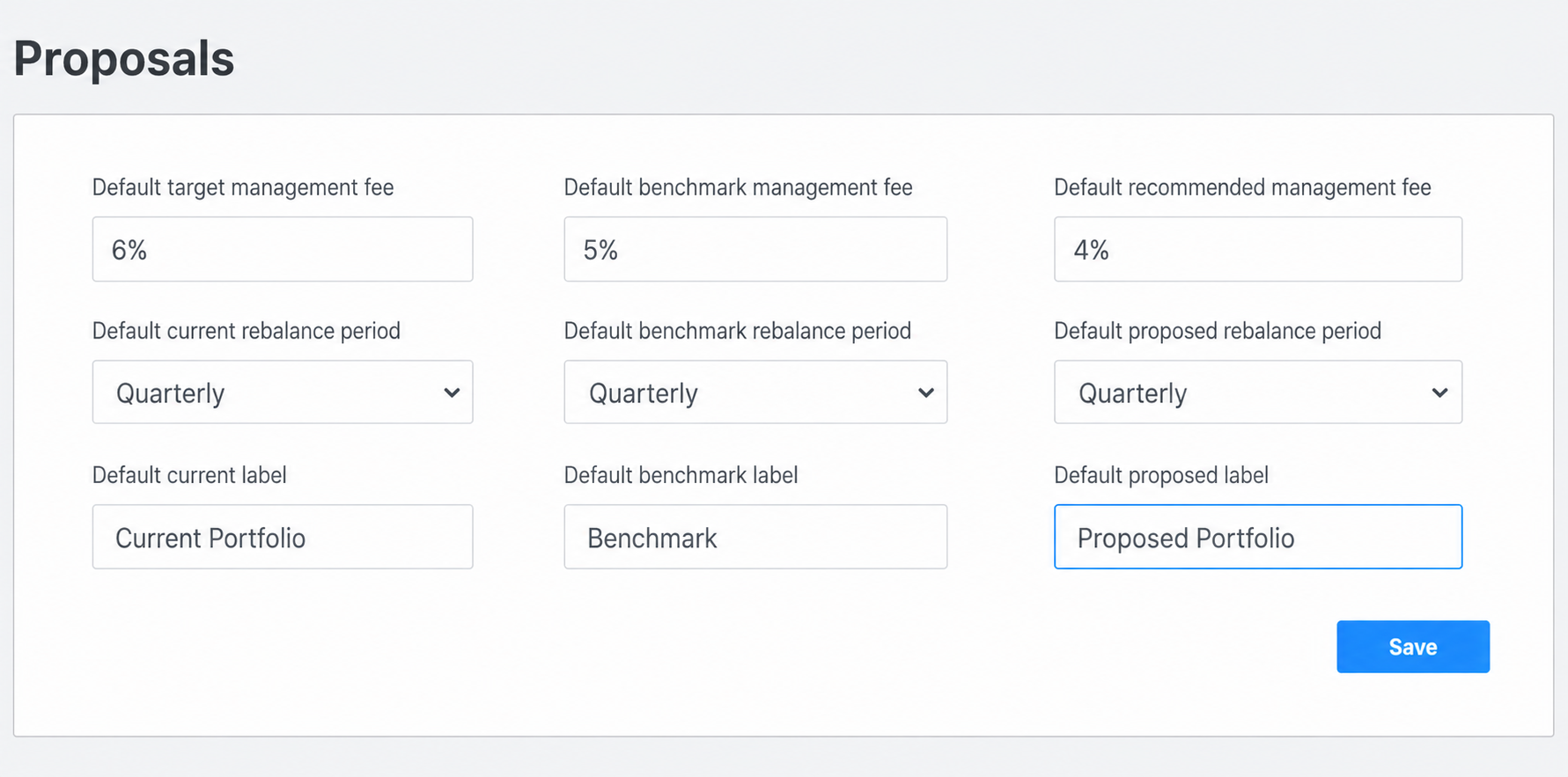
NewFirms can now control the default proposal configuration every advisor starts from when creating a client-ready proposal.
The problem
Advisors should not have to rebuild the same proposal configuration every time they prepare client-ready analysis. At firms with multiple advisors, this also creates inconsistency. The same firm produces two proposals that look meaningfully different because each advisor configured their own defaults.
What is new
Proposal Default Setup gives firms more control over the default configuration advisors start from when creating proposals.
Why it matters
Default configuration is how a firm encodes its analysis methodology, including which benchmarks to use, which time windows to evaluate, and which assumptions to apply. With approved defaults, every advisor starts from the same baseline and customizes from there. The proposal becomes faster to produce, easier to review, and the firm's analytical voice stays consistent.
Documentation and review data
ImprovedTwo workflow improvements landed this month that look incremental on their own but compound across high-volume teams.
RTQ documentation notes
Context flows where reviewers look
Notes captured in the Risk Tolerance Questionnaire workflow are now visible in the Risk Tolerance and Fact Finder forms, and reflected in the compliance notes the system records. Reviewers no longer have to triangulate context across three places.
Client Reviews CSV
Review data is now portable
Client Reviews now support CSV export and import. Operations teams can pull data into spreadsheets for ad-hoc analysis, then bring updates back in without manual re-entry.
These are the kinds of changes that show up in user behavior before they show up in dashboards. They reduce friction in the workflows compliance and operations teams already run every week.
Coming soon
On the roadmapThree capabilities are visible on the near-term roadmap. Each tightens the loop between what the system shows and what the firm can defend in a review.
| Capability | What it changes | Status |
|---|---|---|
| Multi-level Exception Monitoring | Configure surveillance thresholds across account, client, and household levels at the same time. Different risks live at different levels of aggregation, and a single threshold misses signal at the others. | Coming soon |
| Household and Investor Profile Enhancements | AdvisorIQ is getting a richer household profile with combined PRISM and tolerance scores, aggregated financials, and member-level details. The advisor sees the household the way the client experiences it. | Coming soon |
| Proposal Data Transparency | Proposal and Compare & Analyze reports will surface clearer visibility into the return data behind every chart and metric, including proxy usage, shortened analysis windows, exclusions, and live-data limitations. | Coming soon |
OperationsIQ Beta
Limited betaThis is the headline.
OperationsIQ is StratiFi's AI-assisted operational layer. It is a set of workflows designed to compress the time teams spend on suitability and operational review, without giving up the documentation standard those reviews require.
What is in the beta
Select firms have early access to AI-assisted workflows that:
- Extract suitability data from intake documents and existing files.
- Run good-order reviews on submitted business.
- Update CRM fields more efficiently across high-volume review queues.
Why it matters now
Suitability review is one of the most labor-intensive workflows in a wealth operations team. It is also one of the most consequential. The documentation produced here is what defends the firm's recommendations in an examination. Using AI to do the mechanical extraction and field-update work frees reviewers to spend their time on the parts of the review that require judgment, not the parts that require copying.
OperationsIQ is built around a simple principle: AI should compress mechanical work, not replace judgment. Reviewers stay in the loop on every decision that requires it.The StratiFi Team
How to join the OperationsIQ Beta
OperationsIQ is currently in limited beta. Firms interested in participating should reach out to their StratiFi Customer Success Manager. The process typically follows four steps:
- Confirm fit. Existing StratiFi customers running portfolio supervision or proposal workflows are prioritized for early access.
- Email your CSM. Request access and share which review queues you would like to enable first.
- Scope the workflows. Identify the suitability or good-order workflows where AI-assisted extraction and field updates would have the highest impact.
- Onboard. Your CSM schedules onboarding, configures the workflows, and reviews documentation standards before going live.
Want to see the April release in your environment?
Walk through OperationsIQ, Trading Activity Exceptions, and the Salesforce integration with our team.
Three takeaways for compliance and operations leaders
Zoom out and the through-line of the April release is consistent with the StratiFi roadmap as a whole. Compliance, supervision, and operations should be continuous, not project-based, and the work should compress as the firm grows, not expand linearly with it.
What to take away
- Surveillance should cover both tails. If your trading review only flags excessive activity, you are missing half the picture. Under-trading is just as much a supervisory signal.
- Integration is a force multiplier. A supervisory platform that does not connect to the CRM your firm runs on costs you twice, once at entry and once at reconciliation. Removing that duplicate work pays back fast.
- AI should compress mechanical work, not replace judgment. OperationsIQ targets the parts of suitability review that dominate operations time. Reviewers focus on the decisions only humans should make.
Frequently Asked Questions
What is OperationsIQ?
OperationsIQ is StratiFi's AI-assisted layer for suitability and operational review workflows. It helps wealth firms extract suitability data from intake documents, run good-order reviews, and update CRM fields more efficiently across high-volume review queues. As of April 2026, OperationsIQ is available in limited beta to select firms.
How do Trading Activity Exceptions work in StratiFi?
Compliance teams configure rules for expected trading behavior across portfolios over a defined time window. When activity falls outside those rules, either too much (potential excessive trading) or too little (portfolios that may not be actively reviewed or managed), StratiFi raises an exception for review. The exception captures the trigger, the threshold, and the reviewer action, producing a documentable audit trail.
Does StratiFi integrate with Salesforce?
Yes. The April 2026 release introduced a Salesforce integration that connects StratiFi workflows with the CRM many wealth firms already use, so client data, advisor workflows, and compliance documentation stay anchored to the same source of truth.
What are Proposal Defaults in StratiFi?
Proposal Defaults are a firm-level setup that controls the baseline configuration advisors start from when creating proposals. Instead of every advisor configuring their own settings, the firm defines an approved default and advisors customize from there. The result is faster proposal creation and more consistent analysis across the firm.
How do I join the OperationsIQ Beta?
OperationsIQ is currently in limited beta. Firms interested in participating should reach out to their StratiFi Customer Success Manager to discuss eligibility and onboarding.
When will Multi-level Exception Monitoring be available?
Multi-level Exception Monitoring, which lets firms configure surveillance thresholds at account, client, and household levels at the same time, is on the near-term roadmap as of April 2026. StratiFi will share more detail as the release approaches.
What CRM fields does OperationsIQ update?
OperationsIQ updates CRM fields tied to suitability and good-order review workflows, including data that has been extracted from intake documents, results of good-order checks, and review-status fields used by operations and compliance teams. Specific field mapping is configured during beta onboarding.
Evaluating supervisory and operations infrastructure for a growing wealth firm? StratiFi is built for the 50 to 300 advisor scaling curve, with continuous surveillance, AI-assisted suitability workflows, and documentation that is always audit-ready.
See How StratiFi Works