%2010.svg)


Table Of Contents

Compliance documentation is a top priority for RIAs and broker-dealers, particularly larger firms that operate squarely in regulators’ line of sight. Dedicated teams and formal processes are in place to ensure obligations are met.
However, the reality of compliance work is highly manual and increasingly complex. Hence, capturing evidence in real time across accounts, advisors, and portfolios remains difficult, forcing firms to rely on periodic reviews and intensive effort to stay exam-ready.
Most often, it is triggered by FINRA compliance oversight of broker-dealers or by SEC reviews of registered investment advisers.
But documentation isn’t just about paperwork. It is a permanent book of records for fiduciary judgment in compliance management.
Every recommendation, portfolio change, risk adjustment, and suitability decision carries intent, reasoning, and responsibility. Under SEC/ FINRA compliance rules governing suitability, supervision, and recordkeeping, that intent must be clearly documented. This is not just for satisfying regulators but to demonstrate that advice was prudent, consistent, and defensible at the moment it was given.
Compliance documentation is where that intent is captured, or lost.
As regulatory scrutiny increases, product complexity grows, and client relationships span generations, the quality of documentation increasingly determines whether advice is defensible, trust is scalable, and growth is sustainable.
When designed and used correctly, compliance documentation can become a source of operational clarity, advisor confidence, and competitive advantage.
This post explores how leading advisory firms are rethinking compliance documentation: moving it out of spreadsheets and shared drives, embedding it into daily advisory workflows, and transforming it from a cost center into a strategic asset.
The Traditional View: Documentation as a Cost Center
Historically, compliance documentation in RIAs and broker-dealers has been treated as a retrospective task. Documentation in compliance management is typically created at a few fixed moments:
- During onboarding
- During periodic reviews, or
- In response to an upcoming regulatory exam
Decisions, rationale, and client context often live in advisors’ heads or scattered notes rather than in a structured system of record.
Hence, documentation is maintained across disconnected formats:
- PDFs and scanned forms
- Spreadsheets and shared drives
- CRM notes and email threads
- Isolated compliance tools
The outcome of this fragmented approach is -
- Advisors document because they have to, not because it helps them advise better
- CCOs spend time chasing completeness instead of managing risk proactively
- It is typically completed after advice is given, updated during periodic reviews, or reconstructed hurriedly in response to a regulatory exam.
When documentation exists outside advisory workflows, it becomes incomplete, hard to assess, and difficult to produce when needed. More importantly, it becomes an extra task that often gets ignored, failing to document actions or the reasoning behind decisions.
In this model, compliance documentation fails to be strategic. It is viewed purely as a cost of doing business: necessary for exams but disconnected from the real work of advising clients and managing fiduciary responsibility.
Why Compliance Documentation Is Central for RIA and BD Firms
For RIAs and broker-dealers, compliance documentation is not a check-the-box obligation. It is the primary evidence of how fiduciary responsibility is exercised/enforced across the firm.
As regulatory expectations evolve, firms are increasingly judged on whether advice can be shown to be consistently suitable, well-reasoned, and aligned with a client’s best interest over time. Weak or inconsistent documentation turns even well-intentioned advice into regulatory exposure.
Several structural shifts have made documentation in compliance management central to firm resilience:
- Reg BI scrutiny is increasing, with regulators examining why recommendations were made, not just whether disclosures were delivered.
- Investment product complexity has expanded, from alternatives to structured products, making rationale and suitability harder to demonstrate.
- Households span generations, requiring documentation to track evolving goals, risk capacity, and decision context.
- Heirs expect transparency, not verbal assurances, when evaluating whether to stay with a firm.
- Talent expects modern systems, not manual documentation processes that slow them down or increase personal risk.
In such an environment, documentation determines whether advice is defensible and if trust can scale beyond individual relationships. It also assesses if growth introduces hidden risk or institutional strength.
When compliance documentation is strong, firms operate with confidence.
Compliance Documentation as a Decision Intelligence Lever
Compliance documentation becomes truly valuable when it stops recording outcomes and captures decision-making.
For RIAs and broker-dealers, defensibility does not come from the final portfolio alone. It comes from being able to show why a decision was made, what alternatives were considered, how suitability and best-interest standards were evaluated, and when client risk, goals, or behavior changed.
In a well-designed system, documentation reflects advisory judgment in real time and captures:
- The rationale behind recommendations
- The trade-offs discussed with the client
- The alignment between risk profile, portfolio construction, and stated objectives
- The evolution of suitability as markets or client circumstances change
When the documentation is structured this way, it becomes a learning loop for the firm.
Advisors gain clarity in their own thinking. Compliance teams gain visibility into patterns, not just isolated files. Leadership gains insight into how decisions are being made across the organization.
In this model, compliance documentation functions as a system of record for fiduciary intent. It strengthens decision quality, improves consistency, and makes regulatory defensibility a natural byproduct of good advice, not a manual afterthought.
Why Firms Are Unable to Unlock the Compliance Documentation Advantage
When it comes to strong documentation in compliance risk management, the challenge among RIAs and broker-dealers is structure & systems, not intent.
Compliance documentation typically lives across fragmented systems: CRMs, portfolio tools, compliance platforms, PDFs, shared drives, and email threads.
Each system captures a piece of the story, not the full decision-making context. Hence, documentation exists after decisions, not with them.
Advisors are expected to document while managing client relationships, market volatility, and growing administrative demands. For this, they tend to rely on memory, causing them to reconstruct rationale, re-explain trade-offs, and justify decisions after the fact.
Monitoring compounds this problem. Manual review processes operate periodically, that is, monthly, quarterly, or annually. Real-time supervision across hundreds of accounts is too resource-intensive. As a result, gaps persist between what happens in practice and what is formally documented.
This results in:
- Documentation not based on reality
- Compliance being reactive
- Advisors seeing documentation as friction
In such an environment, compliance documentation cannot function as a strategic asset. Rather than strengthening the advisory judgment and oversight, documentation becomes an exercise useful during exams.
Thus, we are looking at a limitation of the operating model.
What Strategic Compliance Documentation Looks Like
Strategic compliance documentation is not something created after advice is delivered. It is generated as advice happens.
At the advisor level, strategic documentation ensures that:
- Suitability, risk context, and recommendation rationale are automatically connected
- Investment Policy Statements, investment proposals, and portfolios remain aligned over time
- Changes in client behavior, goals, or market conditions are captured continuously
- Advisors explain decisions with confidence, not reconstructed memory
Thus, documentation evolves as a support system, not a burden.
For RIAs and broker-dealers, this means:
- Documentation is embedded directly into advisory workflows
- It is linked to risk discussions, portfolio decisions, suitability assessments, and real-time client interactions.
At the firm level, the impact is even more significant:
- Every client account tells a coherent, defensible story
- Regulatory compliance oversight reflects what is actually happening across the firm, not sampled snapshots
- Exams shift from frantic document extraction and collection to simple evidence retrieval
- Leadership gains visibility into patterns, trends, and emerging risk, not just files and folders
Strategic documentation turns compliance into a living record of fiduciary intent. It reflects how decisions were made, why they were appropriate at the time, and how ongoing oversight is maintained.
When documentation in compliance risk management is treated this way, it no longer exists to “prove compliance later.”
It actively strengthens quality, trust, and scalability each day.
The Human + AI Shift: When Compliance Documentation Becomes a Strategic Advantage
For decades, compliance documentation forced RIAs and broker-dealers into a false tradeoff: prioritize rigorous oversight or preserve human-led advisory relationships.
This tradeoff no longer holds.
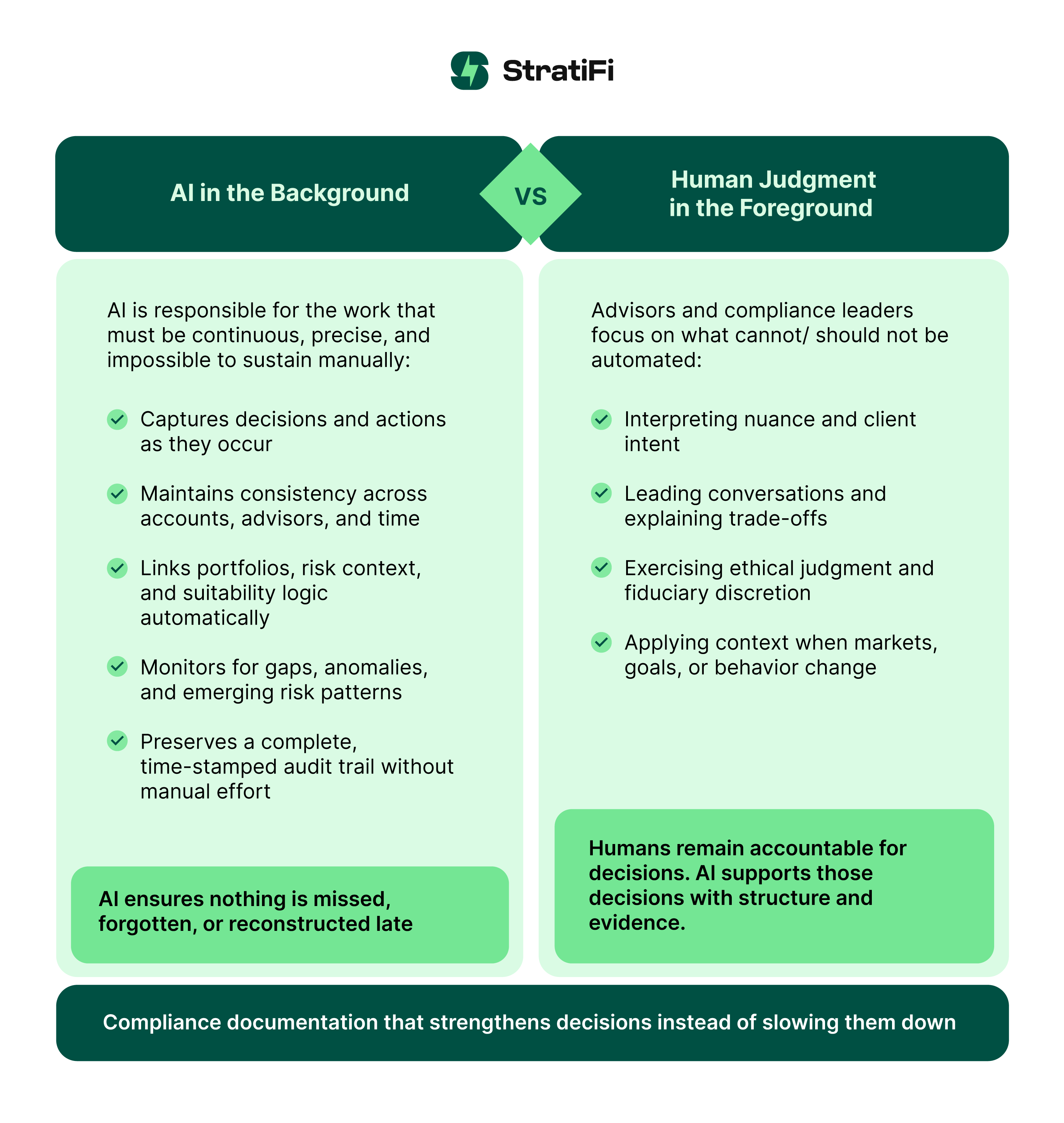
The Human + AI shift is not about replacing human judgment with compliance automation. It’s about redefining who does what, so documentation strengthens decisions instead of slowing them down.
The Human + AI Operating Model
As shown in the graphic below, in this model, you move from “prove it later” to “record as it happens.”
Compliance documentation isn’t assembled after the fact to defend decisions retroactively. It becomes a living system that documents the rationale behind decisions as they happen.
What Does This Shift Unlock?
When compliance documentation moves from a reactive obligation to a real-time operating asset, its impact can be felt across the entire firm. The benefits compound at every level, be it strategic, operational, or client-facing roles.
Simply put, here’s what the human + AI shift encompasses. We have explained each in detail later.
- Firms scale without losing control or trust
- Regulatory compliance leaders operate proactively, not reactively
- Advisors act with more confidence without extra work
For the Firm
Growth becomes safer and more predictable. Leadership reduces key-person risk, gains institutional memory that compounds over time, and scales without losing control or consistency.
For the Compliance Leader
Oversight becomes proactive instead of reactive. Fewer surprises, clearer visibility across accounts and advisors, and defensibility built directly into everyday workflows, not assembled under exam pressure.
For Advisors
Greater confidence in recommendations, less second-guessing, and clearer, faster client conversations. Documentation in compliance management supports advice as it happens, instead of slowing it down afterward.
When compliance documentation works this way, firms operate with clarity, confidence, and conviction, turning regulatory compliance into a durable competitive advantage.
For RIAs and broker-dealers, compliance documentation reflects how clearly a firm thinks, how confidently it makes decisions, and how safely it scales. Firms that document after the fact stay reactive, scrambling before exams and second-guessing judgment. Firms that embed documentation into how advice is delivered operate with far more control.
This is the shift: from proving compliance later to supporting decisions as they happen.
If your firm is re-examining how documentation fits into daily workflows, oversight, and growth, the next step is gaining clarity on where documentation is created today. Schedule a demo with StratiFi to determine whether your documentation truly supports the way your firm advises, supervises, and scales
FAQs
Why is Compliance Documentation So Important for RIAs and Broker-dealers Today?
Documentation shows how advice decisions were made, not just that they were made. With rising Reg BI scrutiny, firms must demonstrate ongoing suitability, rationale, and oversight, not just completed forms.
How is Strategic Compliance Documentation Different from Traditional Recordkeeping?
Traditional documentation is retrospective and manual. Strategic documentation in compliance risk management is created as advice happens, stays aligned with portfolios and risk, and provides continuous evidence of fiduciary judgment.
Does Better Documentation Really Reduce Compliance Risk?
Yes. When documentation is consistent, timely, and connected to decisions, firms reduce gaps, avoid reconstruction under pressure, and surface issues earlier, before they become exam findings.
Will Stronger Compliance Documentation Slow Advisors Down?
Only when it’s manual. When documentation in compliance management is embedded into advisory workflows, advisors spend less time explaining or justifying decisions and more time advising with confidence.
How does Compliance Documentation Support Firm Growth?
It creates institutional memory, reduces key-person risk, improves exam readiness, and allows firms to scale advisors and clients without losing visibility or control.
How does Strong Compliance Documentation Support FINRA and SEC Compliance for RIAs and Broker-dealers?
FINRA and SEC exams evaluate whether recommendations were suitable at the time they were made, aligned with fiduciary and Reg BI standards, and supported by reasonable supervision. Regulators look for clear evidence that advice was based on client objectives, risk tolerance, and product characteristics, not reconstructed after the fact.
Strong compliance documentation creates a time-stamped, contemporaneous record of recommendation rationale, suitability analysis, fiduciary considerations, and supervisory review.
This reduces reliance on post-hoc explanations, supports Reg BI and fiduciary obligations, and enables firms to demonstrate consistent, repeatable compliance across advisors, products, and client segments during both FINRA and SEC examinations.