


Table Of Contents
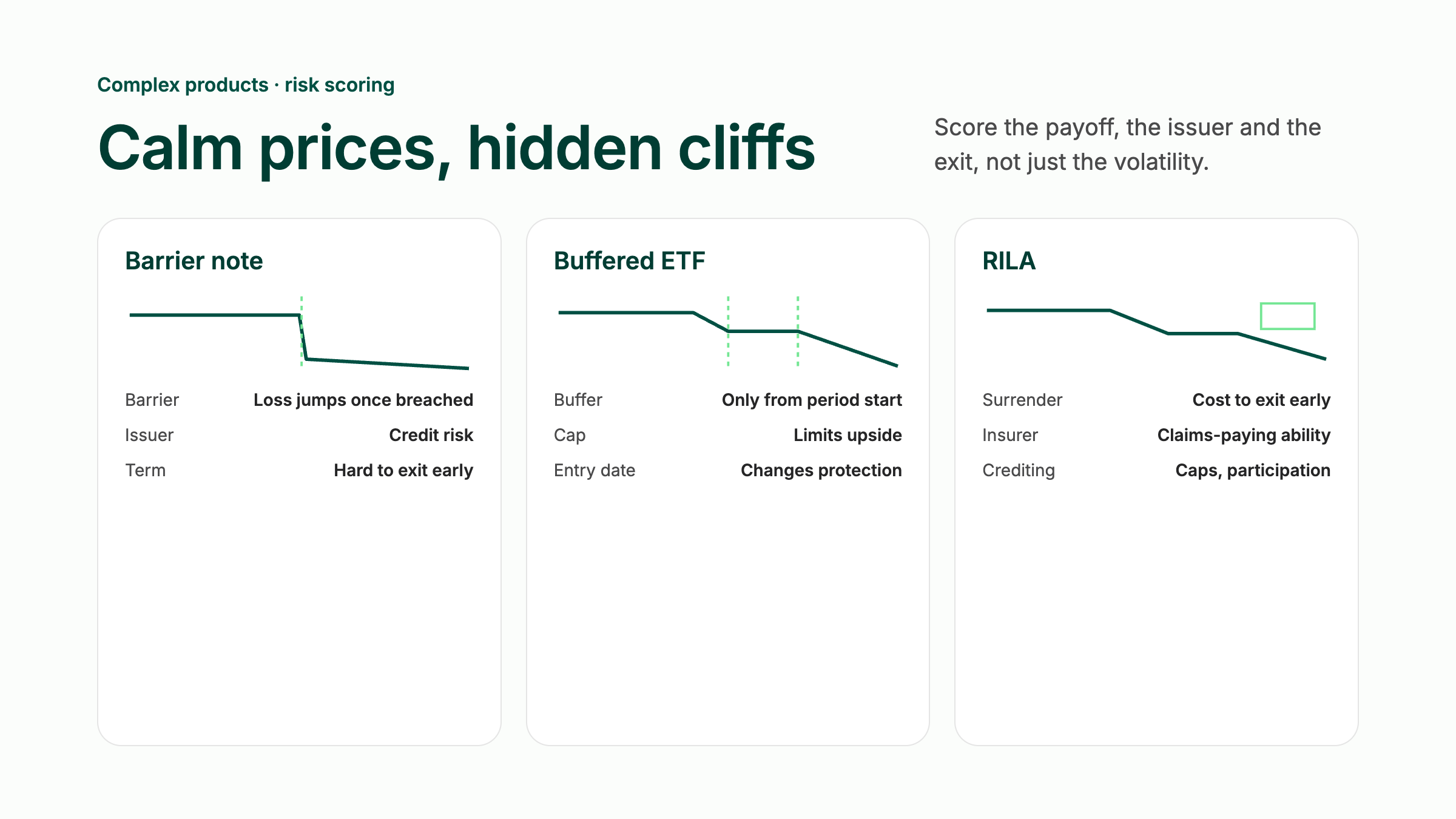
Short answer: Structured notes, buffered ETFs and RILAs have payoffs shaped by caps, buffers and barriers, so their price history can look calmer than the risk they carry. Score them on what drives the payoff: the underlying exposure, the protection terms, issuer or insurer credit, liquidity and how losses behave in a stress scenario. Then document how the result fits the client's capacity and tolerance, because the SEC's FY2027 priorities name these products for review.
Why are complex products in the SEC's spotlight?
Because they are growing quickly and they are hard to explain. The SEC's FY2027 examination priorities list variable and RILA annuities, structured products and complex options among the products examiners will focus on in recommendation reviews (SEC FY2027 priorities). Demand keeps rising: RILA sales reached $44.4 billion in the first half of 2026, 21% ahead of the same period in 2025 (InvestmentNews on LIMRA data).
FINRA has long reminded firms that complex products and options require heightened care in how they are recommended and supervised (FINRA Regulatory Notice 22-08).
Why do simple risk scores get these products wrong?
Most simple scores rely on historical volatility. That works for a diversified stock fund and fails for a payoff with a shape.
- Nonlinear losses. A barrier note can show little movement until the underlying crosses the barrier, then lose much of its value at once. Volatility does not see the cliff.
- Credit hiding in plain sight. A structured note is a debt obligation of its issuer. If the issuer weakens, the protection weakens too, even if the index is fine.
- Entry-date dependence. A buffered ETF's buffer applies over a defined outcome period. An investor who buys mid-period may have far less protection than the headline suggests.
- Liquidity and term. Notes may be hard to sell before maturity and RILAs often carry surrender charges. A client who needs the money early faces a different risk than one who holds to term.
- Misclassification. Firms frequently find complex holdings labeled as simple fixed income in custodial data, which hides them from equity risk checks entirely.
| Product | What actually drives the risk | What a volatility-only score misses | What to document |
|---|---|---|---|
| Structured note with a barrier | Underlying index, barrier level, issuer credit, term | The drop once the barrier is breached; issuer credit | Barrier, issuer, maturity, stress loss, liquidity plan |
| Buffered or defined-outcome ETF | Underlying index, buffer size, cap, outcome period dates | Remaining buffer when bought mid-period | Entry date, remaining buffer and cap, reset date |
| RILA | Index, buffer or floor, cap or participation rate, surrender schedule, insurer strength | Surrender costs and insurer credit | Crediting terms, surrender period, why the client can hold to term |
| Listed options strategies | Underlying, leverage, strike and expiry | Leverage and path risk | Strategy approval level, maximum loss, monitoring cadence |
How should you score a complex product?
Use a holdings-based method that models the payoff, not just the price.
- Identify the instrument correctly. Confirm the product type, underlying, protection terms and dates from the offering documents, not only from a custodial label.
- Model the payoff under scenarios. Run the underlying through mild, severe and extreme declines and record the loss at each level, including what happens past a barrier.
- Add issuer or insurer risk. Treat the protection as only as strong as the entity standing behind it.
- Account for liquidity. Factor in surrender charges, secondary market depth and the client's time horizon.
- Score at the portfolio level. A note's risk depends on what else the client owns, so aggregate it with the rest of the household.
- Compare to capacity and tolerance separately. A client may be willing to accept a barrier loss but not able to afford it.
Do your risk scores see the barrier? See how a holdings-based score handles complex products on a real portfolio. Book a StratiFi demo.
What should the client file show?
An examiner reviewing a complex product recommendation will look for evidence that the advisor understood the product and that it fit this client. A strong file includes the product's key terms, the stress-tested loss in plain numbers, why the client's capacity and tolerance support it, the alternatives considered and a plan for monitoring it after purchase, including reset dates and maturity.
Key takeaways
- Caps, buffers and barriers make complex products look calmer than they are.
- Issuer and insurer credit, liquidity and entry date are part of the risk.
- Score the payoff under stress scenarios, not just historical volatility.
- Measure capacity and tolerance separately and document both.
- The SEC names structured products and RILAs as FY2027 review priorities.
How StratiFi helps
RiskIQ's PRISM scoring is calculated from the client's actual positions and is built to cover alternatives, options and structured products, with stress testing and separate assessments of risk capacity and risk tolerance. Because the same score feeds AdvisorIQ proposals and ComplianceIQ monitoring, the risk you documented at recommendation is the risk you supervise afterwards.
See how your complex holdings score. Book a StratiFi demo.
Frequently Asked Questions
Why do structured notes look low-risk in some risk tools?
Their prices can move very little until the underlying crosses a barrier, so volatility-based scores understate the potential loss and ignore issuer credit.
Does a buffered ETF always protect against the stated loss?
Only over its defined outcome period and only from the period's starting value. Buying mid-period can leave much less buffer.
What risks do RILAs carry beyond market risk?
Caps or participation limits on upside, surrender charges if money is withdrawn early, and reliance on the insurer's ability to pay.
What should an advisor document when recommending a complex product?
The key terms, a stress-tested loss, why it fits the client's capacity and tolerance, alternatives considered and a monitoring plan.
Are complex products an SEC exam priority in 2027?
Yes. The FY2027 priorities name structured products, RILA annuities and complex options in recommendation reviews.
Sources
- SEC FY2027 examination priorities (PDF)
- InvestmentNews on LIMRA first-half 2026 annuity data
- FINRA Regulatory Notice 22-08, Complex Products and Options
About the author: Akhil Lodha is the CEO of StratiFi, the risk and compliance intelligence platform whose PRISM methodology scores client portfolios, including complex and alternative products.