%2010.svg)


Table Of Contents
%20software.png)
SEC examiners have a predictable first request when they arrive at an RIA: produce the Investment Policy Statement (IPS) for a sample of client accounts. Not because the IPS is a formality to check off, but because it is the document that reveals whether the firm’s investment decisions align with its documented client mandates.
When they do not align, the examiner has the evidence. When the IPS is missing, outdated, or was created once and never reviewed again, the compliance gap is immediate and visible.
For RIA principals and compliance officers managing growing client books, the investment policy statement software question is no longer an operational one. It is a regulatory defensibility decision.
Why the IPS Is a Supervision Document, Not Just a Planning Document
The IPS has always served a planning function. What has changed is the regulatory weight it carries. The SEC’s FY2026 Examination Priorities, released November 17, 2025, explicitly prioritize fiduciary standards of conduct, suitability of recommendations, and consistency of investment advice with client disclosures. Each of those priorities connects directly to the IPS.
The IPS is where a firm documents what it committed to do for a client: the asset allocation targets, the risk tolerance parameters, the rebalancing policy, and the governance framework. If the portfolio drifts outside those parameters and no documented supervisory review exists, the gap is not an oversight. It is a fiduciary failure with a paper trail.
This is the operational reframe that makes investment policy statement software a compliance tool, not just a time-saving tool. Software that generates an IPS and then treats it as a static file misses the point. The IPS needs to be a living document connected to ongoing portfolio supervision.
What Is an Investment Policy Statement?
An investment policy statement (IPS) is a strategic governance document that defines a client’s investment objectives, risk tolerance parameters, asset allocation targets, and the policies that govern how the portfolio is managed, monitored, and adjusted over time. It serves as the authoritative reference point for every advisory decision made on the client’s behalf.
Under Rule 206(4)-7 of the Investment Advisers Act of 1940, registered investment advisers are required to maintain written policies and procedures reasonably designed to prevent violations of the Advisers Act. The IPS is not separate from that requirement. It is a core component of the written policies that the supervision rule requires firms to maintain, enforce, and demonstrate when examiners arrive. An IPS that exists but is not supervised against is a compliance liability, not a compliance asset.
What a Defensible IPS Must Document in 2026
An investment policy statement template or generator that produces a document and stops there is not enough in the current exam environment. The IPS must document four specific elements in a way that holds up when an examiner asks for it.
Establish Performance Measurement and Reporting Accountability
The IPS should define who calculates performance for each account, who analysis is reported, and which standards apply. This is not an internal governance preference. Undocumented performance accountability is a supervision gap.
If an examiner asks who reviewed account performance against the client’s stated objectives, and the answer is unclear from the IPS, the firm has a documentation problem regardless of whether any violation occurred.
Establish Consistent metrics for Assessing and Measuring Risk
Risk metrics must be applied consistently across time. The IPS should define which risk measurement framework the firm uses for this client and commit to it. Applying different metrics across review periods, whether to emphasize favorable outcomes or because the methodology was not documented, is an examiner’s finding. Inconsistency in risk measurement is not a best practice gap. It is a supervisory procedure failure.
Define the Procedure for Bringing Portfolios Back to Target Allocations
The IPS must define any deviation thresholds that trigger a rebalancing review, the mechanism for executing that rebalancing, and what happens when the policy is not to rebalance. An undocumented rebalancing threshold is an IPS drift liability under the 2026 fiduciary and suitability scrutiny. If the portfolio drifts and no documented decision exists about whether that drift was reviewed or intentional, the supervision gap is evident on the face of the account record.
IPS Drift Monitoring and Exception Documentation
The 2026 SEC Examination Priorities call out the suitability of recommendations and ongoing supervision consistency as specific examination focus areas. A static IPS, reviewed once at account opening and never again, does not satisfy that standard.
The IPS must be connected to a process that monitors portfolio positioning against its documented parameters and captures exceptions with a rationale. When a portfolio drifts outside its IPS allocation, and no documented review exists, that is not an administrative gap. It is an exhibit in an examination.
The Importance of an Investment Policy Statement
A well-designed IPS establishes asset allocation targets for key asset classes such as equities and bonds, as well as sub-asset classes, alongside the client’s goals, risk tolerance, time horizon, and investment preferences. It should also define the minimum and maximum deviation thresholds that trigger a portfolio rebalancing review.
First, the investment policy statement gives every investment decision a documented purpose. When an advisor and client have agreed in writing on why the portfolio is structured the way it is, it becomes significantly easier to defend that structure during a review, a market downturn, or a client conversation. The portfolio decisions are traceable back to documented intent.
It also provides a framework for asset allocation across time horizons. Growth-oriented assets such as equities can be mapped to long-term spending needs of 10 or more years, while more conservative holdings such as cash and bonds support near-term spending needs of one to ten years. When short-term spending requirements are visible in the IPS, it becomes easier to identify when the allocation mix needs adjustment.
During periods of market volatility, the IPS serves as an anchor. When equity markets decline, an advisor with a well-documented IPS can demonstrate to the client that the short-term allocation was already positioned to weather the drawdown. That conversation is easier when the rationale is written down and agreed to in advance.
Finally, a defined IPS reduces reactive decision-making. When the types of investments the client will hold, the framework for selecting them, and the monitoring process are documented upfront, there is less room for impulsive allocation changes driven by market noise or short-term performance pressure.
Where IPS Workflows Break Down at Scale
Three operational failure points consistently surface when RIAs scale their client books without upgrading their IPS process.
- Manual data gathering across custodians and advisors. Drafting an investment policy statement manually requires pulling risk tolerance scores, account holdings, and client profile data from multiple sources.
At 50 clients, this is manageable. At 500, or across a firm with multiple advisors and custodians, it becomes a bottleneck that creates version inconsistencies and documentation delays. Every hour spent gathering data to build an IPS is an hour the IPS is not in place.
- Version control failures when IPS documents live in email and shared drives. Most firms using manual processes have IPS documents spread across email threads, shared folders, and local drives. When a client’s risk profile changes or a model is updated, the probability that every advisor’s IPS for that client reflects the current version is low.
An outdated IPS used as the reference document during an examination does not demonstrate good faith. It demonstrates a supervision gap.
- The compliance gap that opens when IPS documents are created once and never supervised against. The most common IPS failure in RIA examinations is not the absence of an IPS. It is the presence of an IPS that no one has reviewed since it was created.
A document that was accurate at account opening and has not been updated as the client’s circumstances, risk tolerance, or portfolio positioning changed is not a compliance asset. It is a liability that shows the examiner exactly where supervision stopped.
What to Look for in Investment Policy Statement Software
Here are five criteria an RIA principal should apply when evaluating any investment policy statement software:
- Does it generate the IPS from live portfolio and risk data, or require manual input? Software that requires manual data entry replicates the bottleneck it is supposed to eliminate. The IPS should be generated from the client’s existing risk tolerance score and portfolio data.
- Does it produce an e-signable document or create a PDF that goes back into email? A PDF attached to an email is another version control problem waiting to happen. The IPS workflow should conclude with a documented, e-signed commitment from the client without leaving the platform.
- Is the IPS connected to ongoing supervision, or a one-time output that sits in a folder? An investment policy statement generator that produces a document and disconnects from the portfolio is a compliance tool in name only. The IPS should feed into a supervision system that monitors for drift.
- Can it document IPS exceptions and rebalancing decisions for audit purposes? When the portfolio moves outside IPS parameters, the supervisory decision about what to do next must be captured. Software that does not provide exception documentation leaves the compliance record incomplete.
- Does it integrate with your existing custodian and CRM setup? The IPS should be built from the data you already have, not require a parallel data entry workflow.
How StratiFi Turns an IPS Into a Live Compliance Instrument
StratiFi’s module takes the IPS from a one-time document to a continuous compliance instrument. The workflow begins with the client’s existing risk tolerance score, which StratiFi captures through a questionnaire sent directly from the platform or entered manually.
From that score, a complete multi-page investment policy statement is generated automatically, covering risk tolerance parameters, preferred asset classes, model portfolio alignment, governance terms, and signature lines.
StratiFi helps you create an investment policy statement IPS in three simple steps.
1. From the Client Detail Page, Hit Generate IPS
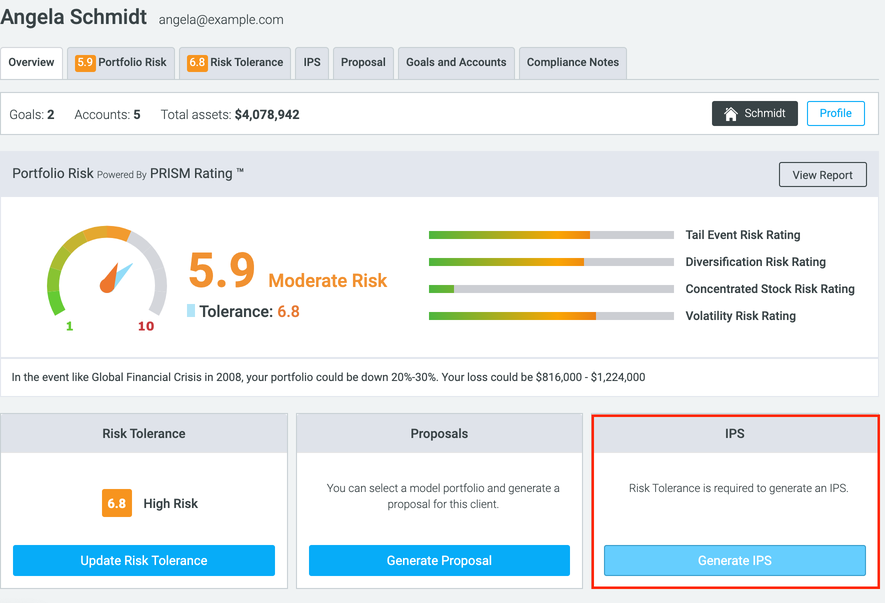
Note: The client/account must have a Risk Tolerance score for an IPS to be created. If there is no score, the Generate IPS button will not be enabled. You can hit the Update Risk Tolerance button to send the client a Risk Tolerance questionnaire or to input the score manually if you have an idea of what it is based on investment objectives.
2. Select the Accounts and Model to Include
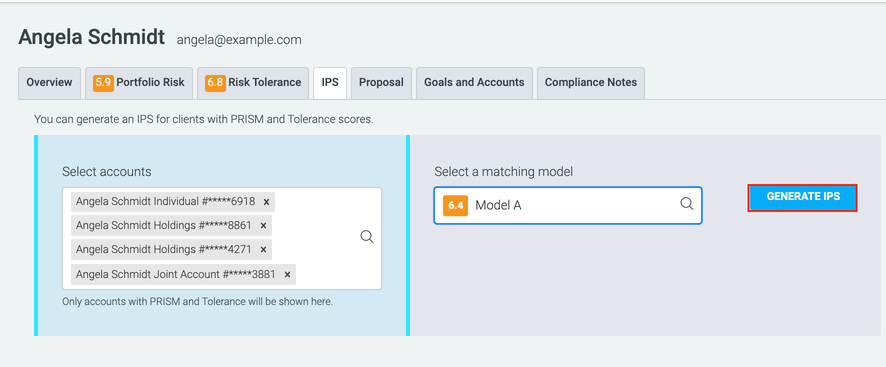
3. Hit Generate IPS
The document is built automatically from live portfolio and risk data.
E-signature without leaving the platform. Once the IPS is generated, StratiFi’s workflows convert the document into an e-signable IPS that the client signs directly within the platform. No PDF attachment. No email thread. No version control gap. The signed document is time-stamped and stored.
Connection to ongoing supervision. The IPS generated in StratiFi feeds directly into ComplianceIQ, which monitors the portfolio against its documented parameters on a continuous basis.
When the portfolio drifts outside IPS-defined allocation ranges or suitability parameters, ComplianceIQ flags the exception with a timestamped record. The compliance evidence exists before an examiner asks for it, not after.
For RIAs managing the investment policy statement workflow at scale across multiple advisors and custodians, StratiFi integrates with Schwab Advisor Services, Altruist, and other custodians, pulling live account data into the IPS generation workflow without manual data entry.
Summing Up
The investment policy statement is the written record of your fiduciary commitment to each client, and the document an SEC examiner will use to evaluate whether your advisory decisions held up to that commitment.
Software that generates an IPS and files it isn’t enough. The IPS needs to be generated from live data, signed without friction, and connected to a supervision system that monitors against it continuously. That is what turns an investment policy statement from a compliance checkbox into a compliance instrument.
If you want to know more about how StratiFi can help your firm build a defensible IPS workflow, book a demo today.
Frequently Asked Questions
What is Investment Policy Statement Software?
Investment policy statement software automates the creation, storage, and supervision of IPS documents for registered investment advisers. It generates client-specific IPS documents from live portfolio and risk data, replacing manual drafting with a structured, audit-ready workflow.
Is an IPS Required for RIAs under SEC Regulations?
The SEC does not mandate a standalone IPS document by name, but Rule 206(4)-7 requires written policies and procedures governing portfolio management and client suitability. In practice, the IPS is the primary document that satisfies and demonstrates that obligation during examinations.
What should an RIA’s IPS Include to Satisfy Rule 206(4)-7?
A defensible IPS should document the client’s risk tolerance, asset allocation targets, performance measurement standards, rebalancing thresholds, and the governance framework for ongoing review. It must also connect to a supervisory process that monitors portfolio positioning against those documented parameters continuously.
How is an IPS Different from a Financial Plan?
A financial plan covers a client’s broad financial goals, including retirement, tax, and estate planning. An IPS is narrower and more specific: it governs how the investment portfolio is managed, monitored, and adjusted, and serves as the compliance record behind every portfolio decision.
Can Investment Policy Statement Software Generate E-signed Documents?
Yes. Modern IPS platforms, including StratiFi, convert generated IPS documents into e-signable agreements that clients sign directly within the platform. This eliminates PDF attachments, email threads, and version control gaps, and produces a timestamped, stored record of client acknowledgment.
How does IPS Software Connect to Portfolio Supervision and Compliance Monitoring?
IPS software that integrates with a compliance module monitors the portfolio against its documented parameters on an ongoing basis. When the portfolio drifts outside IPS-defined allocation ranges, the system flags the exception with a timestamped record, creating continuous exam-ready documentation.
How Often should an RIA Update a Client’s IPS?
The IPS should be reviewed whenever a client’s financial situation, risk tolerance, or investment objectives change, and at a minimum annually as part of the firm’s Rule 206(4)-7 compliance review. Any material change to the portfolio strategy should also trigger an IPS update and re-documentation.
What Happens During an SEC Exam If Your IPS Documentation is Incomplete?
Incomplete IPS documentation is a direct examination finding under Rule 206(4)-7. If the examiner finds portfolio decisions that diverge from the client’s documented objectives with no supervisory record explaining why, the firm faces deficiency citations and potential enforcement referral for failure to supervise.