


Table Of Contents
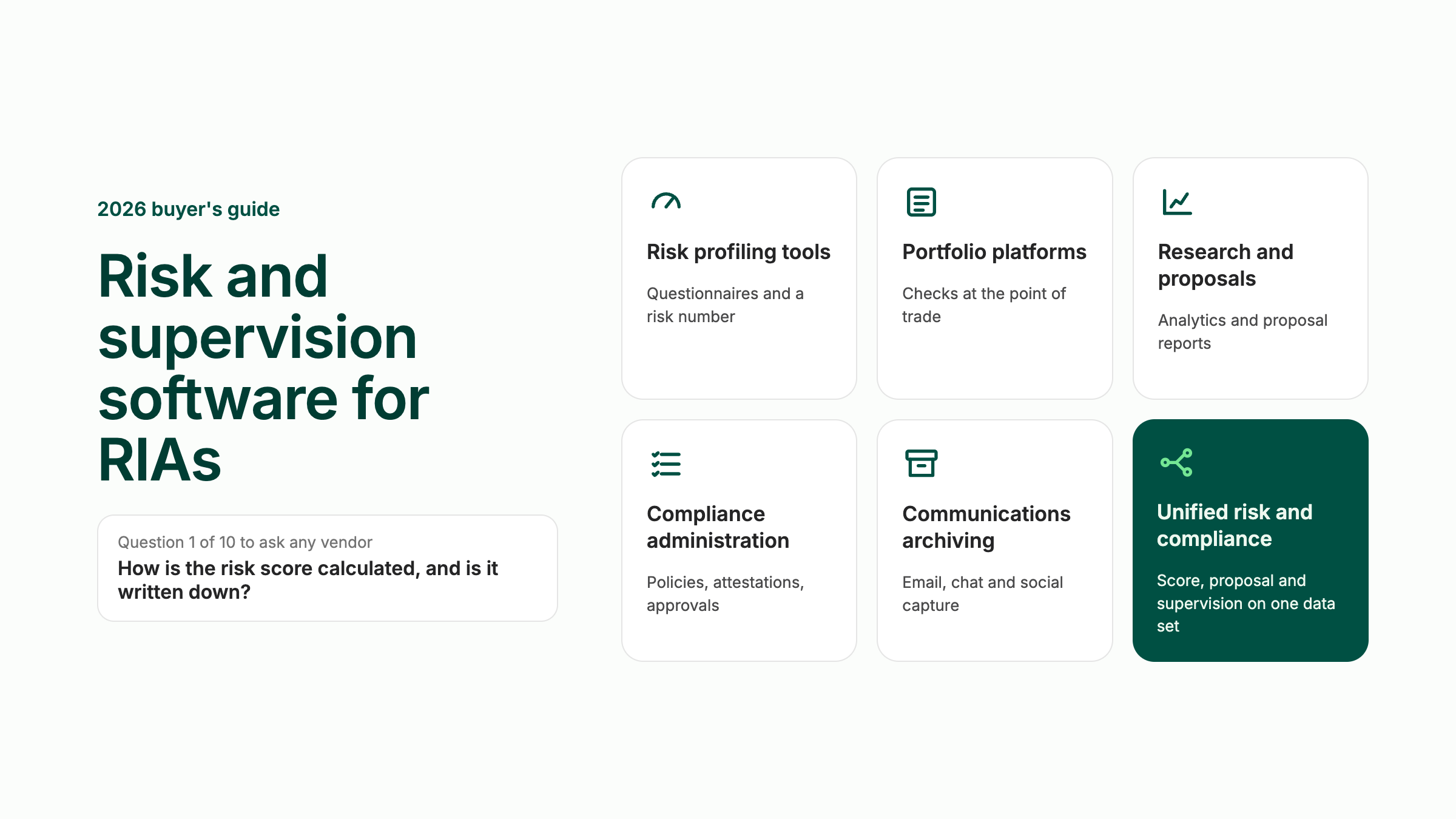
Short answer: RIA risk and compliance software falls into six categories: risk profiling tools, portfolio platforms with built-in risk checks, research and proposal tools, compliance program administration, communications archiving and unified risk and compliance platforms. Most firms use several. The right choice depends on one question: do you need to supervise portfolios continuously against each client's documented profile, or only to administer the compliance program around them?
Disclosure: this guide is written by StratiFi, which sells a unified risk and compliance platform. We have tried to describe every category fairly, including when ours is not the right fit.
What are the main categories of RIA risk and compliance software?
| Category | What it does well | Examples | What to check if you need supervision |
|---|---|---|---|
| Risk profiling tools | Client risk questionnaires and a risk number for conversations | Nitrogen (formerly Riskalyze) | Whether complex products are scored on their payoff and whether the portfolio is monitored after the sale |
| Portfolio platforms with built-in risk checks | Accounting, reporting, trading, plus risk checks at the point of trade | Orion, GeoWealth | What happens after the trade, and whether assets held elsewhere are covered |
| Research and proposal tools | Analytics, model comparison and proposal reports | YCharts, Kwanti | Whether anything monitors and documents the portfolio after the proposal |
| Compliance program administration | Policies, attestations, marketing review, approvals, filings | COMPLY, MyComplianceOffice, Smartria, Hadrius | Whether client portfolios are monitored, not only the program documented |
| Communications archiving | Capturing and supervising emails, chats and social | Smarsh, Global Relay | Not designed for portfolio risk; usually kept alongside other tools |
| Unified risk and compliance platforms | Risk scoring, proposals, suitability data and portfolio supervision on one data set | StratiFi | Integration with your portfolio accounting, CRM and custodians |
Why are risk checks being bundled into other platforms?
Because risk profiling has become a feature many platforms want to own. Research and proposal tools have added customizable risk profiles to proposal workflows (YCharts, April 2025), and portfolio platforms have added real-time checks at the point of trade (GeoWealth June 2026 release notes).
A bundled check can be genuinely useful. Before relying on it as your supervision program, confirm how the number is produced, whether it watches the account after the trade, and whether it sees the client's assets held elsewhere. The SEC's FY2027 priorities say examiners will test whether algorithm output is consistent with investor profiles (SEC FY2027 priorities), so the methodology question matters more than the price.
What questions should you ask any vendor?
- How is the client risk score calculated, and is the methodology documented in writing?
- Does the same input always produce the same score?
- How are structured products, alternatives, options and annuities scored?
- Are risk capacity and risk tolerance assessed separately?
- After a trade, what monitors drift from the client's IPS, and how often?
- Does monitoring cover assets at every custodian, or only one platform?
- What does the alert queue look like for the CCO: ownership, ageing, resolution notes?
- Can you export a client's full supervision history for an examiner in one step?
- Where does suitability data come from, and is it re-keyed anywhere?
- What do we keep, and what do we replace, if we adopt your product?
How do you run a fair evaluation in 30 days?
- Pick ten real households, including at least two with complex products and one acquired or inherited book.
- Run them through each finalist and compare risk scores, alerts and the evidence produced.
- Ask each vendor to produce an exam-ready file for one household and time how long it takes.
- Test the integrations with your portfolio accounting, CRM and custodians on live data.
- Decide on the record of truth. Pick the system whose supervision record you would hand an examiner.
Want StratiFi in your side-by-side? We will run your sample households through the platform. Book a StratiFi demo.
When is a unified platform the right fit, and when is it not?
A unified platform fits firms that want one data lineage from scanned statement to ongoing supervision, especially multi-advisor firms, hybrids and acquirers. It is not necessary if you only need policy administration or communications archiving; a specialist tool may be enough. Unified platforms also do not replace everything: StratiFi, for example, integrates with portfolio accounting systems such as Orion, Black Diamond and Addepar and with common CRMs rather than replacing them, and archiving remains a separate category.
Key takeaways
- Most RIAs use tools from several categories; the question is which one holds the supervision record.
- Bundled risk checks are spreading; check what happens after the trade.
- Ask every vendor how the score is produced and whether it is reproducible.
- Evaluate on real households, including complex products and acquired books.
- Choose the system whose evidence you would hand an examiner.
See where StratiFi fits
StratiFi combines AdvisorIQ, RiskIQ, OperationsIQ and ComplianceIQ on one data lineage: the score used in the proposal is the score supervised afterwards, with every alert timestamped and attributed. Book a StratiFi demo and bring your toughest households.
Frequently Asked Questions
What software do RIAs use for portfolio risk and compliance?
Usually a mix: a risk profiling or proposal tool, a portfolio accounting platform, a compliance program tool and an archiving tool. Some firms consolidate risk and supervision onto one platform.
What is the difference between compliance administration and portfolio supervision?
Compliance administration manages policies, attestations and reviews. Portfolio supervision monitors whether client portfolios stay consistent with their documented profiles and IPS.
Is a risk check built into my portfolio platform enough?
It can be a useful control at the point of trade. Check whether it monitors accounts afterwards, covers assets at other custodians and has a documented methodology.
What should I ask a risk software vendor?
How the score is calculated, whether it is reproducible, how complex products are scored, how drift is monitored and how evidence is exported for an exam.
How long should an evaluation take?
About 30 days if you test ten real households, including complex products, on each finalist.
Sources
- YCharts Risk Profiles announcement, Business Wire, April 2025
- GeoWealth June 2026 release notes
- SEC FY2027 examination priorities (PDF)
About the author: Bruno Gianello is a Product Manager at StratiFi, working on how risk scoring, proposals and supervision connect across the platform.