


Table Of Contents
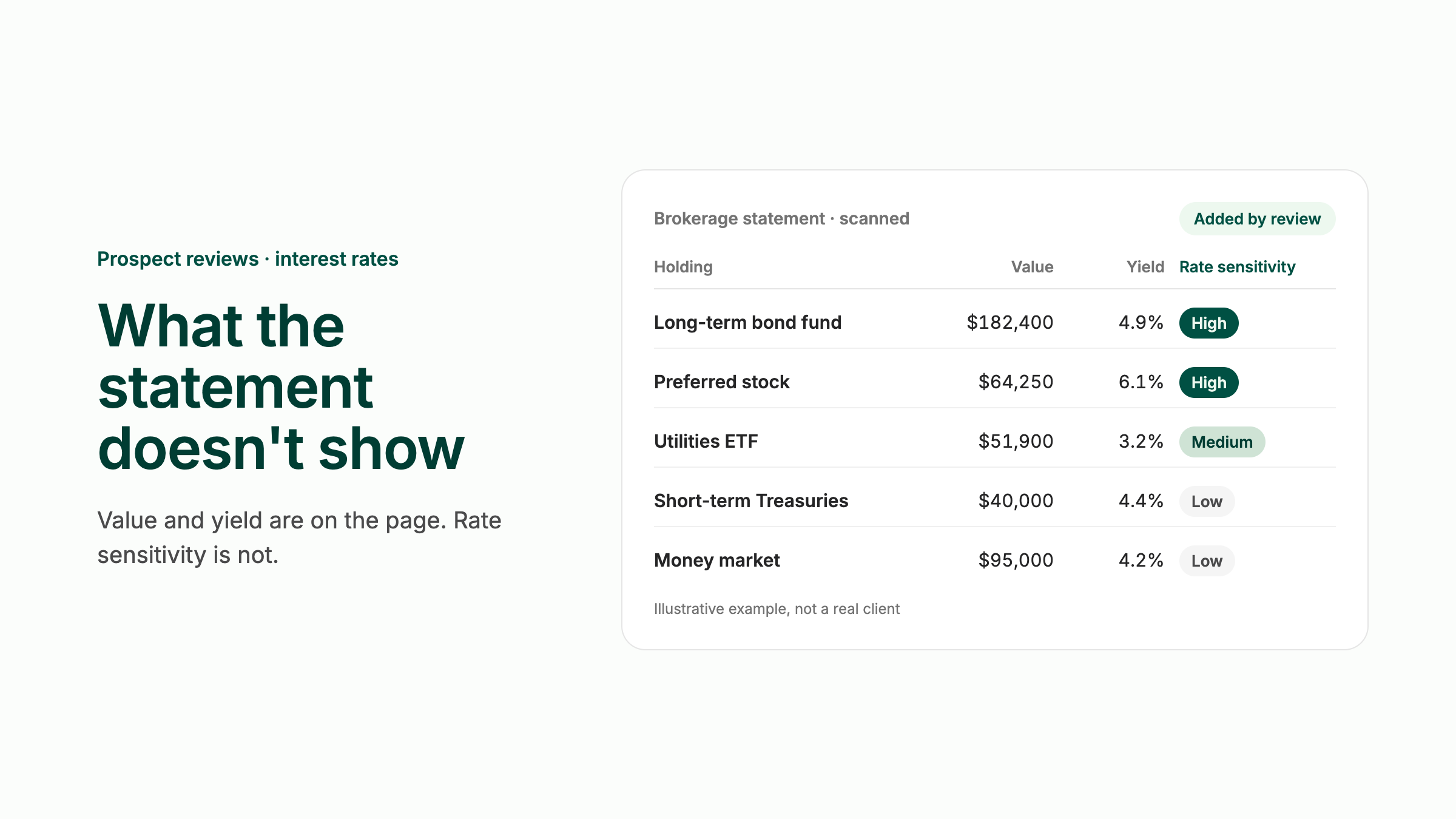
Short answer: A brokerage statement shows market value, income and yield. It does not show duration, which is how much a holding's price moves when interest rates change. When rates move quickly, many prospects hold more rate risk than their statements suggest. Reviewing holdings line by line before the second meeting turns that gap into a clear, useful conversation.
Why are interest rates a client conversation?
Because rate moves change the value of holdings many clients think of as safe. When yields rise, the prices of existing bonds and bond funds fall, and the longer the duration, the bigger the drop. Periods of fast-moving rates are when the gap between how a statement looks and what a portfolio is exposed to grows widest.
When yields swing like this, prospects tend to look at the headline balance on their statement. If equities are holding up, the statement can look fine while the bond side has quietly repriced.
What does a statement not show?
Three things that matter for rate risk:
- Duration. A statement lists price and yield, not how sensitive each holding is to rate changes. As a rule of thumb, a bond fund with a duration of 6 would lose roughly 6% of its value if rates rose by one percentage point (illustration only).
- Where the rate exposure actually sits. Rate sensitivity is not only in bond funds. Preferred stock, utilities, REITs, long-dated CDs and some annuity and structured holdings can all respond to rates.
- Concentration across accounts. A prospect may hold similar long-duration funds in an IRA, a 401(k) and a taxable account at different firms. No single statement shows the total.
What should you look for when you scan a prospect's statements?
| Holding type | What the statement shows | What to check |
|---|---|---|
| Long-term bond funds and ETFs | Price, yield, market value | Duration and how much of the portfolio it represents |
| Individual bonds and CDs | Coupon, maturity, value | Maturity dates, call features, laddering gaps |
| Preferred stock | Dividend, value | Long or perpetual terms that behave like long duration |
| Rate-sensitive equity sectors | Holdings and value | Concentration in utilities or REITs |
| Structured notes and annuities | Value, sometimes labeled as fixed income | The actual product terms, issuer and liquidity |
| Cash and money market | Balance and yield | How much is idle versus needed for near-term goals |
The last row matters too. Rising yields make cash look attractive, but large idle balances can drift away from the client's stated objectives.
How do you explain rate risk without alarming the prospect?
Keep it factual and personal to their portfolio.
- Start with what they own. Show the holdings that are most sensitive to rates, in their own accounts.
- Use a simple scenario. Illustrate what a one-point move in rates would mean for those holdings, clearly labeled as hypothetical.
- Connect it to their goals. Rate risk matters more for money needed soon than for money invested for decades.
- Separate capacity from comfort. Ask how much decline they could afford, and how much they would be comfortable seeing.
- Document the discussion. Record what you reviewed and what the prospect said, so the recommendation that follows has a clear rationale.
Spending hours keying in prospect statements? See how holdings flow straight from the PDF into a risk view. Book a StratiFi demo.
A five-step checklist before the second meeting
- Collect every statement, including retirement plans and accounts held elsewhere.
- Capture every holding, quantity and cost basis in one place.
- Flag rate-sensitive positions and their share of the total portfolio.
- Run the portfolio through a few rate and market stress scenarios.
- Bring one page that shows where the risk sits, in plain language.
Key takeaways
- Statements show value and yield, not rate sensitivity.
- Rate exposure hides in bond funds, preferreds, rate-sensitive equities and complex products.
- Combine every account to see the real concentration.
- Use labeled, hypothetical scenarios and tie them to the client's goals.
- Document the review; it becomes the rationale for your recommendation.
How StratiFi helps
AdvisorIQ · Statement Scanning reads a prospect's brokerage, retirement and annuity statements and pulls out every holding, quantity and cost basis, so you are not re-keying PDFs before a meeting. RiskIQ then scores the combined portfolio from its actual positions, with stress testing, so you can show a prospect where their risk really sits. Advisory firms using StratiFi report faster proposal turnaround, with Fortis Capital moving from 24 to 48 hours to same day (StratiFi case study).
Walk into the second meeting with the whole picture. Book a StratiFi demo.
Frequently Asked Questions
What is bond duration in simple terms?
Duration estimates how much a bond or bond fund's price changes when interest rates move. Higher duration means larger price swings.
Why doesn't my brokerage statement show interest rate risk?
Statements report value, income and yield. Rate sensitivity depends on each holding's duration and terms, which statements usually do not list.
Which investments are sensitive to interest rates besides bonds?
Preferred stock, utilities, REITs, long-dated CDs and some structured products and annuities can all react to rate changes.
How can an advisor show a prospect their rate risk?
Combine every account, flag rate-sensitive holdings and illustrate a labeled hypothetical rate scenario tied to the client's goals.
Is holding more cash a good response to high yields?
It depends on the client's goals and timeline. Large idle balances can drift from the stated objective, so review them like any other holding.
About the author: Beverly Flaxington leads Sales at StratiFi and works with advisory firms on turning first meetings into clients.
This article is for educational purposes and is not investment advice.