%2010.svg)


Table Of Contents

SEC compliance requirements require RIAs and broker-dealers to go beyond merely having written policies or conducting regular reviews. They expect registered investment advisors to show that these policies are implemented.
In recent SEC enforcement actions and deficiency letters to RIAs, there has been a greater emphasis on the implementation and supervision of their activities.
Therefore, RIA compliance requirements are not just about documentation; they are expected to show supervisory evidence of their activity in the business model.
In this guide, we will throw light on the SEC compliance requirements for registered investment advisors in 2026 and their significance. We will also share how fiduciary duty, Reg BI compliance, and supervisory monitoring are examined by the SEC.
Top SEC expectations from RIAs in 2026
The SEC requirements for RIAs have grown in recent years. As firms grow in scale, product offerings become increasingly complex, and data-driven records facilitate regulatory examination.
Here are some of the key areas where SEC regulations for RIAs are placing greater emphasis in 2026
1. Fiduciary Duty as a Continuous Obligation
RIAs are required to follow the fiduciary duty as per the Investment Advisers Act of 1940. This means they must act in the best interest of the client. However, this does not end at the time the recommendation was initially made. They need to prove the alignment of the portfolio over time.
Hence, regulators are increasingly examining whether to rely on ongoing compliance oversight rather than solely on initial suitability reviews.
2. Reg BI and Ongoing Suitability Expectations
Reg BI compliance for RIAs is often linked with broker-dealers. Yet, regulators expect similar standards for advisory firms for recommendation disclosures, conflict of interest resolutions, and client alignment. The firm needs to show how its recommendations remain suitable after implementation.
Supervisory procedures should identify instances where portfolio allocations move away from the client’s defined risk tolerance and where product concentrations introduce unintended exposure.
3. Documentation Must Show Supervision, Not Just Policies
Many firms have developed substantial compliance manuals and internal operating procedures. However, SEC examination requirements emphasize whether these policies can be evidenced through supervisory activities.
Regulators expect RIA compliance programs to provide evidence of the review processes, supervisory escalation, and documentation related to advisory activity.
4. Rule 204-2 Recordkeeping Must Reflect Real Activity
SEC Rule 204-2 recordkeeping requirements stipulate that RIAs maintain records related to client accounts, investment recommendations, and communications. In modern examinations, it is common for regulators to compare these records to ensure they are accurate and reflect portfolio activity.
If these records are found to be deficient or created after the fact, the firm may face scrutiny, even if appropriate investment decisions are made.
5. Exam Frequency, Triggers, and Focus Areas
The SEC’s Division of Examinations uses risk factors such as rapid growth, complex products, marketing practices, and prior deficiencies in its evaluation process. For many firms, examinations occur every few years, while some may be subject to examinations more frequently, depending on the risk factors.
Understanding the expectations shared above can help financial advisors design compliance processes that align with regulatory requirements.
Check out these priorities RIAs should bear in mind during SEC examinations.
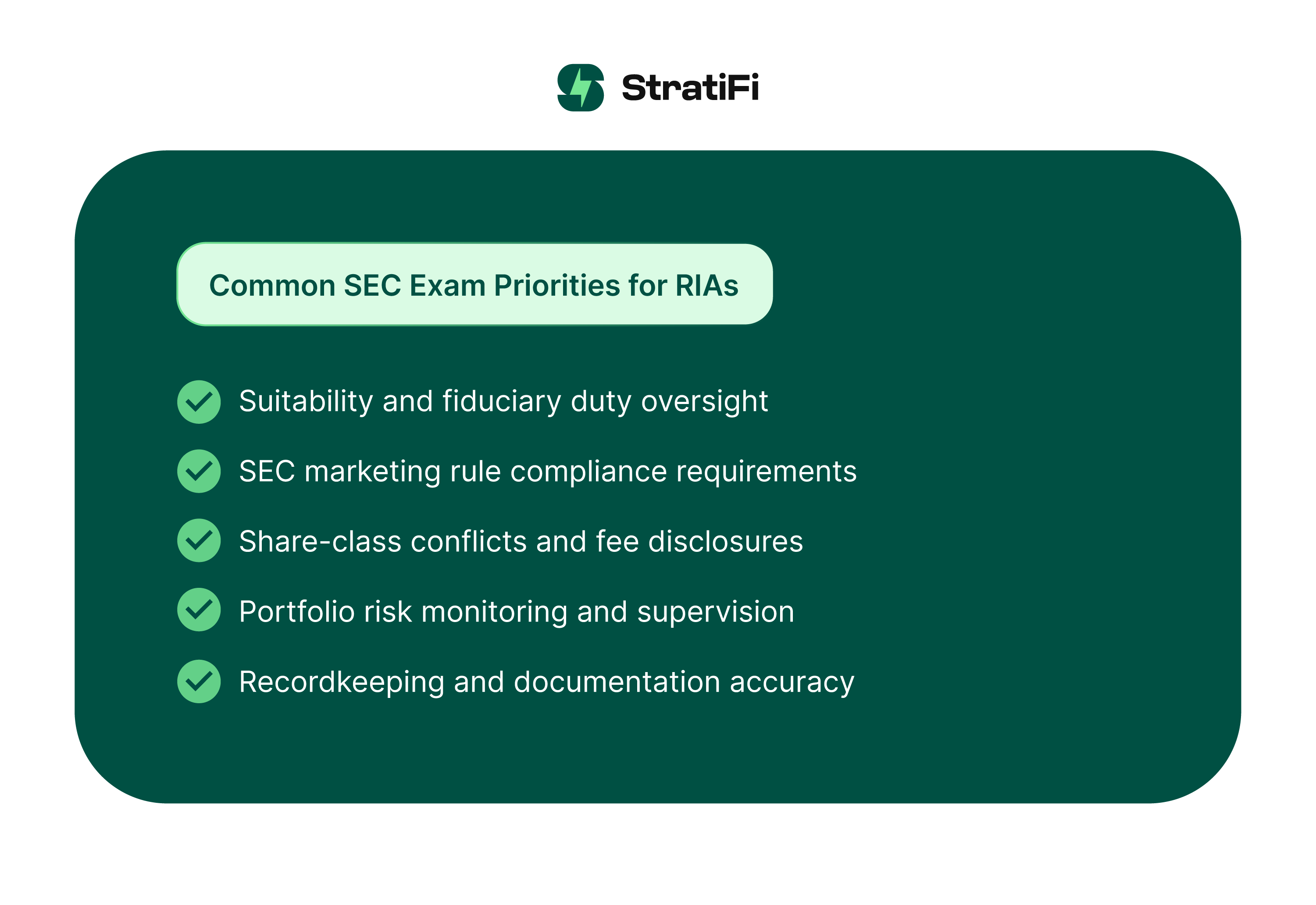
Documentation and Record-Keeping: What Records Must Demonstrate During SEC Exams
Strong documentation remains one of the most visible elements of SEC compliance requirements for RIAs. However, regulators increasingly evaluate records for what they reveal about the advisory process.
Documentation must show how recommendations were formed, how portfolios evolved, and how supervisory oversight occurred over time.
Time-Stamped Advisory Rationale and Supervisory Review
Examiners frequently request records that show the reasoning behind investment recommendations. Firms must be able to demonstrate when advice was given, what client information was considered, and whether supervisory review occurred.
Time-stamped documentation helps establish a clear chain of accountability across advisors and compliance teams.
Linking Client Profile Updates to Recommendation Changes
Client objectives, financial circumstances, and risk tolerance can change. RIA recordkeeping requirements, hence, extend beyond initial onboarding.
Firms must show how client profile updates are captured and how portfolio recommendations adjust when those changes occur.
Advertising and Marketing Rule Substantiation Requirements
The SEC advertising rule for RIAs requires firms to substantiate performance claims, testimonials, and marketing statements.
During exams, regulators may request supporting records demonstrating how marketing materials were approved and whether the claims presented to clients are accurate and consistent with portfolio activity.
Evidence of ongoing suitability monitoring
Documentation should also demonstrate RIA compliance monitoring after recommendations are implemented. Regulators may examine whether portfolios remain aligned with client risk profiles and whether supervisory processes identify situations such as portfolio drift or excessive concentration.
Common Deficiencies Related to Incomplete/Reconstructed Records
SEC exam findings frequently cite documentation gaps rather than outright misconduct. Typical deficiencies include:
- Incomplete or missing supervisory records
- Client suitability documentation created after recommendations
- Marketing materials lacking supporting evidence
- Portfolio monitoring records that do not reflect actual supervisory review
These issues often arise when documentation is created retrospectively rather than as part of normal advisory workflows. Hence, modern firms are investing in RIA compliance technology and compliance automation, thereby ensuring that the records accurately reflect advisory activity as it occurs.
Monitoring and Supervision: The Shift toward Continuous Oversight
Beyond documentation, regulators are increasingly evaluating how firms monitor portfolios and supervise investment activity in real-time. In recent years, several SEC risk alerts and exam findings have emphasized that compliance programs must actively identify and mitigate risks, rather than relying solely on periodic testing.
This shift has expanded expectations around RIA compliance monitoring and supervisory processes.
Why Periodic Testing Alone Is No Longer Enough
Many firms historically relied on quarterly or annual reviews to evaluate portfolio suitability and compliance controls. While these reviews remain part of an RIA compliance program, regulators increasingly expect firms to maintain visibility between review cycles.
Supervisory systems should be capable of identifying emerging risks, such as portfolio drift, product concentration, or unusual trading patterns, before they become regulatory issues.
Account-Level Monitoring vs. Advisor Attestations
In many firms, compliance oversight has traditionally relied on advisor attestations or manual certifications. However, regulators often assess if firms independently verify advisory activity.
Effective RIA supervision requirements, therefore, involve monitoring portfolio activity at the account level rather than relying solely on advisor self-reporting.
Detecting Suitability Drift and Share-Class Conflicts
Modern compliance oversight must address risks that emerge as portfolios evolve. Regulators frequently examine whether firms monitor situations such as:
- portfolios drifting beyond a client’s stated risk tolerance
- excessive exposure to a single asset class or product type
- mutual fund share-class conflicts, where lower-cost options may have been available
These issues often appear gradually across accounts and can be difficult to detect without consistent portfolio monitoring.
How Examiners Test Supervision Effectiveness
During SEC examinations, regulators often review a sample of accounts and compare portfolio activity with client profiles, marketing materials, and supervisory records.
They may also examine patterns across advisors or product recommendations to determine whether compliance controls are functioning as intended.
If supervisory processes appear inconsistent, examiners may conclude that the firm’s compliance program lacks sufficient oversight.
What Ongoing Compliance Oversight Means Operationally
For many firms, meeting modern SEC compliance requirements means embedding supervision directly into advisory operations.
Rather than relying on after-the-fact reviews, firms increasingly use systems that provide continuous visibility into portfolio activity, risk alignment, and supervisory workflows. This approach allows compliance teams to identify emerging issues earlier while maintaining clearer documentation of how oversight occurred.
Common SEC Exam Patterns: Where RIAs Fall Short
Despite investing in policies, procedures, and compliance staff, many advisory firms still receive SEC deficiency letters after examinations. In most cases, the issue is not the absence of a compliance program but gaps between documented policies and actual supervisory practices.
Recent SEC exam findings for RIAs frequently highlight operational weaknesses in how compliance evidence is maintained across portfolios, advisors, and marketing activities.
1. Fragmented Compliance Evidence across Systems
One of the most common issues regulators encounter is fragmented documentation. Portfolio monitoring, marketing approvals, communications archiving, and supervisory notes often exist in separate systems.
When examiners request records, firms often struggle to present a unified narrative of advisory activity.
2. Policies Not Reflected in Daily Advisory Behavior
Many firms maintain detailed RIA policies and procedures, but regulators look for evidence that those policies guide real decisions.
If portfolio activity, marketing practices, or client communications appear inconsistent with written policies, regulators may question whether compliance controls are functioning effectively.
3. Compliance Disconnected from Portfolio Oversight
Under the SEC marketing rule compliance requirements, firms must substantiate performance claims and promotional statements.
Examiners frequently review marketing materials alongside portfolio records to verify that claims made to clients accurately reflect investment results and strategy.
4. Inconsistent Supervision across Advisors
Another common finding relates to uneven supervision. In larger firms, examiners may detect situations where different advisors follow inconsistent documentation or monitoring practices.
These inconsistencies can create the appearance of weak supervisory oversight across the organization.
5. Post-Hoc Documentation during Exams
Some firms attempt to reconstruct documentation after exam requests are issued. Regulators are increasingly sensitive to this practice.
Records created retroactively often lack the time stamps and contextual details that demonstrate genuine supervisory review.
6. Weak Annual Review Processes under Rule 206(4)-7
SEC Rule 206(4)-7 requires RIAs to conduct an annual review of their compliance program. However, examiners frequently find that these reviews are superficial or fail to identify operational risks.
Effective reviews should evaluate whether policies, monitoring systems, and supervisory workflows function as intended.
How to Build a SEC-Ready Compliance Program: A Practical Framework
Meeting modern SEC compliance requirements requires firms to structure their RIA compliance program so that documentation, monitoring, and supervisory oversight reflect how advisory decisions occur.
The following framework highlights how RIAs can strengthen their compliance infrastructure and remain prepared for regulatory reviews.
1. Align Fiduciary Duty, Reg BI, and Supervision Processes
A firm’s compliance program should reflect the continuous nature of its fiduciary duty. This means supervisory processes must evaluate whether portfolio recommendations remain aligned with client objectives, risk tolerance, and investment strategy.
Align Reg BI compliance for RIAs, suitability oversight, and supervisory review to ensure that recommendations can be defended when regulators evaluate advisory activity.
2. Structure Documentation to Mirror Examiner Workflows
During examinations, regulators often reconstruct advisory decisions by reviewing portfolios, client records, and supervisory documentation together. Firms can improve exam readiness by structuring records in ways that mirror this process.
Clear documentation should connect client profiles, investment recommendations, portfolio changes, and supervisory reviews within the same compliance narrative.
3. Embed Monitoring into Daily Advisory Operations
Effective RIA compliance monitoring should occur alongside advisory activity rather than through periodic reviews alone. Monitoring portfolio risk, suitability alignment, and marketing disclosures as they occur helps firms identify potential issues earlier.
Many firms are adopting RIA compliance technology and compliance automation for RIAs to support this continuous oversight.
4. Prepare for Examinations Year-Round
SEC examinations often evaluate records spanning multiple years. Firms that maintain consistent documentation and supervisory records throughout the year are typically better positioned during regulatory reviews.
Preparing for exams on an ongoing basis, rather than shortly before an examination, ensures that SEC compliance for RIAs reflects real advisory activity rather than reconstructed records.
As regulatory expectations evolve, SEC compliance requirements for RIAs will increasingly focus on how firms supervise advisory activity in practice. Documentation, monitoring, and supervisory oversight must work together to demonstrate that recommendations remain aligned with client interests over time.
For many advisory firms, this means moving toward operational systems that maintain visibility across portfolios, advisors, and client relationships.
If you are looking to strengthen your firm’s supervision while reducing compliance complexity, book a demo with StratiFi to learn more. You will experience how portfolio-aware monitoring and compliance intelligence can help you remain exam-ready year-round.
FAQs
What Are the SEC Compliance Requirements for RIAs?
SEC compliance requirements for RIAs include maintaining a written compliance program, documenting investment recommendations, monitoring client portfolios for suitability, maintaining records under Rule 204-2, supervising advisor activity, and conducting annual compliance reviews under Rule 206(4)-7 of the Investment Advisers Act.
What Is Reg BI Compliance for RIAs?
Reg BI compliance requires firms to ensure investment recommendations are made keeping in mind the best interest obligations. Also, conflicts should be disclosed or mitigated. For RIAs, this aligns closely with fiduciary obligations, requiring documentation, supervision, and ongoing monitoring of recommendations.
What Records Must RIAs Keep for SEC Compliance?
RIAs must maintain records such as client agreements, investment recommendations, communications, portfolio transactions, marketing materials, and supervisory reviews.
Under SEC Rule 204-2, these records must be preserved for specific retention periods and made available during SEC examinations.
How Often Does the SEC Examine RIAs?
SEC examination frequency varies based on firm size, growth, and risk indicators. Many RIAs are examined every three to five years, though firms with rapid growth, complex products, or past deficiencies may face more frequent regulatory reviews.
What Are Common SEC Compliance Violations for RIAs?
Common SEC violations include inadequate documentation of recommendations, weak supervisory oversight, marketing rule violations, failure to monitor portfolio suitability, incomplete recordkeeping, and conflicts of interest, such as mutual fund share-class selection issues.
How Can RIAs Automate SEC Compliance?
RIAs automate SEC compliance by using RIA compliance technology that monitors portfolios, maintains time-stamped supervisory records, tracks marketing approvals, and links client profiles to investment recommendations.
Automation helps firms maintain continuous oversight and produce documentation during regulatory examinations.
What Are Mutual Fund Share Class Violations and How Can RIAs Avoid Them?
Mutual fund share class violations occur when a client is placed in a higher-cost share class (such as a Class A or Class C with 12b-1 fees) when a lower-cost institutional or clean share class is available and appropriate. The SEC's Share Class Selection Disclosure (SCSD) initiative specifically targets this disclosure failure. RIAs avoid violations by implementing a written share-class review policy, maintaining a comparison matrix of available share classes for each fund family in use, and using compliance software that flags when a client is allocated to a non-optimal class. All share-class selection rationale should be documented at the time of recommendation.