


Table Of Contents
Short answer: The SEC's Division of Examinations published its fiscal year 2027 priorities on October 23, 2026. For investment advisers, the focus stays on fiduciary duty, conflicts, recommendations and the strength of compliance programs. What changes in practice: examiners want evidence that policies are implemented, that merged and multi-branch firms supervise consistently, and that automated tools produce output consistent with each client's profile.
What did the SEC announce for fiscal year 2027?
The Division of Examinations released its FY2027 priorities on October 23, 2026, covering more than 34,000 registrants across advisers, broker-dealers, funds and market infrastructure (SEC press release 2026-109; Mondo Visione summary). The Division is clear that the list is not exhaustive. It describes the areas it sees as carrying heightened risk this year.
For advisers, four themes lead: fiduciary duty, conflicts of interest, investment recommendations and whether the compliance program actually works. The document also introduces the term "super intelligence" for advanced AI, which is new language for a familiar question: can a firm stand behind what its technology does?
What changes for RIAs in practice?
Three shifts matter more than any single topic on the list.
- Implemented, not written. Examiners typically start with the annual compliance review, and the stated test is whether policies are being carried out, with particular weight on fee-related conflicts (FY2027 priorities). A policy manual with no evidence trail is now the weakest part of most exam files.
- Firms that changed shape are higher risk. The priorities name advisers that merged, changed business model or expanded to multiple branch offices. This continues a theme from FY2026, when the Division also called out merged or consolidated advisers (KPMG summary of FY2026).
- Automated tools must match their claims. Examiners will test whether representations about automated investment tools are accurate, whether operations match disclosures and whether algorithm output is consistent with investor profiles.
The common thread: each one asks for proof that exists before the exam starts, not a narrative assembled during it.
Which products and practices are on the list?
For Regulation Best Interest, the review areas include account type and rollover recommendations. Priority products include variable and RILA annuities, ETFs holding illiquid assets, private placements, structured products and complex options. On the operational side, the priorities carry forward the June 9, 2026 risk alert on economic conflicts and name the amended Regulation S-P and Regulation S-ID, custody arrangements where third parties can access client accounts, wrap accounts and Form CRS.
If your advisers recommend structured notes, buffered products or annuities, assume an examiner will ask how the risk of those holdings was assessed against the client's profile.
What does "implemented, not merely written" look like to an examiner?
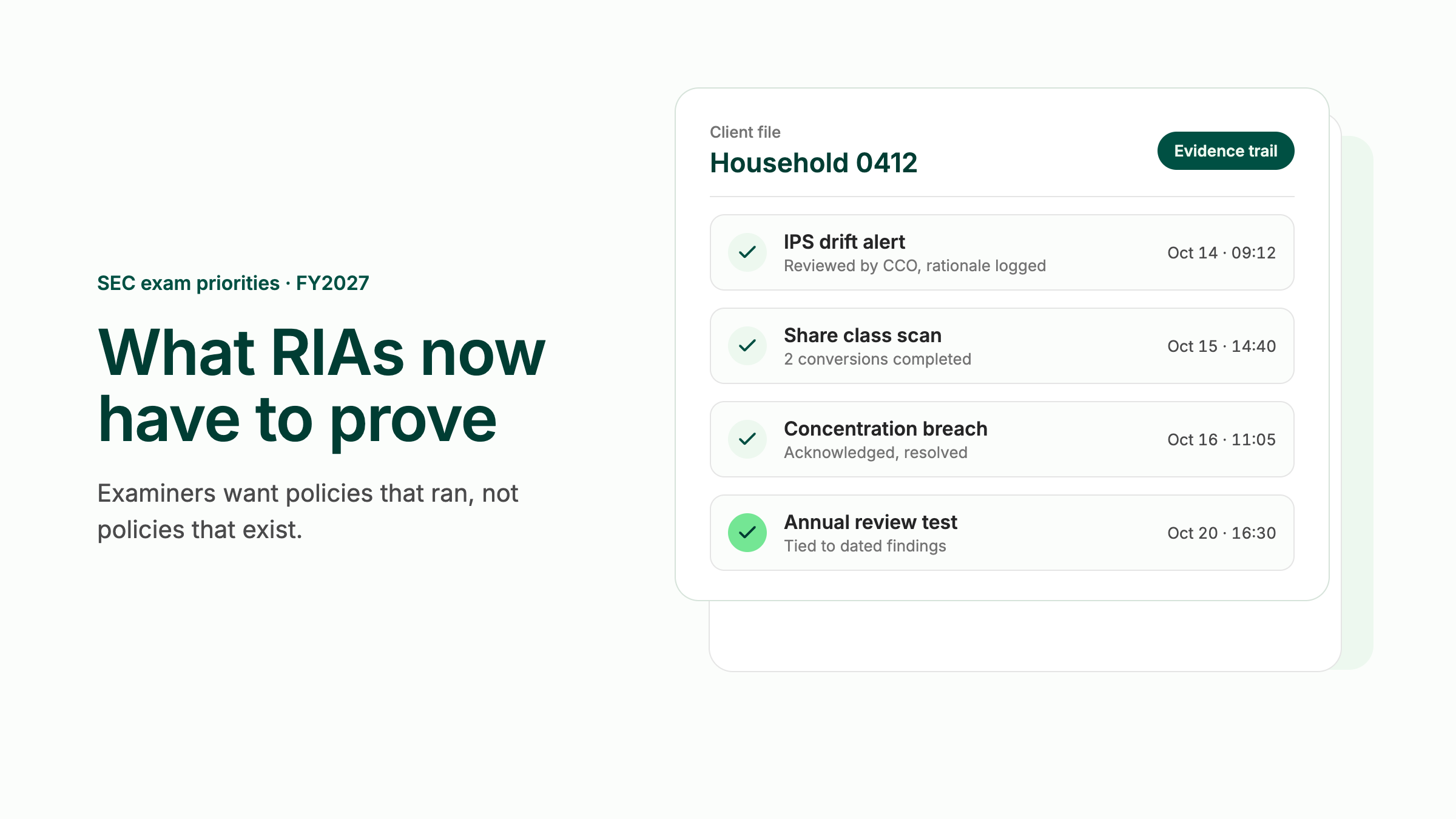
It looks like a dated, attributable record that a control ran, found something, and someone resolved it. The table below maps common policies to the evidence examiners request.
| Policy says | Evidence an examiner asks for | Where it often lives today |
|---|---|---|
| Portfolios stay aligned with each client's IPS and risk profile | Drift alerts, who reviewed them, when, and the documented resolution | Quarterly spreadsheet, advisor memory |
| Clients hold the lowest-cost share class available | Periodic share-class scans and the conversions they triggered | Ad hoc review before an exam |
| No fee-for-no-service in advisory accounts | Flags on accounts with no trading or high cash, plus follow-up notes | Rarely tracked at all |
| Concentration limits are enforced | Breach alerts with acknowledgment and rationale | Email threads |
| The identity theft program (Reg S-ID) is operating | Periodic reviews, red-flag updates, senior oversight records | A written program that was never run |
| The annual review tests the program | Testing results tied to specific findings and fixes | A narrative memo |
The cost of the gap is concrete. On October 23, 2026, the SEC settled with TAG Associates for $175,000. From 2015 to 2024 the firm failed to identify 112 of its 116 client accounts to its surprise-exam accountant, and it never actually operated its written identity theft prevention program (SEC order IA-7028). Both failures were about execution, not about missing policies.
Why are merged and multi-branch firms a higher exam risk?
Because an acquisition imports a second set of controls, and for months nobody owns the gap between them. The acquired book arrives with its own IPS templates, its own risk tool, its own exception history and often its own custodian. Integration plans tend to sequence systems and billing first, and supervision later.
The pool of firms exposed to this is growing fast. Cerulli reports that the number of RIAs managing more than $5 billion nearly doubled in five years, from 194 to 343, with hybrid RIAs holding 51% of those assets (Cerulli, Oct 21, 2026). Hybrid firms carry the heaviest supervision load, because advisory and brokerage obligations sit side by side.
The practical question an examiner will ask is simple: which supervisory record governs the book you acquired, and since when? If the answer takes a week to assemble, that is the finding.
Scale does not have to break supervision. Kingsview grew from 45 advisors and $3 billion to 100 advisors and $8 billion while its compliance team stayed at five people, using continuous drift monitoring on one platform (Kingsview COO, StratiFi case study).
Running an acquisition this year? See how one data lineage keeps inherited books under the same supervision record. Book a StratiFi demo.
What will examiners ask about your automated tools?
Expect three questions, taken directly from the priorities. Are your representations about the tool accurate? Do your operations match what you disclosed? Is the tool's output consistent with each investor's profile?
That third question is where most firms are exposed. If a risk score drives proposals, the firm should be able to show how the score is produced, which holdings it covers (including alternatives and structured products), and evidence that the resulting portfolio stayed consistent with the client's documented profile after the trade, not only at the moment of the trade. A one-time check at the point of sale answers half of it. Ongoing monitoring answers the rest.
A 30-day readiness plan for CCOs
- Map the priorities to your written procedures. Mark every FY2027 area that applies to your business model and note the control that covers it.
- Pull ten client files at random. For each, check whether the recommendation rationale, risk assessment and IPS are in the file, or living somewhere else.
- Reconcile populations. Compare the accounts your controls actually cover against your full account list, including custody and any acquired books.
- Inventory automated tools. List every tool that influences a recommendation, what you disclose about it and how you would show its output matched client profiles.
- Name the governing record for every acquired book. Document the date each one moved onto your supervision process.
- Turn the annual review into evidence. Tie each test to a dated finding and its fix, so the review reads as proof rather than narrative.
Key takeaways
- The FY2027 priorities reward evidence of controls that ran, not the existence of policies.
- Firms that merged, changed business model or added branches are explicitly higher risk.
- Automated tools must produce output consistent with each client's profile, and firms must be able to show it.
- Structured products, annuities and complex options remain priority products for recommendation reviews.
- Thirty days is enough to find the gaps before an examiner does.
How StratiFi helps
ComplianceIQ monitors every client portfolio against its IPS and your supervision policies continuously, flagging drift, concentration, share-class and cash issues as they happen. Each alert carries reviewer attribution, a timestamped acknowledgment and a link back to the source document, so the evidence an examiner asks for is produced by normal work rather than rebuilt under deadline. Because the same platform holds the risk score, the IPS and the proposal, an acquired book can move onto one supervision record instead of two.
See what your exam file could look like before the exam. Book a StratiFi demo.
Frequently Asked Questions
When did the SEC release its FY2027 exam priorities?
On October 23, 2026. The Division of Examinations published them as a press release and a full priorities document on sec.gov.
Are merged RIAs more likely to be examined in 2027?
The priorities name advisers that merged, changed business model or expanded to multiple branch offices as presenting higher risk. That does not guarantee an exam, but it raises the likelihood and the depth of review.
What does the SEC mean by "super intelligence"?
It is the Division's term for advanced AI. Examiners will check whether firms' claims about automated tools are accurate and whether those tools produce advice consistent with investor profiles.
Which products get extra scrutiny in 2027?
Variable and RILA annuities, ETFs holding illiquid assets, private placements, structured products and complex options are named in the Regulation Best Interest review areas.
How should a CCO prepare in the next 30 days?
Map each priority to a control, sample client files for complete rationale, reconcile account populations, inventory automated tools and turn the annual review into dated evidence.
Sources
- SEC press release 2026-109
- SEC FY2027 examination priorities (PDF)
- Mondo Visione, SEC announcement summary
- SEC order IA-7028, TAG Associates
- Cerulli press release, Oct 21, 2026
- KPMG summary of FY2026 priorities
About the author: Akhil Lodha is the CEO of StratiFi, the risk and compliance intelligence platform used by SEC-registered RIAs and broker-dealers to monitor portfolios, document suitability and stay exam-ready.