%2010.svg)


Table Of Contents

Financial advisors and RIAs are inundated with data locked inside PDFs. Custodial statements, tax returns, onboarding forms, and client agreements hold a lot of data, rarely in a structured format.
Extracting this information manually is time-consuming and creates operational bottlenecks, delays client onboarding, and increases the risk of costly errors during compliance reviews.
This is where AI document data extraction tools for financial advisors are transforming workflows. By using OCR (Optical Character Recognition), machine learning, and domain-specific models, these tools convert unstructured financial documents into clean, structured data that can seamlessly feed into portfolio management, risk analysis, CRM, and compliance systems.
As firms scale, automated document processing for RIAs becomes essential. This article aims to help you choose the best AI document data extraction tool that saves time while enabling faster decision-making, improving data accuracy, and strengthening compliance readiness in an increasingly regulated environment.
Let’s get started.
Comparing vendors specifically for RIA-fit? See our companion comparison of the best financial document extraction vendors for RIAs (2026) — covers pricing, integrations, and where each vendor fits in the firm's workflow.
Why Financial Advisors Need AI Document Data Extraction
For most RIAs and financial advisory firms, document handling is one of the most underestimated operational bottlenecks. On the surface, the task seems like a simple back-office job; however, at scale, it becomes a serious drag on growth, accuracy, and compliance.
Advisory firms routinely process hundreds (at times thousands) of custodial statements, brokerage PDFs, 401(k) records, tax returns, and client onboarding documents each month. These documents hold critical data like holdings, transactions, income details, and beneficiary information that must be manually reviewed and entered into multiple systems.
This creates three core challenges:
1. Manual Extraction Doesn’t Scale
As the number of clients and advisors grows, document volume increases proportionally. But manual workflows like reading PDFs, copying data into spreadsheets, or systems don’t scale with it.
This leads to slow onboarding, delayed portfolio analysis, and operational inefficiencies.
2. Errors Introduce Compliance and Client Risk
Even small inaccuracies in data entry, like incorrect cost basis, missing transactions, or misclassified income, can cascade into larger issues. These errors often surface during audits, client reviews, or regulatory checks, creating both reputational and compliance risk.
With regulations like SEC Rule 204-2 mandating accurate recordkeeping, poor data quality is not just inefficient—it’s risky.
3. Data Trapped in PDFs Limits Advisory Intelligence
Unstructured documents cannot directly feed into portfolio management systems, risk analytics tools, or compliance workflows. This means valuable client and portfolio data remains siloed unless manually extracted, thus preventing advisors from delivering timely, insight-driven advice.
This is why AI-powered document data extraction for financial advisors is becoming foundational infrastructure. It transforms static documents into structured, usable data, enabling faster onboarding, real-time portfolio insights, and audit-ready compliance workflows.
In short, AI document data extraction is about unlocking the data layer that modern advisory firms depend on.
Types of Document Extraction Modern RIAs and Financial Advisors Need
The value of AI document data extraction for financial advisors lies in how well it handles different document types and how that extracted data flows into actual advisory workflows.
Broadly, there are three high-impact categories we have summed up in the table below.
|
Category |
Type 1 – Portfolio & Brokerage Statement Extraction |
Type 2 – Tax Document Extraction |
Type 3 – Client Document & Meeting Intelligence |
|
Document Type |
Custodial statements from Schwab, Fidelity, Pershing, and others in varying formats. Includes holdings, cost basis, account numbers, and transaction data. Manual extraction is slow and error-prone. |
Tax returns documents containing income composition, deductions, capital gains, retirement contributions, and other financial details are critical for planning. |
Onboarding forms, meeting notes, account opening documents, emails, and client communications that contain valuable but unstructured data. |
|
Core Challenge |
Data is locked in PDFs and cannot directly feed into portfolio systems or risk tools without manual effort. |
Complex and dense data make manual review time-intensive, delaying actionable insights. |
Information is fragmented across formats and systems, making it difficult to capture and use consistently. |
|
Best Tools Should |
Be trained on financial statement formats and automatically extract structured data directly into portfolio, risk, and compliance systems. |
Convert tax documents into structured data and surface actionable planning insights for advisors. |
Capture and structure insights from unstructured interactions and sync them into CRM and advisory workflows. |
|
Primary Outcome |
Faster portfolio analysis, accurate data for risk and compliance, and reduced manual effort. |
Improved tax planning conversations and faster turnaround on client insights. |
Better client context, improved documentation, and stronger compliance readiness. |
The key to choosing the right AI document data extraction tool for financial advisors is identifying where your biggest bottleneck lies. Is it portfolio data, tax insights, or client intelligence?
6 Best AI Document Data Extraction Tools for Financial Advisors and RIAs
In this section, we have shared 6 relevant tools mapped to the categories shared above.
For Portfolio & Brokerage Statement Extraction (Type 1)
StratiFi
What it does:
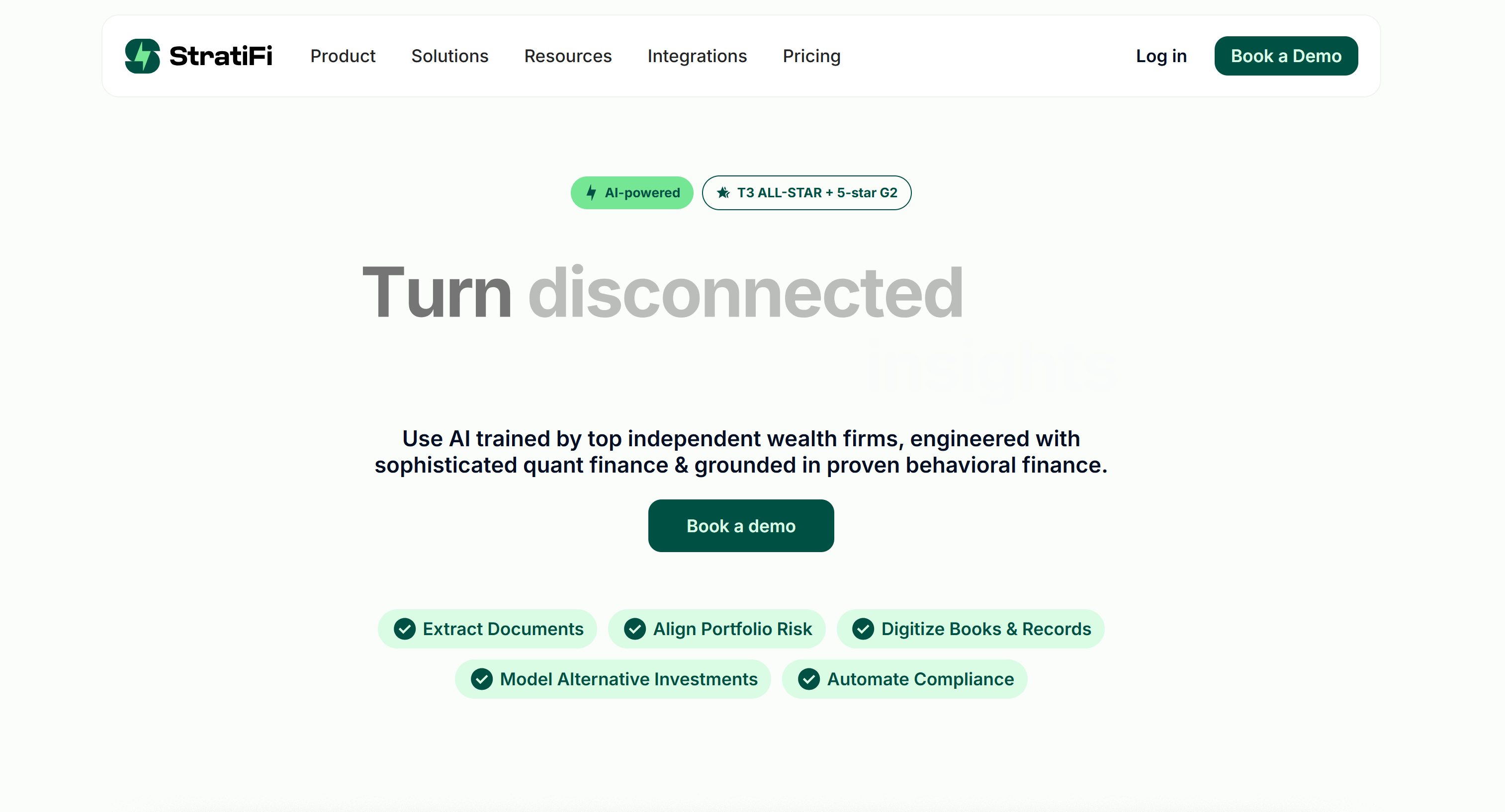
StratiFi offers an AI-powered document data extraction platform for financial advisors built specifically for advisory workflows. \
It ingests custodial statements, brokerage records, 401(k) documents, and portfolio PDFs, automatically extracts structured data (holdings, transactions, cost basis, account details), and feeds it directly into portfolio analytics, risk monitoring, and compliance systems.
Why it stands out:
Unlike standalone extraction tools, StratiFi connects extracted data directly to what advisors need to do next: risk analysis, suitability checks, and compliance oversight. This eliminates the gap between data ingestion and action.
Key capabilities:
- Automated extraction of holdings, transactions, and account-level data from custodial documents
- Direct integration with portfolio risk analytics and performance workflows
- Built-in suitability monitoring and AI compliance alignment
- Handles multi-format statements across custodians (Schwab, Fidelity, Pershing, etc.)
- Reduces manual reconciliation and improves data accuracy across systems
Best for:
RIAs and financial advisory firms looking to automate portfolio data extraction while tightly integrating it with risk management and compliance workflows.
Consideration:
Best suited for firms preferring an end-to-end workflow solution (extraction + analytics + compliance) over a standalone document parsing tool.
Powder
What it does:
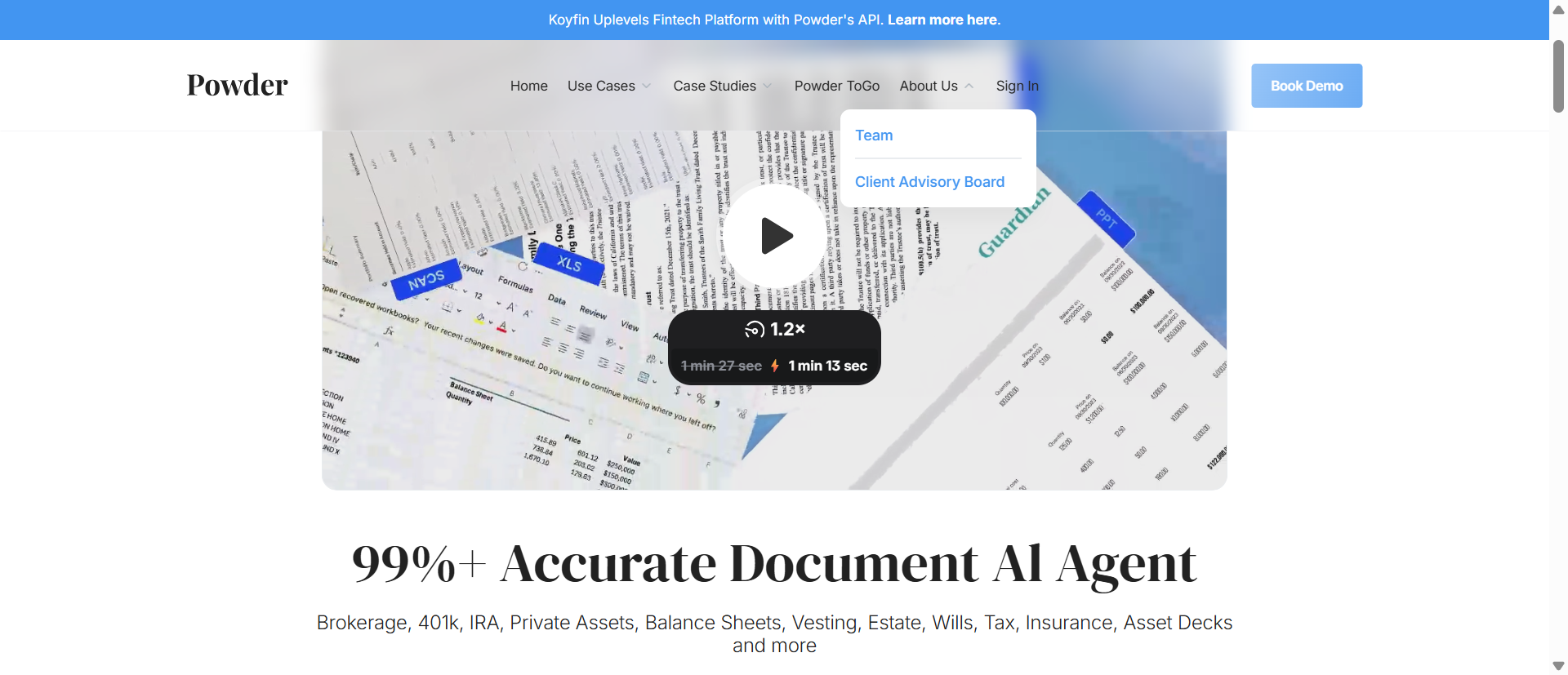
Powder is an AI-powered data extraction platform designed specifically for financial advisors to automate the ingestion of custodial statements and portfolio documents. It converts unstructured PDFs into structured portfolio data that can be used across advisory systems.
Key capabilities:
- Extracts holdings, transactions, and account-level data from custodial statements
- Supports multiple custodians and statement formats
- Delivers normalized, structured data for downstream systems
- Reduces manual data entry and reconciliation effort
Best for:
Advisory firms looking to automate portfolio data extraction and streamline back-office operations, especially when dealing with high volumes of custodial documents.
Investipal
What it does:
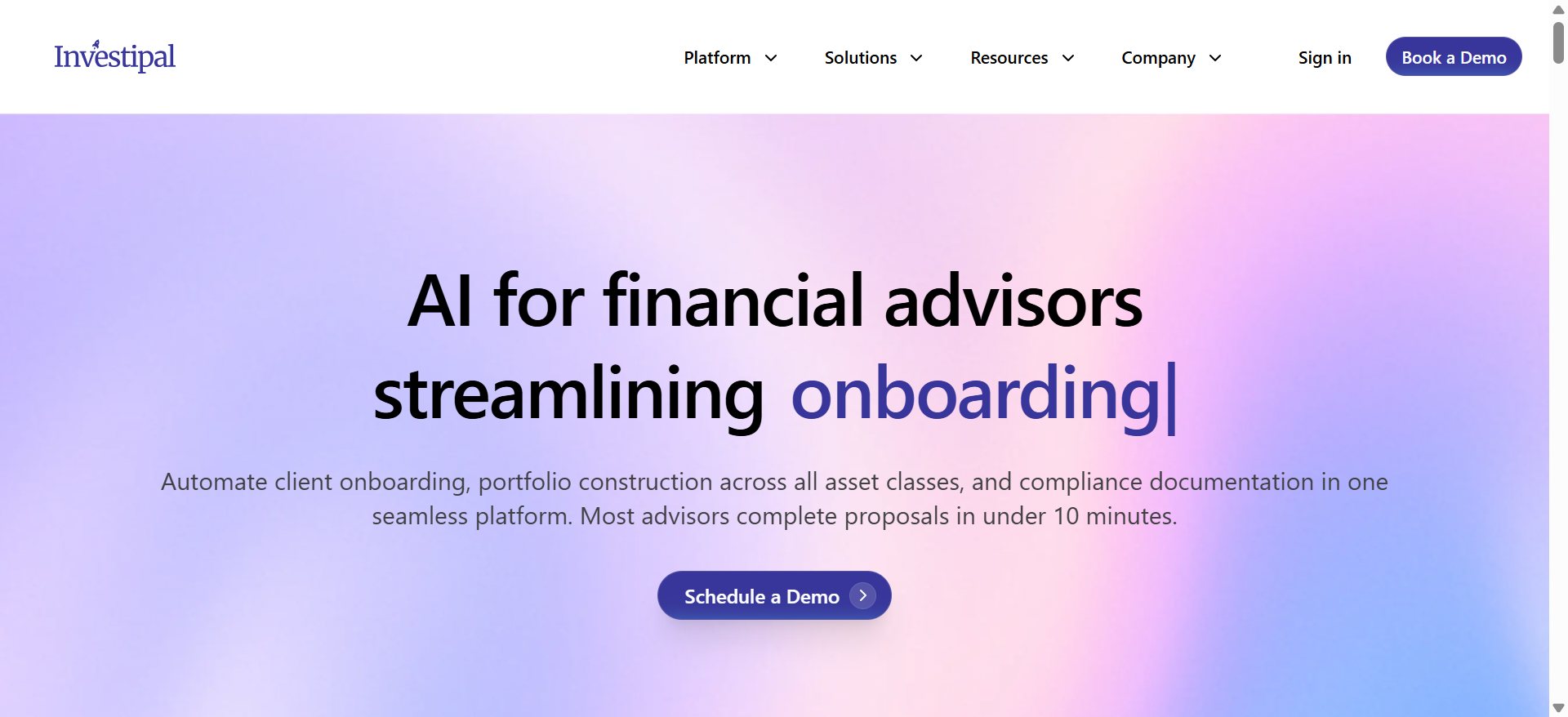
Investipal is a portfolio proposal and client presentation platform that extracts data from brokerage statements to help advisors quickly generate investment proposals and comparisons.
Key capabilities:
- Extracts holdings and portfolio data from client statements
- Converts extracted data into proposal-ready formats
- Enables side-by-side portfolio comparisons and recommendations
- Streamlines prospect-to-client conversion workflows
Best for:
Advisors focused on prospecting, proposal generation, and converting external portfolios into managed assets.
For Tax Document Extraction (Type 2)
Holistiplan
What it does:
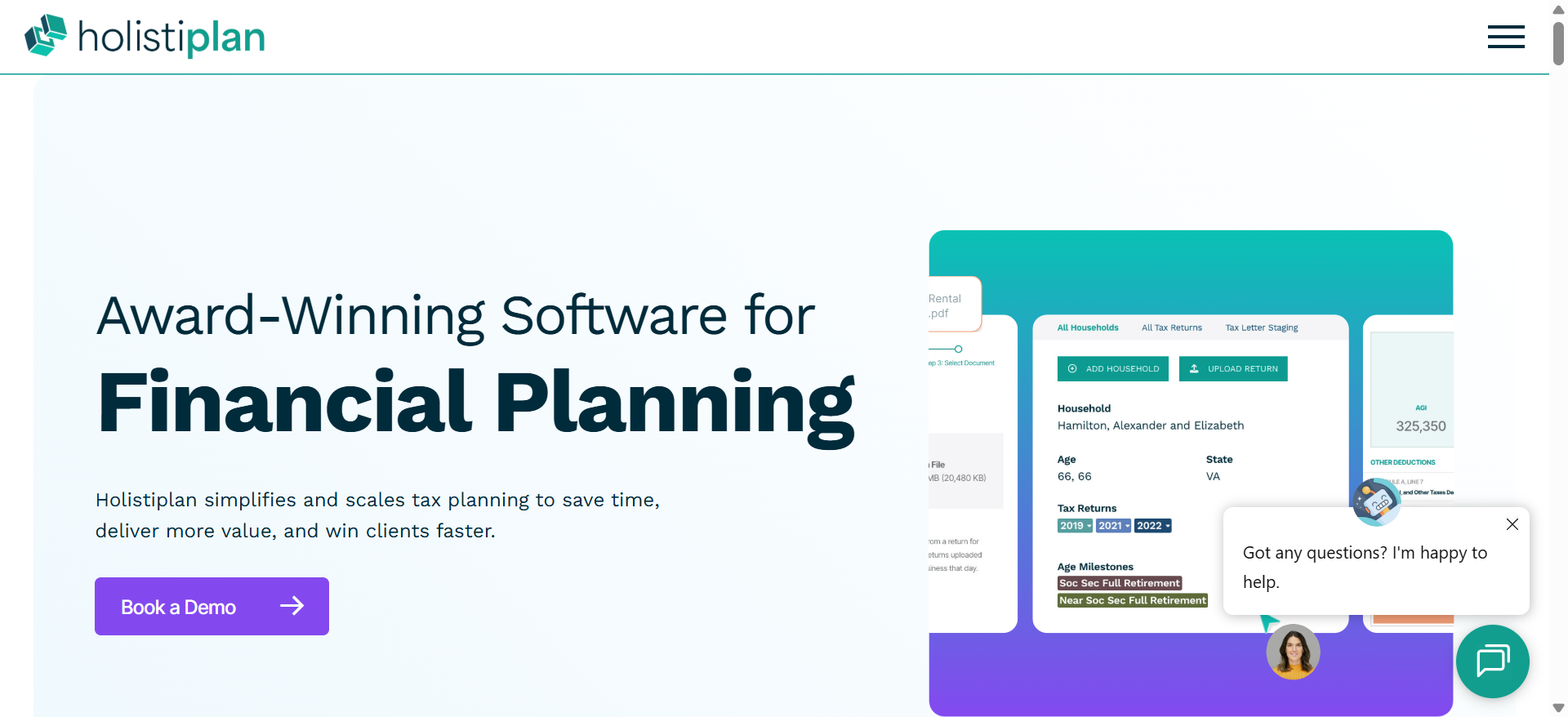
Holistiplan is a leading AI-powered tax planning tool that uses OCR to scan tax returns and convert them into structured data and actionable insights for advisors.
Key capabilities:
- Extracts data from tax returns in seconds using OCR
- Identifies tax-saving opportunities (deductions, credits, Roth conversions, etc.)
- Generates client-friendly tax reports and planning scenarios
- Integrates tax insights into broader financial planning workflows
Best for:
Financial advisors who want to scale tax planning and deliver actionable tax insights without manual analysis.
FP Alpha
What it does:
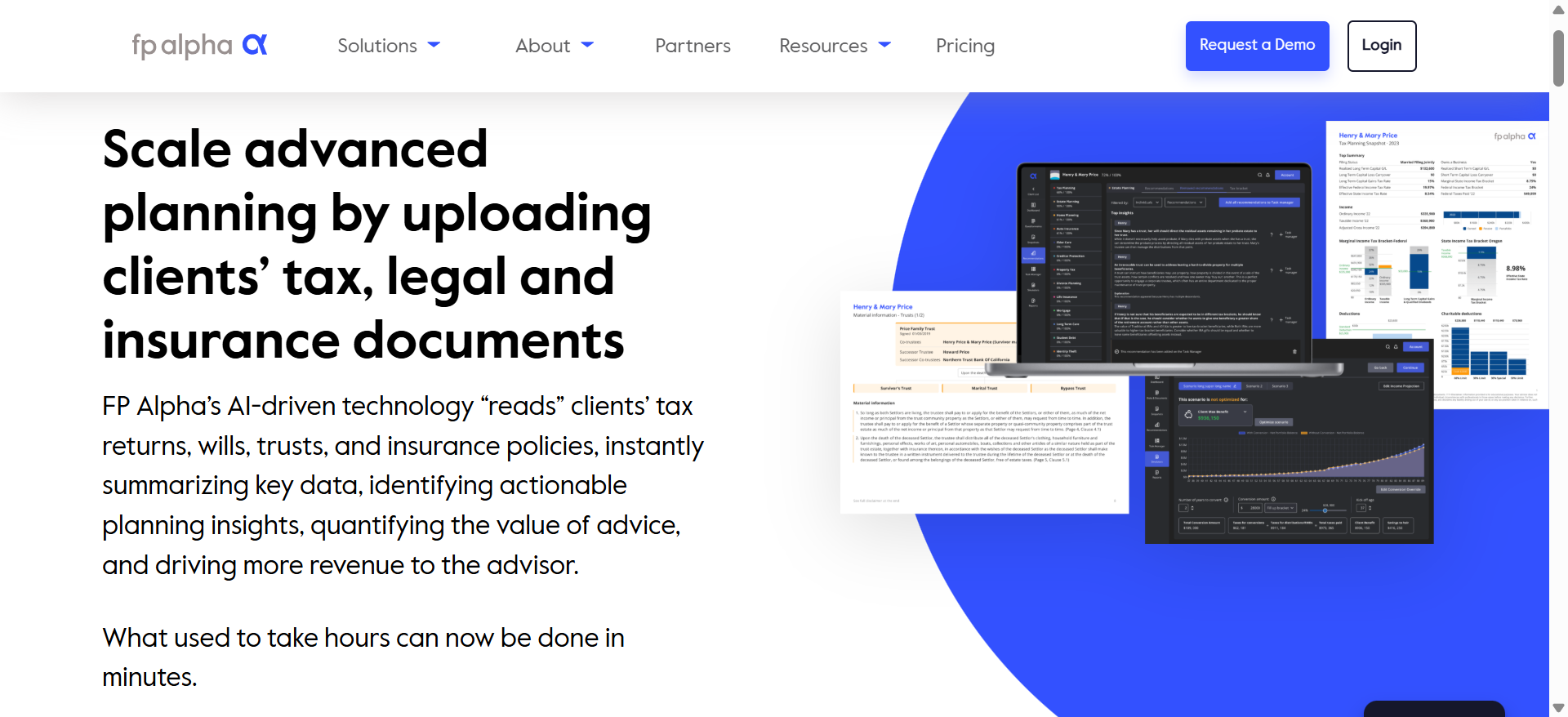
FP Alpha is an AI-driven financial planning platform that reads and analyzes multiple client documents like tax returns, estate documents, and insurance policies, and converts them into actionable planning recommendations.
Key capabilities:
- Extracts and summarizes data from tax, legal, and insurance documents
- Identifies planning opportunities across tax, estate, and insurance domains
- Generates recommendation-driven reports and planning snapshots
- Helps advisors deliver holistic financial advice at scale
Best for:
Advisors looking to provide holistic, multi-domain financial planning beyond investments.
For Client Document & Meeting Intelligence (Type 3)
Zocks
What it does:
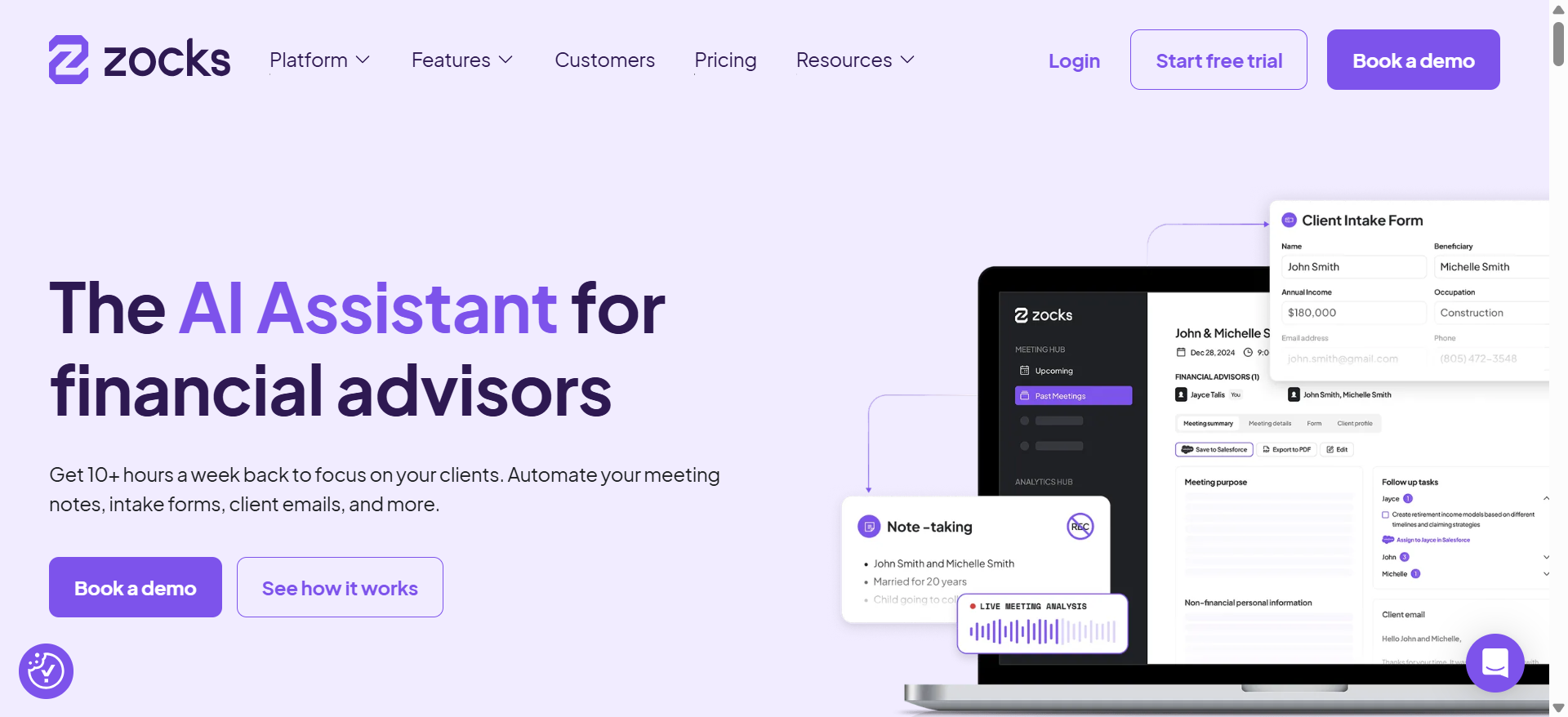
Zocks is an AI-powered advisor assistant that captures and structures data from client meetings, onboarding workflows, and ongoing communications, turning them into actionable insights and CRM-ready records.
Key capabilities:
- Automatically generates meeting notes, summaries, and action items
- Extracts client data from conversations and syncs it into CRM systems
- Assists with meeting prep, follow-ups, and client communication workflows
- Integrates with planning, CRM, and portfolio tools for unified workflows
Best for:
Advisors who want to automate client documentation, meeting intelligence, and CRM data capture.
Comparison of the 6 AI Document Data Extraction Tools for Financial Advisors
|
Tool |
Primary Document Focus |
What It Extracts |
Workflow Integration |
Advisory Use Case |
Best For |
|
StratiFi |
Portfolio & brokerage statements |
Holdings, transactions, cost basis, account-level data |
Direct integration with portfolio risk, performance, and compliance workflows |
Risk analysis, suitability monitoring, compliance oversight |
RIAs looking for end-to-end portfolio intelligence (extraction to action) |
|
Powder |
Portfolio & brokerage statements |
Holdings, transactions, account data |
Data delivery into portfolio/accounting systems |
Portfolio data aggregation and operational efficiency |
Firms focused on automating back-office data extraction at scale |
|
Investipal |
Brokerage statements |
Portfolio holdings and allocation data |
Proposal generation and client presentation tools |
Prospect conversion, portfolio comparisons |
Advisors focused on winning new clients and proposals |
|
Holistiplan |
Tax returns |
Income, deductions, capital gains, tax liabilities |
Tax planning reports and financial planning workflows |
Tax optimization and client advisory conversations |
Advisors offering deep tax planning services |
|
FP Alpha |
Tax, estate, insurance documents |
Multi-domain client data (tax, legal, insurance insights) |
Financial planning platforms and recommendation engines |
Holistic financial planning across domains |
Firms delivering comprehensive financial advice beyond investments |
|
Zocks |
Client meetings & documents |
Meeting notes, action items, and client data from conversations |
CRM systems and client communication workflows |
Client engagement, documentation, and follow-ups |
Advisors aiming to automate client intelligence and CRM updates |
AI document data extraction is quickly becoming the data foundation for modern advisory firms. Whether it’s portfolio data, tax insights, or client intelligence, the ability to convert unstructured documents into structured, usable information directly impacts how fast and effectively advisors can serve clients.
Each of the tools covered above solves a specific piece of this problem. But the real advantage comes when extraction is not treated as a standalone task.
StratiFi takes a different approach.
Instead of stopping at data extraction, it connects that data directly to what advisors need to do next.
When a custodial statement is uploaded, extracted portfolio data flows immediately into risk analysis, suitability monitoring, and compliance oversight - all within one platform.
If your firm is still spending hours extracting data from PDFs or dealing with delays, inconsistencies, and compliance gaps, it’s time to rethink your approach. Book a demo with StratiFi now to see how you can transform document data extraction into real-time portfolio intelligence and compliance-ready workflows.
FAQs
What is AI Document Data Extraction, and How Does It Work for Financial Advisors?
AI document data extraction uses OCR and machine learning to convert unstructured documents like PDFs into structured data. For financial advisors, this means automatically extracting holdings, transactions, and financial details from statements and reports.
Why Do Financial Advisors Need AI Document Data Extraction Tools?
Manual data entry is time-consuming and error-prone. AI tools help advisors save time, reduce errors, improve compliance accuracy, and scale operations as document volume grows.
What Types of Documents can AI Extract Data from in Advisory Firms?
AI tools can process custodial statements, brokerage reports, tax returns, onboarding forms, client agreements, meeting notes, and emails, turning them into structured, usable data.
What Features should I Look for in an AI Document Extraction tool?
Look for tools that offer high accuracy, financial document specialization, integrations with portfolio/CRM systems, compliance support, and real-time data processing, not just basic OCR.
How do I Automate Focument Data Extraction for My RIA?
Start by identifying your biggest bottleneck (portfolio, tax, or client data), choose a tool built for that use case, and integrate it with your existing systems to enable end-to-end automated workflows.
What is the Difference Between Portfolio Statement Extraction and Tax Document Extraction?
Portfolio extraction focuses on holdings, transactions, and account data for investment analysis, while tax extraction focuses on income, deductions, and tax liabilities for planning and optimization.