%2010.svg)


Table Of Contents

Broker-dealers operate under a compliance architecture that most general-purpose tools were never built to carry. FINRA Rule 3110 mandates written supervisory procedures (WSPs), OSJ oversight, branch inspection programs, trade blotter reviews, and Regulation Best Interest (Reg BI) documentation.
The wrong software does not just create friction; it creates the documentation gaps that surface as deficiencies during FINRA cycle exams or sweep examinations.
Compliance needs also differ significantly by use case: a firm managing trade activity surveillance has different requirements from one managing communications archiving or employee personal trading.
This post compares 6 platforms, each positioned where it genuinely leads, so BD compliance teams can match the right tool to the right gap.
|
Which Broker-Dealer Compliance Software Leads Each Category in 2026? Each platform in this list leads a specific compliance function. StratiFi for trade-activity and suitability surveillance; Smarsh for multi-channel communications archiving; Global Relay for enterprise-scale e-discovery; Hadrius for Rule 3110 supervisory workflow and OSJ structure; MyComplianceOffice for employee compliance and Reg BI conflict management; and StarCompliance for personal trading surveillance and political contributions. |
What Makes Broker-Dealer Compliance Software Different from RIA Tools
Broker-dealers and RIAs face different regulatory regimes, and the software built for one does not map neatly onto the other.
If you are an RIA evaluating compliance platforms, see our companion guide: 8 Best Financial Compliance Software for RIAs (2026).
1. FINRA Oversight, Not Just SEC Oversight
RIAs operate under the Investment Advisers Act, supervised by the SEC. Broker-dealers are FINRA member firms, subject to a separate and more operationally prescriptive rulebook. FINRA Rule 3110 (Supervision), Rule 4511 (Books and Records), and Regulation Best Interest create a compliance framework with no direct equivalent in the RIA-only world. Software built exclusively for Rule 206(4)-7 compliance will have gaps when applied to a BD environment.
2. Written Supervisory Procedures (WSPs) as the Operating Document
Every BD compliance program runs against a WSP, a firm-specific supervisory document that must be actively maintained, tested, and demonstrated during FINRA examinations.
FINRA Rule 3110 requires WSPs to cover investment banking and securities business, correspondence and internal communications, and customer complaints, with named responsible persons for each review category. BD compliance software must connect to and support the WSP framework, not operate independently of it.
3. Trade Surveillance and OSJ Supervision at Scale
Trade blotter reviews, suitability surveillance across registered representatives, OSJ (Office of Supervisory Jurisdiction) inspection programs, and Reg BI documentation for retail recommendations are BD-native obligations.
OSJs must be registered with FINRA via Form BR and are subject to annual inspections. These create a supervision infrastructure that requires purpose-built technology, not general-purpose compliance tools repurposed for a BD environment.
How We Evaluated These Platforms
Platforms were assessed against the following 7 criteria specific to the broker-dealer compliance environment:
- FINRA Rule 3110 and 4511 compliance coverage: Whether each platform is purpose-built to support FINRA’s core supervisory and recordkeeping rules. Tools built exclusively for RIA compliance often lack the supervisory structure Rule 3110 requires.
- WSP connectivity and supervisory workflow documentation: Whether the platform connects to and operates within the firm’s Written Supervisory Procedures, or runs independently of them. A compliance tool that doesn’t map to the firm’s WSP framework creates a gap between written policy and documented practice, which is exactly what FINRA examiners are trained to find.
- Trade surveillance depth (blotter review, suitability flags, activity and inactivity pattern detection): Whether the platform goes beyond basic trade logging to surface meaningful signals like excessive trading, unsuitable recommendations, and low-activity accounts in fee-based programs. Pattern detection across the full book is what separates active supervision from recordkeeping.
- Reg BI documentation at the point of recommendation: Whether the platform captures the rationale behind recommendations when they are made, not reconstructed afterward. Reg BI’s care and conflict-of-interest obligations require demonstrable, contemporaneous documentation, and platforms that produce it as a byproduct of the workflow are more defensible than those that rely on manual input.
- Communications archiving (multi-channel capture, WORM storage, and e-discovery): The breadth of channel capture, including off-channel applications like WhatsApp, Teams, and Zoom, and whether records are stored in tamper-proof, WORM-compliant formats meeting SEC Rule 17a-4 and FINRA Rule 4511. Speed and reliability of production for regulatory inquiries were also assessed.
- OSJ and branch supervision scalability: Whether the platform can support multi-branch and OSJ structures without requiring proportional increases in manual compliance headcount. FINRA requires annual OSJ inspections and a documented supervisory system across all locations, and platforms that do not scale across that structure create coverage gaps as firms grow.
- Exam readiness (on-demand production of records without manual assembly): Whether complete, defensible supervision records can be produced on demand, or whether an exam triggers weeks of manual reconciliation. The best platforms make audit readiness a continuous state, not a pre-exam sprint.
6 Best Broker-Dealer Compliance Software Platforms in 2026
1. StratiFi (ComplianceIQ) — Best for Trade-Activity and Suitability Surveillance
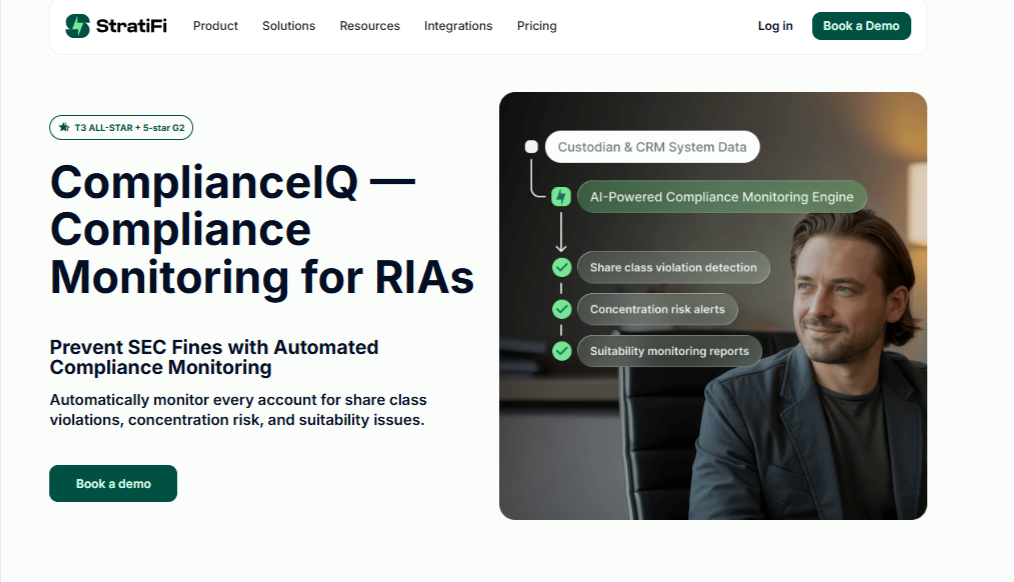
StratiFi’s ComplianceIQ module addresses the portfolio supervision and trading-activity surveillance layer that most BD compliance programs rely on manual review or periodic sampling to cover. For broker-dealers and hybrid RIA/BD firms, its genuine lane is detecting churning and reverse-churning patterns across registered rep books — continuously, not at quarter-end.
What it does for broker-dealers
StratiFi monitors trading activity and inactivity at the account and advisor level, surfacing churning signals (excessive transaction frequency, turnover ratios that trigger suitability questions) and reverse-churning patterns (low or zero activity in fee-based accounts where management fees continue to accrue).
Both categories represent regulatory exposure under FINRA Rule 2111 (Quantitative Suitability) and Reg BI, and both require documented supervisory review.
Key BD strengths
- Continuous trade-activity and inactivity monitoring — flags both excessive trading and fee-based accounts with insufficient activity, producing documented exception records at the account and advisor level
- Suitability surveillance identifies portfolio positioning inconsistencies and share class concerns across rep books in real time, not at exam time
- Audit-ready documentation compliance evidence captured at the point of detection, not reconstructed after the fact; see also StratiFi’s approach to compliance documentation for RIAs and broker-dealers
- ComplianceIQ integrates with custodians, including Schwab, Fidelity, and Altruist, connecting portfolio data directly to the compliance function
Best for
Broker-dealers and hybrid RIA/BD firms that need systematic, documented trading-activity surveillance for churning and reverse-churning detection, particularly firms whose compliance program currently runs on periodic manual blotter review.
Considerations
StratiFi is purpose-built for portfolio-level supervision and trading-activity surveillance. It does not perform communications archiving or full FINRA WSP workflow management; firms needing those capabilities should pair StratiFi with a dedicated comms platform.
2. Smarsh — Best for FINRA-Compliant Communications Archiving and Supervision

Smarsh is the market-leading platform for multi-channel communications capture, immutable archiving, and AI-assisted supervision for broker-dealers. It is purpose-built for the FINRA and SEC recordkeeping obligations that form the core of most BD compliance programs: Rule 17a-4, Rule 4511, and Rule 3110 communications supervision.
What it does for broker-dealers
Smarsh captures business communications across email, mobile messaging, social media, voice, video, AI-generated content, and emerging channels, including WhatsApp and Microsoft Teams.
Every message is archived in tamper-proof, WORM-compliant storage with fast indexed access for supervisory review and regulatory production. AI-assisted risk detection surfaces potential violations without requiring reviewers to read every message.
Key BD strengths
- WORM-compliant archiving meeting FINRA Rule 4511 and SEC Rule 17a-4 requirements, six-year retention with tamper-proof, immutable storage
- AI-powered risk detection across all captured channels, surfacing potential policy violations and reducing false-positive manual review burden
- On-demand e-discovery for FINRA cycle exams, sweep examinations, and litigation holds, indexed archive with fast production capability
- Scales for multi-branch and enterprise BD structures; trusted by thousands of regulated firms across the broker-dealer, hedge fund, and investment management space
Best for
Mid-to-large broker-dealers with high-volume, multi-channel communications environments requiring FINRA-compliant archiving and AI-assisted supervisory review at scale.
Considerations
Smarsh is a communications-focused platform. It does not address portfolio-level suitability oversight, trading-activity surveillance, or Reg BI documentation at the recommendation level. Most BD compliance programs use Smarsh alongside, not instead of, a portfolio supervision tool.
3. Global Relay — Best for Enterprise Communications Compliance and E-Discovery
Global Relay is an enterprise-grade communications compliance platform for broker-dealers managing complex, high-volume environments with significant off-channel communication exposure. It specializes in multi-channel capture, AI-powered surveillance, and WORM archiving for firms with institutional scale or international regulatory obligations alongside US FINRA/SEC requirements.
What it does for broker-dealers
Global Relay captures and archives communications across email, instant messaging, voice, video, social media, and hard-to-supervise off-channel applications, including WhatsApp, Signal, and Microsoft Teams.
AI-powered analytics detect potential insider trading, market abuse, and policy violations. The platform’s e-discovery capability allows rapid production of records for FINRA inquiries and litigation.
Key BD strengths
- Comprehensive off-channel capture specifically addresses WhatsApp, Signal, and Teams, which have generated billions in FINRA and SEC enforcement penalties in 2023–2025 for firms that failed to archive them
- AI-powered behavior analytics for insider trading detection and market abuse surveillance across communication patterns
- Fast e-discovery indexed archive with self-service export capability for on-demand regulatory production
- MiFID II compliance alongside FINRA/SEC — relevant for broker-dealers with European institutional counterparties or operations
Best for
Large broker-dealers and institutional firms with complex multi-channel communication environments, significant off-channel exposure, and cross-jurisdictional regulatory obligations, including MiFID II.
Considerations
Enterprise pricing (typically $50,000+ annually) and implementation complexity make Global Relay impractical for mid-market or boutique broker-dealers. It is a communications and e-discovery platform — not a portfolio supervision or WSP workflow tool.
4. Hadrius — Best for FINRA Rule 3110 Supervisory Framework and OSJ Oversight
Hadrius is a BD-native supervisory compliance platform built to automate the full FINRA Rule 3110 supervisory framework, trade review, communications surveillance, marketing review, attestations, and branch/OSJ inspection workflows. All this, in a single system with timestamped, audit-ready records producible on demand for FINRA exams, sweeps, or inquiries.
What it does for broker-dealers
Hadrius applies AI routing to prioritize the highest-risk trades, communications, and marketing materials so supervisors focus their review time on material issues rather than false positives. Every supervisory action, like review, escalation, approval, and remediation, is timestamped and archived. The platform is configured to the firm’s written supervisory procedures and supports multi-branch and OSJ structures with unified oversight across all registered representative populations.
Key BD strengths
- Purpose-built Rule 3110/3120/3130 supervisory workflow — all supervisory activities run against the firm’s WSP structure, with a complete, producible supervisory record for examiners
- Multi-branch and OSJ structure support — unified oversight across all rep populations, including remote and residential supervisory locations, introduced under FINRA’s 2024 rule amendments
- AI-assisted review cuts false positives by 90% or more per Hadrius’s published benchmarks, reviewers focus on real issues, not noise
- Deploy in weeks, not months. It is designed for rapid implementation without lengthy IT projects
Best for
FINRA-registered broker-dealers at any scale that want to automate their Rule 3110 supervisory control framework and produce complete, examiner-ready supervision records without spreadsheet-based manual workflows.
Considerations
Hadrius is a supervisory workflow and communications surveillance platform. It addresses FINRA 3110/3120/3130 compliance and communications oversight, not portfolio-level suitability surveillance at the account level or AML/financial crime detection.
5. MyComplianceOffice (MCO) — Best for Employee Compliance and Reg BI Conflict Management

MyComplianceOffice is a cloud-based compliance management platform covering the full employee compliance lifecycle for broker-dealers: personal trading surveillance, outside business activities, gifts and entertainment, political contributions, attestations, and Reg BI conflict documentation across registered representative populations.
What it does for broker-dealers
MCO centralizes the employee-facing compliance obligations that accumulate across a multi-rep firm, like pre-clearance workflows, OBA disclosures, gifts and entertainment approvals, and the conflict-of-interest documentation that underpins Reg BI care obligation defensibility. Automated monitoring replaces manual attestation collection, and dashboards give compliance teams firm-wide visibility into rep-level compliance status.
Key BD strengths
- Personal trading pre-clearance and post-trade surveillance across all rep accounts — FINRA personal trading rule compliance built into the workflow
- OBA monitoring and disclosure management centrally tracks and documents outside business activity approvals and updates
- Reg BI conflict documentation tracks rep-level disclosures and certifications needed to demonstrate compliance with the care and conflict-of-interest obligations
- Email and communications archiving alongside compliance workflows gives compliance teams a unified view of rep activity
Best for
Broker-dealers managing rep-level personal trading compliance, conflict-of-interest documentation, and Reg BI disclosure requirements across large or geographically distributed representative populations.
Considerations
MCO is strong on employee compliance and conflict management. It is not a portfolio-level suitability or trading-activity surveillance platform, and its communications archiving is lighter than dedicated enterprise archiving solutions like Smarsh or Global Relay.
6. StarCompliance — Best for Personal Trading Surveillance and Political Contributions Monitoring
StarCompliance is a SaaS compliance platform specialising in the employee-facing regulatory obligations that carry particular weight for broker-dealers serving institutional and municipal clients: personal account dealing surveillance, political contributions (Pay-to-Play) tracking, gifts and entertainment management, and OBA disclosures, with automated workflows and real-time alerts.
What it does for broker-dealers
StarCompliance provides pre-clearance and post-trade oversight across 35 million+ global securities, including cryptocurrencies, ETFs, mutual funds, and leveraged loans. Automated broker feed integrations refresh every 24 hours, eliminating manual statement entry.
Political contribution monitoring with automated public securities review addresses MSRB Rule G-37 Pay-to-Play compliance, a specific and material regulatory risk for broker-dealers managing relationships with public pension funds and municipal issuers.
Key BD strengths
- Advanced political contribution monitoring with automated public securities review, specifically built for MSRB Pay-to-Play compliance, is critical for BDs with municipal or public pension exposure
- Configurable personal trading pre-clearance with automated broker feed integration, 35M+ securities covered, with daily-refresh data
- Firm trade surveillance automatically compares firm trades against watch lists and restricted lists to detect and document potential trading risks
- Gifts, hospitality, and OBA management with audit trails give compliance teams a single evidence record for employee conduct oversight
Best for
Broker-dealers with significant institutional or municipal business where political contribution compliance is a material regulatory risk, alongside standard personal trading and employee conduct obligations.
Considerations
StarCompliance is focused on employee compliance and conduct risk. It is not a communications archiving, portfolio-level suitability, or AML/trade surveillance platform.
Quick Reference Comparison
|
Platform |
Best For |
Key BD Capability |
Not Designed For |
|
StratiFi (ComplianceIQ) |
Trade-activity & suitability surveillance |
Churning/reverse-churning detection, portfolio supervision |
Comms archiving, WSP workflow |
|
Smarsh |
FINRA communications archiving |
Multi-channel capture, WORM archive, AI supervision |
Portfolio suitability, trade surveillance |
|
Global Relay |
Enterprise comms & e-discovery |
Off-channel capture, MiFID II, fast e-discovery |
Portfolio supervision, employee trading |
|
Hadrius |
Rule 3110 supervisory workflow |
WSP-connected supervision, OSJ/branch structure |
AML, portfolio-level suitability |
|
MyComplianceOffice |
Employee compliance & Reg BI conflicts |
Personal trading, OBA, Reg BI disclosures |
Comms archiving, trade surveillance |
|
StarCompliance |
Personal trading & political contributions |
Pay-to-Play monitoring, pre-clearance, firm trade surveillance |
Comms archiving, portfolio supervision |
What to Look for in Broker-Dealer Compliance Software
Here are 5 questions a BD compliance officer or CCO must answer when evaluating any platform:
- Does it connect to your WSP framework or operate independently of your supervisory procedures?
Software that doesn’t map to your WSPs creates a disconnect between your written policies and what the system actually monitors — the exact gap examiners are trained to look for. - Does it provide continuous, real-time surveillance or periodic review that misses what happens between cycles?
FINRA examiners review 12 months of activity. A compliance system that only runs monthly sampling leaves 11-month gaps in the documented evidence trail. - Does it produce on-demand, audit-ready records or require manual assembly before an exam?
The difference between a clean exam and a deficiency finding is often whether the supervision documentation was already there or had to be reconstructed. - Does it scale across branches, OSJs, and rep populations without proportionally scaling headcount?
Manual compliance processes that work at 10 reps become structural liabilities at 50. The platform must scale supervision coverage without scaling the manual review burden. - Does it address your specific BD obligations, or is it a general-purpose compliance tool repurposed for BDs?
Portfolio suitability, communications archiving, employee conduct, and trade surveillance require different platform architectures. A single general-purpose tool rarely serves all of them well.
Summing Up
Broker-dealer compliance often fails because procedures are not enforced, tested, and documented continuously across every rep, branch, and product type.
The right software closes that gap before an examiner surfaces it. Start with your firm’s most exposed obligation, match the tool to that specific gap, and build from there. The firms that get this right treat compliance as a continuous operating discipline, not an annual event or a pre-exam sprint.
Want to see how StratiFi’s ComplianceIQ fits in your compliance tech stack? Get in touch with us or book a demo to see StratiFi in action.
Frequently Asked Questions
What is Broker-dealer Compliance Software?
Broker-dealer compliance software is a purpose-built platform that helps FINRA-registered firms manage supervisory obligations, document trading activity, archive communications, and produce audit-ready records for regulatory examinations — all within a structured, rules-based framework.
How is Broker-dealer Compliance Software Different from RIA Compliance Software?
RIA compliance software is built around the Investment Advisers Act and SEC oversight. Broker-dealer platforms address FINRA Rule 3110, written supervisory procedures, OSJ structures, Reg BI documentation, and communications archiving obligations that have no direct RIA equivalent.
What does FINRA Rule 3110 Require from a Broker-dealer’s Supervisory System?
FINRA Rule 3110 requires firms to establish written supervisory procedures, designate registered principals for each business line, conduct annual OSJ inspections, review correspondence and internal communications, and maintain a supervisory system reasonably designed to achieve compliance with applicable securities laws.
What is a Written Supervisory Procedure (WSP), and How does Compliance Software Support it?
A WSP is a firm-specific document that maps supervisory responsibilities to named individuals and business activities. Compliance software supports it by running surveillance and review workflows against the WSP structure, creating a documented connection between written policy and actual supervisory practice.
How does Reg BI Change the Documentation Requirements for Broker-dealers?
Reg BI requires broker-dealers to document that each recommendation to a retail customer reflects the customer’s best interest, accounting for costs, risks, and alternatives. This documentation must be contemporaneous, defensible, and producible during a FINRA examination.
What Communications Channels must Broker-dealers Supervise under FINRA Rules?
FINRA requires supervision of all business-related communications, including email, instant messaging, social media, voice, and increasingly off-channel platforms like WhatsApp and Microsoft Teams. Failure to capture and archive these channels has resulted in billions in enforcement penalties across the industry since 2023.
Can a Single Compliance Platform Cover All Broker-dealer Obligations — or do Firms Need Multiple Tools?
Most broker-dealers need more than one platform because portfolio suitability surveillance, communications archiving, employee conduct monitoring, and trade surveillance each require different architectures. The right approach is to identify your firm’s primary compliance gap and select purpose-built tools that address it without creating new integration complexity.
What should a Broker-dealer Look for in Compliance Software when Scaling Across Multiple Branches?
Firms scaling across branches and OSJ structures should prioritize platforms that provide centralized oversight without requiring proportional increases in compliance headcount. Look for tools that produce on-demand supervisory records, connect to the firm’s WSP framework, and support annual OSJ inspection documentation at every registered location.