%2010.svg)


Table Of Contents

For RIAs and broker-dealers, regulatory exams still trigger a cycle of disruption. Teams scramble through spreadsheets, email threads, custodian exports, and shared drives to reconstruct what happened, why decisions were made, and whether documentation is complete.
Related reading: the 2026 investment-adviser compliance landscape.
In today’s era, compliance has become a time-bound project, not an ongoing capability.
For a broader view, see the full landscape of wealth-management compliance in 2026.
This approach poses so many risks: Manual sampling reviews only a fraction of accounts. Documentation is often assembled after the fact. Oversight depends on individual memory and best efforts rather than systematic processes.
Meanwhile, regulatory expectations around Reg BI, suitability, and ongoing supervision are making it tougher to rely on static reports or legacy processes.
The result? Firms invest heavily in compliance and yet feel exposed each time an exam letter arrives.
Modern advisory firms are proactive enough to recognize these challenges and rethink the model. Instead of periodic audit jobs or sometimes reacting to regulatory exams, they are moving toward continuous exam readiness. This is the model where compliance reporting, documentation, and supervision happen automatically as part of day-to-day operations.
They are investing in robust compliance automation reporting tools that offer the infrastructure to RIAs and broker-dealers to surface evidence, exceptions, and oversight in real time (long before regulators ask for them).
If you're evaluating platforms, see what to look for in a compliance automation platform.
This article explores how compliance automation reporting tools work to help RIAs and broker-dealers stay audit-ready before exams happen.
How Do Compliance Automation Reporting Tools Keep RIAs and Broker-Dealers Audit-Ready
Compliance automation reporting tools are designed to solve a specific gap in advisory firm processes. They turn supervision and documentation into a continuous capability, not a periodic scramble.
At a practice level, these tools help firms monitor, surface, and prove oversight across accounts and advisors, without relying on sampling, ad-hoc spreadsheets, and manual reporting.
-
Continuously monitor accounts, advisors, and portfolios
Instead of reviewing a subset of activity on a monthly/quarterly cadence, modern tools support always-on visibility, allowing compliance teams to know what’s happening across the business. This is especially relevant as investment complexity and advisor volume increase.
Thus, these tools replace periodic spot-checks, manual report pulls, and random supervision.
-
Generate exception reports automatically
Exception-based reporting, or EBR, highlights where attention is most needed. EBR typically answers, what happened (the exception), why it matters (the regulatory exposure risk), who owns it (advisor/ account), and the next steps (action/ tracking).
This prevents the creation of giant spreadsheets and generic dashboards.
-
Maintain audit-ready documentation and evidence trails
During exams, firms are often asked whether the policy was followed consistently and how the firm responded when an exception occurred.
These modern tools support time-stamped activity workflows, history, exception-review notes, resolution status, and supporting records.
-
Enforce workflows so issues are tracked and resolved
Beyond reporting, the regulatory compliance software must ensure that issues are assigned, tracked, escalated, and closed, with a record of resolution. Here’s where reporting becomes operational control, reducing manual follow-ups, compliance chasing, and unresolved exceptions that resurface during exams.
-
Surface firm-wide risk visibility in real time
During exam preparation, ‘truth’ is often spread across custodian data, CRM notes, PDFs, marketing archives, trade review records, and more.
Robust compliance automation reporting tools reduce the need to stitch narratives in real time. They replace leadership dashboards built on manual rollups and inconsistent definitions.
Moreover, they answer -
- Where are we exposed right now?
- What patterns are emerging?
- Are exceptions getting resolved consistently?
If these capabilities aren’t present, firms will still have ‘reporting’, but the reporting documents the past, and doesn’t focus on preventing exam-day surprises.
Why Traditional Compliance Reporting Fails during Exams
Traditional compliance reporting wasn’t designed for the way RIAs and broker-dealers operate today. It evolved in an era of fewer products, smaller advisor teams, and less frequent regulatory scrutiny.
As firms scale, these legacy approaches fall short, visibly during exams.
-
Monitoring only a fraction of accounts
Most traditional reporting models rely on sampling. Reviews are performed monthly, quarterly, or annually on a small subset of accounts or activities. While this may satisfy internal process requirements, it leaves large portions of the business effectively unobserved.
During an exam, regulators ask what was missed, not what was sampled. Gaps created by partial monitoring surface at the worst possible time.
-
Fragmented systems that create fragmented narratives
Compliance evidence typically lives across custodians, CRMs, document repositories, email threads, and point solutions. Each system may be ‘compliant’ on its own, but together they create fragmented compliance workflows that fail to tell a coherent story.
During exams, teams are forced to reconcile -
- portfolio activity from custodians
- suitability and client context from CRMs
- communications and approvals from separate archives
- policies and attestations stored elsewhere
The result is a time-consuming effort to reconstruct intent and oversight after the fact.
-
Increasing product complexity
As firms expand into alternatives, structured products, interval funds, buffered ETFs, and model-driven strategies, the volume and nuance of compliance data increase dramatically.
Static reports and checklist-driven reviews struggle to keep up with -
- evolving suitability considerations
- concentration and liquidity risk
- portfolio drift across volatile market conditions
By the time reports are reviewed, the underlying risk has often already changed.
-
Regulatory ambiguity and evolving Reg BI interpretation
Reg BI and fiduciary standards increasingly emphasize process, rationale, and ongoing care, not just outcomes. Regulators want to understand -
- Why were recommendations made
- How conflicts were evaluated
- How suitability was monitored over time
Traditional reporting focuses on documenting events, not decision paths—making it harder to demonstrate defensibility under modern scrutiny
-
Reporting happens after reality, not alongside it
The biggest limitation is timing. In legacy models, reporting is generated after decisions, trades, and client interactions have already occurred.
This creates a persistent lag -
- Documentation trails reality
- Issues are identified late
- Remediation is reactive
By the time an exam arrives, compliance teams are explaining history instead of demonstrating control.
Thus, traditional compliance reporting is episodic, fragmented, and retrospective. Exams often expose these gaps because regulators test the system, not just the paperwork.
Hence, firms are moving away from periodic reporting toward continuous exam readiness. They are opting for a model where detection, documentation, and supervision happen as work occurs, not months later.
The Shift to Continuous Exam Readiness
As regulatory scrutiny intensifies, RIAs and broker-dealers are rethinking a core assumption of compliance: that exams are events you prepare for. Increasingly, firms are recognizing that this model no longer works.
The alternative is continuous exam readiness, a compliance operating model where oversight, documentation, and reporting are always up to date, not assembled under pressure.
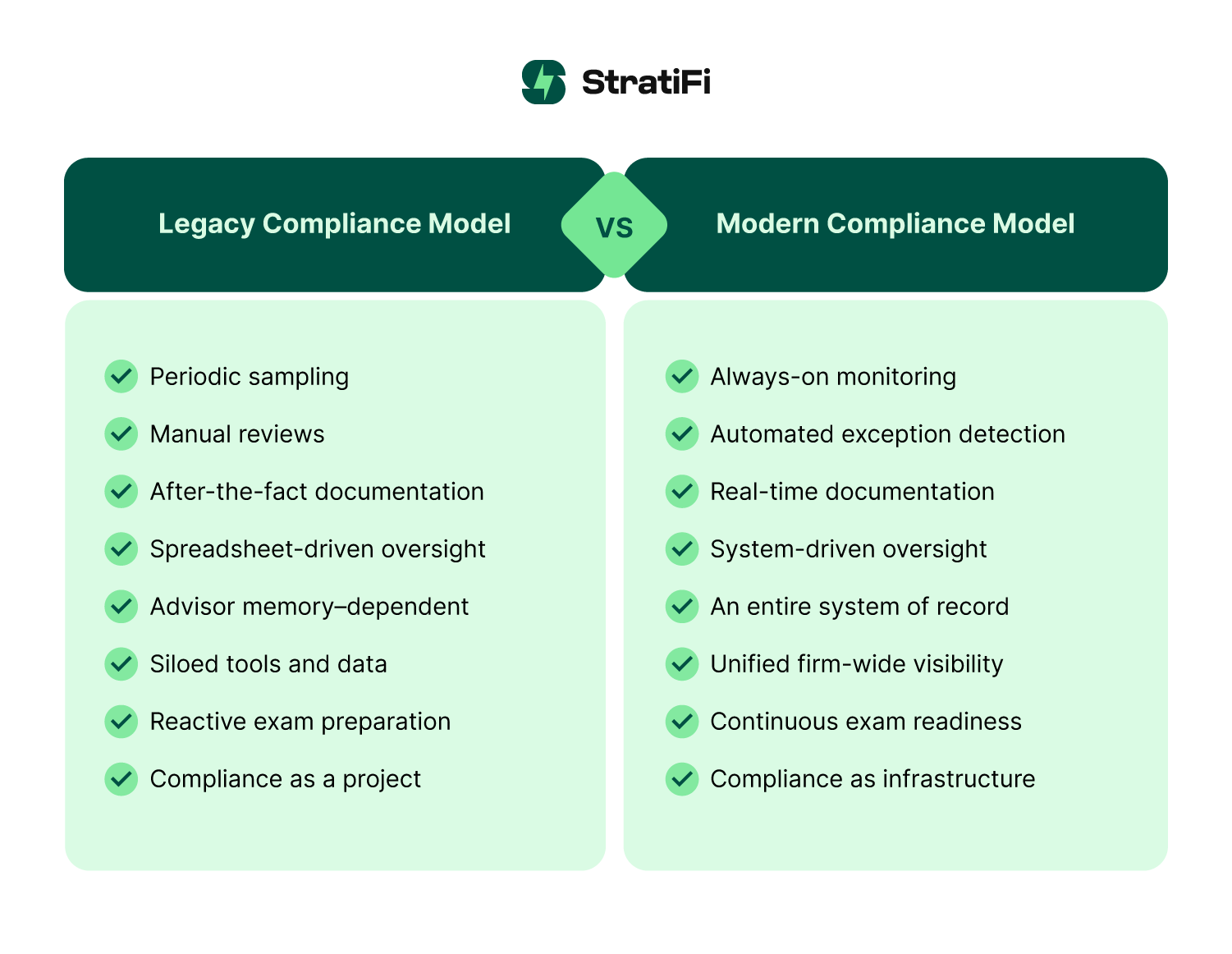
The Legacy Model
In traditional environments, compliance follows this sequence:
Review -> Detect -> Document -> Explain (after the fact)
So, reviewing happens after the activity has occurred. And documentation is often reconstructed from spreadsheets, and worse, from memory. Explanations get created when regulators ask for them.
This model builds friction and risk because:
- Issues get discovered late
- Documentation reflects outcomes, not strategic decision paths
- Compliance teams spend exam cycles assembling evidence, not demonstrating control
Thus, the most well-run firms feel exposed because they lack system design.
The Modern Model: Readiness by Default
The modern model (continuous readiness model) changes the compliance sequence:
Review -> Detect -> Document -> Explain (as it happens)
Here, oversight is embedded into daily operations, allowing documentation to happen as decisions are made, reviewed, and resolved. So, when exams occur, evidence already exists.
How Does This Impact RIAs and Broker-Dealers?
With the continuous exam readiness model:
- Exams become retrieval exercises, not reconstruction efforts
- Compliance teams move from firefighting to oversight
- Leadership gains confidence that growth isn’t introducing hidden exposure
Besides, firms stop optimizing for the exam window and start optimizing for control, consistency, and defensibility each day.
This huge shift sets the foundation for modern compliance automation reporting tools. These platforms are designed to replace episodic reporting with real-time insight and audit-ready evidence across the firm.
Core Reporting Capabilities RIAs and Broker-Dealers Need
Compliance automation reporting tools are defined by what they make visible, when they surface it, and how easily that data can be defended during an exam.
Here are 5 reporting capabilities that separate scalable systems from manual or reactive ones. These capabilities improve efficiency and enable RIAs and BDs to move from compliance management tasks to managing compliance risk.
-
Firm-Wide Compliance Dashboards
RIAs and broker-dealers need a single, consolidated view of compliance risk across accounts, advisors, and activities.
Effective dashboards:
- Roll up risk and supervision signals across the entire firm
- Highlight areas that require attention without forcing manual reconciliation
- Replace spreadsheet-based rollups and one-off status checks
In the absence of firm-wide dashboards, compliance leaders are left managing data fragments.
-
Exception-Based Reporting
Manual reporting assumes every account deserves equal attention. Modern compliance reporting assumes the opposite with exception-based reporting:
- It flags only what deviates from policy, suitability, or risk thresholds
- It prioritizes issues by materiality, not volume
- Directs human review to genuine compliance management risk
This shift is central for firms to scale. Firms cannot grow advisor headcount or product complexity if compliance review grows linearly with activity.
-
Automated Audit Trails
During exams, regulators ask:
- Who was the reviewer?
- When was the issue addressed?
- What rationale supports the decision?
With automated audit trails, firms have documentation that is evidence, not a narrative:
- They have time-stamp reviews, approvals, and remediation
- They can preserve historical context without manual note-taking
- They reduce dependence on reconstructed explanation
-
On-Demand Evidence Retrieval
Exam readiness heavily relies on the retrieval speed. A robust compliance automation reporting tool allows teams to:
- Export exam-ready documentation without manual assembly
- Retrieve evidence by account, advisor, issue, or timeframe
- Respond to regulator requests in hours instead of weeks
If evidence requires stitching together PDFs and spreadsheets, reporting fails its purpose.
-
Workflow Enforcement and Resolution Tracking
Reporting without enforcement fails to create accountability. An effective compliance software:
- Assigns ownership to issues automatically
- Tracks resolution status and follow-ups
- Preserves documentation of how and when issues were closed
This ensures compliance management doesn’t stop at detection but becomes a closed-loop process, where oversight, action, and documentation remain connected.
How ComplianceIQ Enables Automated Compliance Reporting
Compliance automation reporting tools create value when they change how oversight actually works day to day.
StratiFi’s ComplianceIQ is built around this shift. Instead of generating reports after reviews, it embeds reporting into continuous monitoring, supervision, and documentation, so evidence exists before regulators ask for it.
It automatically detects share class violations, monitors position concentration in illiquid, less liquid, and complex products, and tracks portfolio drift in real-time.
- Automated portfolio monitoring
It evaluates accounts continuously, surfacing changes in risk, concentration, and suitability as they occur. This reduces the blind spots across growing account bases, allows early issue detection, and enables oversight that scales without adding headcount.
- Proactive exception reporting
It highlights only material issues, prioritizing what requires human judgment. This reduces noise, focuses reviews on real risk, and ensures documentation reflects decisions rather than task completion.
- Advisor oversight at scale
It standardizes supervision across advisors while preserving historical context. This improves firm-wide visibility, reduces key-person risk, and allows consistent oversight as advisor headcount grows.
Modern compliance management is about building an operating model where oversight, documentation, and evidence exist before regulators ask.
If your firm is still relying on manual reviews, spreadsheets, or after-the-fact reporting, it may be time to evaluate whether your compliance reporting infrastructure can actually scale with your growth.
A short walkthrough of StratiFi’s core compliance platform can quickly show you where reporting, documentation, and supervision break down and what continuous exam readiness looks like in practice. Book a demo now to see automated compliance reporting in action.
FAQs
What are Compliance Automation Reporting Tools?
Compliance automation reporting tools help RIAs and broker-dealers continuously monitor accounts, generate exception reports, and maintain audit-ready documentation without relying on manual reviews or spreadsheets.
How Do These Tools Help with SEC Exams?
They ensure documentation, supervision records, and audit trails are created continuously. When an exam occurs, firms retrieve existing evidence instead of reconstructing it under pressure.
Are Compliance Automation Tools Only Useful During Exams?
No. Their primary value is day-to-day oversight, surfacing exceptions early, enforcing workflows, and reducing reliance on memory and manual effort long before an exam happens.
Do Compliance Automation Tools Replace Compliance Teams?
No. They reduce manual workload and blind spots, allowing compliance teams to focus on judgment, escalation, and risk trends rather than data collection.
When Should an RIA or Broker-dealer Upgrade from Manual Reporting?
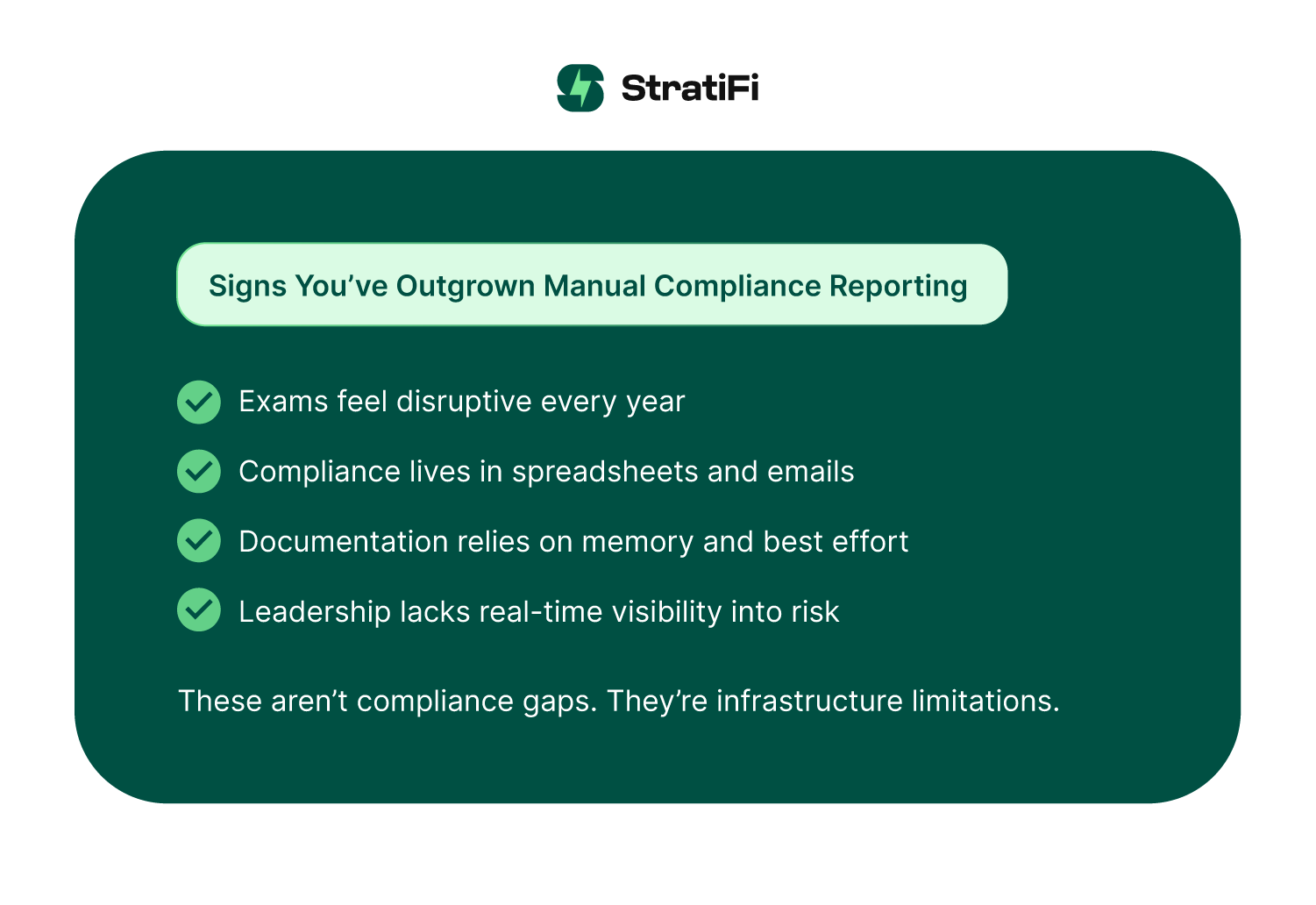
If exams feel disruptive every year, compliance lives in spreadsheets, documentation is inconsistent, or leadership lacks firm-wide visibility, it’s a strong signal that manual reporting no longer scales.
Related reading
- For more on this, see how the wash sale rule affects RIA compliance.
- Related practice: how to set trading-activity thresholds for an RIA.