%2010.svg)


Table Of Contents
.png)
Portfolio compliance monitoring failures are rarely the first thing to be discovered. They surface during SEC examinations, through client complaints, or after a share class violation has accumulated across hundreds of accounts without triggering a single alert.
The monitoring gap doesn’t necessarily mean the absence of a compliance program. It’s the absence of continuous, portfolio-level visibility into what’s actually happening inside client accounts as markets move, advisors make decisions, and portfolios drift.
This post covers what portfolio compliance monitoring requires, the specific risks it must catch, the best practices that make it defensible, and the tools built to handle it at scale.
What Is Portfolio Compliance Monitoring?
Portfolio compliance monitoring involves the continuous and systematic review of client portfolios against documented compliance parameters at the account, client, and household levels. It differs from managing a firm’s general compliance program, which encompasses policies, procedures, filings, and annual reviews.
Portfolio compliance monitoring is narrower and more operational. It answers three specific questions in real time across every account a firm manages:
- Is the portfolio positioned in alignment with the client’s documented risk tolerance and IPS parameters?
- Are concentration limits being respected at the account and household level?
- Are there share class violations, suitability exceptions, or allocation breaches that require supervisory review and documentation?
The regulatory obligation to answer these questions continuously runs across three frameworks.
Rule 206(4)-7 of the Investment Advisers Act requires RIAs to maintain and enforce written compliance policies governing portfolio management and suitability on an ongoing basis.
Regulation BI requires broker-dealers to ensure that recommendations reflect the client’s best interest at the time they are made and that the portfolio continues to reflect that standard.
FINRA Rule 3110 requires broker-dealers to establish a supervisory system that includes review of trading activity and account activity across registered representatives.
A compliance program that generates policies but doesn’t monitor portfolios against them continuously is creating documentation without offering supervision.
What Portfolio Compliance Monitoring Must Catch
Effective portfolio compliance monitoring is defined by the risk categories it’s built to detect. The four categories below are where regulatory exposure concentrates and where manual review processes consistently fail to keep pace.
1. IPS Drift and Policy Breach
IPS drift occurs when a client’s portfolio positioning moves outside the allocation ranges, risk parameters, or investment objectives documented in the Investment Policy Statement without a supervisory review and rationale.
The portfolio drift itself may not be a violation. The absence of documented supervisory review is.
Under Rule 206(4)-7, the IPS is the written policy that the supervision framework requires firms to enforce. When portfolio positioning diverges from the IPS, and no record exists showing the deviation was identified, reviewed, and either corrected or justified, the supervision gap is visible on the face of the account record.
2. Concentration Risk
Concentration risk occurs when a portfolio develops excessive exposure to a single security, sector, or asset class relative to the client’s documented investment objectives and risk tolerance.
It can build gradually as certain positions outperform, through dividend reinvestment, or through hidden overlap across ETF holdings.
Standard mutual fund regulations cap illiquid asset exposure at 15% of fund assets. No equivalent automatic constraint governs advisor-managed accounts. Concentration monitoring must be done at the portfolio level, not left to periodic manual review of individual positions.
3. Share Class Violations
Share class violations occur when a client holds a mutual fund share class with higher costs, such as Class A or Class C shares, when a lower-cost institutional or clean share class was available for the same underlying fund.
The SEC has consistently cited share class selection failures in enforcement actions and has made share class compliance a specific examination focus area.
Detecting share class violations requires comparing the client’s actual holdings against available alternatives at the account level, continuously, not as a one-time onboarding check.
4. Suitability Monitoring
Suitability monitoring evaluates whether the portfolio’s current risk positioning remains aligned with the client’s documented risk tolerance as portfolios evolve and market conditions change.
A portfolio that was suitable at the time of construction may drift outside suitability parameters as markets move, allocations shift, or the client’s circumstances change.
Reg BI requires broker-dealers to ensure that recommendations reflect the client’s best interest at the time they are made. Rule 206(4)-7 requires ongoing supervision. Both standards require that suitability monitoring is continuous, not confined to scheduled review dates.
Why Manual Portfolio Compliance Monitoring Fails at Scale
Three structural failure points explain why firms that rely on manual monitoring processes accumulate compliance exposure as they grow.
Fragmented Systems
Manual portfolio compliance monitoring typically requires compliance teams to switch between custodian platforms, pull reports from multiple sources, reconcile data in spreadsheets, and track exceptions in email threads.
Each system hand-off creates a potential gap between what is happening in client accounts and what the compliance team can see.
When data lives in multiple systems with no continuous connection between them, the supervisory record captures what was reviewed during the most recent cycle. It doesn’t record what is actually happening in portfolios between reviews.
Partial Account Coverage
Manual compliance testing covers a fraction of client accounts. A compliance team running quarterly sampling on a portfolio of 2,000 accounts may review 200 in a given cycle, leaving 1,800 accounts without documented supervisory review for the quarter. The accounts not reviewed are the accounts where undetected violations accumulate.
The stakes are not abstract. In fiscal year 2024, the SEC reported $8.2 billion in fines, with individual penalties reaching $50 million per firm. Firms operating without systematic portfolio-level monitoring are carrying that exposure across every unreviewed account.
Investment Complexity
Leveraged ETFs, structured products, buffered ETFs, and interval funds each carry risk profiles that do not behave as their underlying asset class labels suggest. A portfolio flagged as moderate by a risk tolerance questionnaire may hold leveraged ETF positions that produce extreme downside in drawdown scenarios.
Manual review processes cannot assess the layered risk profile of complex product combinations across hundreds of accounts in real time.
5 Portfolio Compliance Monitoring Best Practices
1. Monitor at the account, client, and household level
Compliance exposure does not always surface at the account level. A client with multiple accounts across different strategies may appear compliant at the individual account level while carrying concentrated or unsuitable exposure at the household level.
Monitoring must extend across all three levels to provide complete supervisory coverage.
2. Catch violations through continuous monitoring, not periodic review cycles
Portfolio positioning changes daily as markets move, dividends are reinvested, and advisors trade. A compliance program that reviews accounts quarterly documents what the portfolio looked like at the end of the quarter.
It does not document what happened in the 89 days between reviews. Continuous monitoring closes the gap that periodic review cycles leave open.
3. Connect portfolio data directly to IPS parameters and suitability records
The supervisory record is only defensible when it connects portfolio positioning directly to the client’s documented parameters.
A monitoring system that flags a concentration breach is only useful if the flag is linked to:
- The client’s IPS allocation limit
- The date the breach was identified
- The advisor responsible for the account
- The resolution or documented rationale
4. Document every exception with a timestamp, violation detail, and resolution
The SEC’s examination process reconstructs advisory decisions from records. An audit trail that documents these is the difference between a clean exam and a deficiency finding.
- When an exception was identified
- What the violation was
- Who reviewed it
- What action was taken
That documentation must exist before the examiner requests it, not be assembled in response to an exam request.
5. Configure alerts by violation type and severity
Not every exception requires the same response. A concentration breach in a client with an aggressive risk profile and a long time horizon is a different supervisory issue than the same breach in a client with a conservative IPS.
Alert configuration should allow compliance teams to prioritize material violations without being overwhelmed by low-risk exceptions that dilute attention from the issues that matter.
Top 5 Tools for Portfolio Compliance Monitoring
The tools below are evaluated specifically on their portfolio-level surveillance capabilities, specifically IPS drift, concentration monitoring, suitability alignment, and share class detection.
For general compliance program management software covering policies, attestations, and marketing review, we recommend reading our article: 8 Best Financial Compliance Software for RIAs.
1. StratiFi ComplianceIQ: The Best for Continuous Portfolio-Level Suitability, Share Class, and Concentration Monitoring
StratiFi’s ComplianceIQ is built specifically for the portfolio surveillance challenge: catching share class violations, concentration breaches, and suitability exceptions across every account automatically, before examiners or client complaints surface them.
What it does for portfolio monitoring
ComplianceIQ connects directly to custodian data and monitors every account on a continuous basis against share class, concentration, and suitability parameters.
Exceptions are flagged with specific violation details, recommended actions, and documentation for regulatory requirements, inside a unified compliance dashboard that gives compliance teams firm-wide visibility at the account, client, and household level.
Key portfolio monitoring strengths
- Automatic detection of mutual fund share class violations across all accounts
- Real-time concentration limit monitoring with drift detection
- Continuous suitability monitoring with risk tolerance alignment checks
- Trading activity monitoring, including systematic analysis of advisor trading patterns
- Complete audit trail with an integrated dashboard showing all compliance exceptions with detailed documentation
- Automated workflows with assignment tracking and escalation procedures
- Integrates with custodians, CRM systems, and portfolio reporting tools
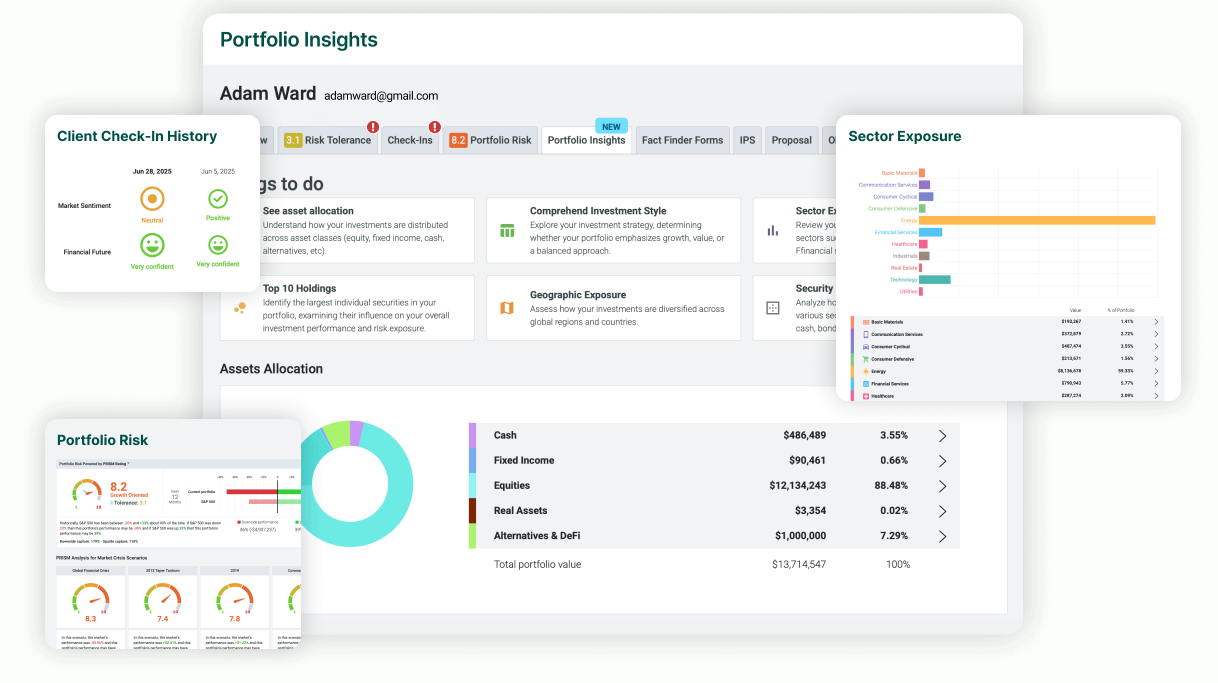
Best for
Mid-to-large RIAs and broker-dealers that need continuous, account-level portfolio surveillance across all clients and advisors, not periodic sampling.
Considerations
StratiFi is a portfolio supervision and monitoring platform. Firms that also need communications archiving or general compliance program management will need additional tools alongside ComplianceIQ.
2. Orion Compliance: Best for Portfolio Compliance Monitoring Within the Orion Ecosystem
Orion Compliance provides compliance tools integrated directly with Orion’s portfolio accounting, trading, and reporting infrastructure. For firms already operating within the Orion ecosystem, this integration connects compliance oversight directly to the portfolio data that drives it.
What it does for portfolio monitoring
Orion Compliance’s Client Oversight tool integrates with Orion Risk Intelligence for allocation and risk drift monitoring. Pre-trade compliance is included within the Orion Advantage Stack, connecting the compliance review process directly to the trading workflow. Brokerage feeds are pulled in automatically, eliminating manual data entry for account-level monitoring.
Key portfolio monitoring strengths
- The Client Oversight tool integrates with Orion Risk Intelligence for allocation and risk drift monitoring
- Pre-trade compliance reviews connected to the trading workflow inside the Orion ecosystem
- Automatic brokerage feed integration, eliminating manual account data imports
- Tied for the highest market share among traditional RIA compliance platforms in the 2026 T3/Inside Information Software Survey
Best for
RIAs and broker-dealers already running Orion’s portfolio accounting and trading infrastructure who want compliance monitoring embedded within their existing platform.
Considerations
Orion Compliance functions as an embedded layer within the Orion environment. Firms not using Orion’s broader platform will find less integration value and may find the portfolio-monitoring depth limited compared to purpose-built surveillance tools.
3. ACA ComplianceAlpha: Best for Institutional-Grade Regulatory Compliance Monitoring and Testing
ACA ComplianceAlpha is a regulatory technology platform backed by ACA Group’s compliance consulting expertise, used by over 800 financial services firms globally. It integrates risk and compliance activities, surveillance, monitoring, testing, and analytics in one platform.
What it does for portfolio monitoring
ComplianceAlpha provides compliance monitoring, testing, and surveillance capabilities with risk assessment and heat maps across investment guidelines and trading activity.
ACA’s regulatory advisory services back the platform, which combine software with external compliance guidance for firms that require institutional-grade oversight, along with consulting support and technology.
Key portfolio monitoring strengths
- Integrated risk and compliance platform with investment guideline oversight
- Compliance monitoring, testing, surveillance, and analytics in a unified view
- AI-powered marketing review through Encore AI
- Backed by ACA Group’s regulatory consulting expertise across cybersecurity, ESG, and performance, alongside compliance
Best for
Enterprise RIAs, broker-dealers, and institutional firms with complex compliance programs that need both regulatory technology and ongoing advisory support from a compliance consulting firm.
Considerations
ACA ComplianceAlpha is enterprise-grade in scope and pricing. Smaller RIAs seeking purpose-built portfolio drift and share class monitoring without the broader GRC infrastructure may find the platform over-specified for their needs.
4. Hadrius: Best for Compliance Operations Combining Supervisory Workflow Automation and Trade Surveillance
Hadrius is a compliance operations platform that automates supervisory workflows across trade review, communications oversight, marketing review, and attestations, using AI-assisted routing to prioritize material issues.
What it does for portfolio monitoring
Hadrius applies AI routing to compliance review workflows, directing supervisor attention to the highest-risk trades and compliance activities.
Every supervisory action, including review, escalation, approval, and remediation, is timestamped and stored in a producible record. The platform supports multi-branch structures with unified oversight across advisor populations.
Key portfolio monitoring strengths
- AI-assisted review routing prioritizes material trades and compliance exceptions, reducing false positive review burden
- Timestamped supervisory record for every review action, producible on demand
- Multi-branch and OSJ structure support for firms with distributed advisor populations
- Rapid implementation designed for deployment in weeks without extended IT projects
Best for
FINRA-registered broker-dealers and RIAs that want to automate their supervisory review workflow and build a complete, examiner-ready compliance record across advisor activity.
Considerations
Hadrius is a supervisory workflow and compliance operations platform. It addresses the review and documentation workflow rather than providing the continuous portfolio-level suitability and concentration surveillance that purpose-built monitoring platforms deliver.
5. Advyzon: Best for Smaller RIAs Needing Portfolio Compliance Monitoring Alongside Portfolio Management
Advyzon is an all-in-one platform combining portfolio management, CRM, compliance monitoring, billing, and reporting in a single interface. It earned the highest client satisfaction score among all-in-one advisor platforms in the 2026 T3 Advisor Technology Survey for the ninth consecutive year.
What it does for portfolio monitoring
Advyzon includes a compliance module alongside its portfolio management capabilities, giving smaller RIAs visibility into account activity, trading review, and compliance documentation without needing a separate compliance-specific platform.
Key portfolio monitoring strengths
- Compliance monitoring is embedded alongside portfolio management, CRM, and billing in one platform
- Practical pricing for RIAs managing under $2 billion in AUM
- Strong integration with RightCapital and other financial planning tools
- Highest client satisfaction score in the all-in-one advisor platform category, 2026 T3 Advisor Technology Survey
Best for
Smaller RIAs that want compliance monitoring included in an all-in-one practice management platform without the cost and complexity of a dedicated compliance surveillance tool.
Considerations
Advyzon’s compliance module is designed for general compliance oversight within its all-in-one environment.
Firms with complex portfolio monitoring requirements, specifically automated share class detection, real-time concentration alerts, or multi-custodian suitability surveillance, may outgrow the depth available within Advyzon’s compliance module.
What to Look for in Portfolio Compliance Monitoring Software
Five questions you must answer before evaluating any platform:
1. Does it monitor every account continuously, or sample a fraction periodically?
A platform that samples accounts leaves the unreviewed majority exposed. Continuous account-level monitoring is the standard that regulatory examinations now test against.
2. Does it connect to your custodian and CRM automatically, or require manual data imports?
Manual data imports create the same fragmentation problem that manual compliance monitoring creates. The platform should pull custodian data automatically and connect it directly to client records and compliance parameters.
3. Does it catch share class violations, concentration breaches, and suitability exceptions in one dashboard, or require separate tools for each?
Compliance teams managing three separate monitoring tools for three separate risk categories are adding reconciliation burden rather than removing it. A unified dashboard that surfaces all three categories in one place is a material operational advantage.
4. Does it produce audit-ready documentation at the point of detection, or after the fact?
Documentation created after the fact in response to an exam request is a different quality of evidence than documentation created automatically as the exception is detected.
The standard that holds up in examinations is documentation that existed before the examiner asked for it.
5. Does it scale across hundreds of advisors and thousands of accounts without proportionally scaling compliance headcount?
The manual compliance model requires more headcount as account volume grows. A properly designed monitoring platform surfaces more accounts with the same compliance team, which is the operational and economic case for systematic portfolio surveillance.
Summing Up
Portfolio compliance monitoring is a continuous operating discipline that determines whether your firm’s supervisory record can defend your advisory decisions when an examiner reviews them.
The firms that get this right treat every account as continuously supervised, not as periodically sampled. The gap between those two approaches is where most SEC examination deficiencies are found.
If you want to know more about how StratiFi’s ComplianceIQ monitors every account automatically and builds the audit trail before it is needed, book a demo today.
FAQs
What is portfolio compliance monitoring?
Portfolio compliance monitoring is the continuous, automated review of client investment portfolios against documented compliance parameters, including IPS allocation limits, suitability requirements, concentration thresholds, and share class standards at the account, client, and household level.
How is portfolio compliance monitoring different from general compliance program management?
General compliance program management covers policies, procedures, regulatory filings, annual reviews, and employee conduct. Portfolio compliance monitoring is specifically focused on what is happening inside client accounts in real time, including suitability alignment, IPS drift, concentration risk, and share class violations.
What are the most common portfolio compliance violations found during SEC examinations?
SEC examinations most frequently cite portfolio drift outside IPS parameters without documented supervisory review, share class selection failures where higher-cost classes were held when:
- Lower-cost alternatives were available
- Concentration risk that developed without detection
- Suitability exceptions where portfolio positioning diverged from documented client objectives.
What is post-trade compliance monitoring, and why does it matter?
Post-trade compliance monitoring reviews account activity after trades are executed to detect violations of investment guidelines, concentration limits, or suitability parameters.
It matters because trade-level violations are often only visible in their full impact after execution, and because documented post-trade review is a specific supervisory requirement under FINRA Rule 3110 for broker-dealers and is relevant to Rule 206(4)-7 supervision for RIAs.
How does continuous compliance testing differ from periodic compliance review?
Continuous compliance monitoring evaluates every account on an ongoing basis as portfolio activity occurs. Periodic compliance review samples a subset of accounts at scheduled intervals.
The practical difference is coverage: continuous monitoring catches issues as they develop across all accounts, while periodic review can only identify issues that are present in the accounts reviewed and at the time of the review.
Can portfolio compliance monitoring software integrate with custodians and CRM platforms?
Yes. Purpose-built portfolio compliance monitoring platforms integrate directly with major custodians, including Schwab, Fidelity, and Pershing, pulling account holdings and transaction data automatically.
Integration with CRM platforms connects that data to client profiles and IPS parameters, enabling automated suitability and drift monitoring without manual data entry.
What documentation does a portfolio compliance monitoring system need to produce for an SEC exam?
The documentation package for an SEC exam should include a timestamped record of every compliance exception identified, the specific violation details, the advisor responsible for the account, the date and nature of supervisory review, and the resolution or documented rationale for maintaining the position. This documentation must exist before the examiner requests it.
How do RIAs monitor suitability compliance across hundreds of client accounts?
RIAs managing large account volumes use portfolio compliance monitoring platforms that continuously compare each account's risk positioning against the client's documented risk tolerance and IPS parameters.
When the portfolio drifts outside suitability parameters, the system generates an exception alert with documentation for supervisory review. This replaces the manual sampling approach that leaves most accounts unreviewed between cycles.